Japanese
English
- 有料閲覧
PPV購入案内
1,320円 (1,200円+税10%) こちらは、1093ページから1100ページの文献です。購入には医書.jp本会員登録が必要です。
会員登録完了後に改めて上記「購入サイトへ」を選択してください。
または「購入サイトへ」選択後に「購入ログイン」、「新規会員登録」の順に進んでください。
会員登録について詳しくはをご確認ください。
- Abstract 文献概要
- 1ページ目 Look Inside
- 参考文献 Reference
Ⅰ.緒 言
脳塞栓症のうち,特に心原性脳塞栓症は,突発完成型の発症様式をとることが通常であるが1),なかには,劇的な改善を認めたり9),進行性であったり,動揺性であったりと,突発完成型の発症様式を呈さない症例が稀に存在する2).最近は,血管病変の評価として,magnetic resonance angiography(MRA)やcomputed tomography angiography(CTA)での評価が通常であるが,特にMRAの画像は,脳血流が低下している時は,狭窄病変が過大に評価され5),アテローム硬化による狭窄病変との判別が困難な場合もある.
今回,われわれは,入院時の心電図で心房細動を認めず,発症経過や急性期のcomputed tomography(CT), magnetic resonance imaging(MRI)の画像所見から,入院当初,アテローム血栓性脳梗塞が疑われた脳塞栓症と考えられたが,亜急性期に心房細動を認め神経症状が増悪し経皮的血栓回収術を施行した症例を経験したので,文献的考察を加えて報告する.
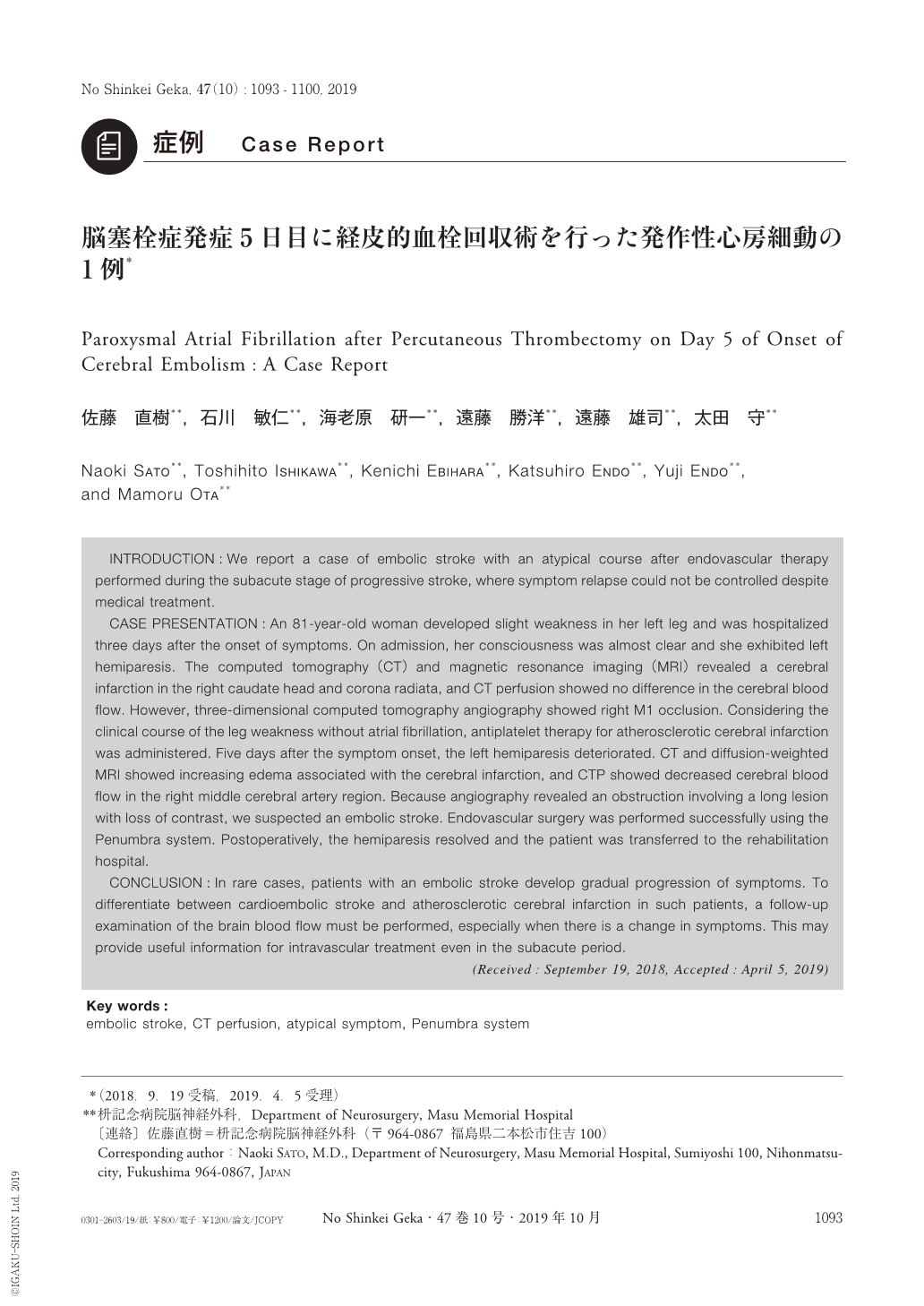
INTRODUCTION:We report a case of embolic stroke with an atypical course after endovascular therapy performed during the subacute stage of progressive stroke, where symptom relapse could not be controlled despite medical treatment.
CASE PRESENTATION:An 81-year-old woman developed slight weakness in her left leg and was hospitalized three days after the onset of symptoms. On admission, her consciousness was almost clear and she exhibited left hemiparesis. The computed tomography(CT)and magnetic resonance imaging(MRI)revealed a cerebral infarction in the right caudate head and corona radiata, and CT perfusion showed no difference in the cerebral blood flow. However, three-dimensional computed tomography angiography showed right M1 occlusion. Considering the clinical course of the leg weakness without atrial fibrillation, antiplatelet therapy for atherosclerotic cerebral infarction was administered. Five days after the symptom onset, the left hemiparesis deteriorated. CT and diffusion-weighted MRI showed increasing edema associated with the cerebral infarction, and CTP showed decreased cerebral blood flow in the right middle cerebral artery region. Because angiography revealed an obstruction involving a long lesion with loss of contrast, we suspected an embolic stroke. Endovascular surgery was performed successfully using the Penumbra system. Postoperatively, the hemiparesis resolved and the patient was transferred to the rehabilitation hospital.
CONCLUSION:In rare cases, patients with an embolic stroke develop gradual progression of symptoms. To differentiate between cardioembolic stroke and atherosclerotic cerebral infarction in such patients, a follow-up examination of the brain blood flow must be performed, especially when there is a change in symptoms. This may provide useful information for intravascular treatment even in the subacute period.
Copyright © 2019, Igaku-Shoin Ltd. All rights reserved.