Japanese
English
- 有料閲覧
PPV購入案内
1,320円 (1,200円+税10%) こちらは、381ページから385ページの文献です。購入には医書.jp本会員登録が必要です。
会員登録完了後に改めて上記「購入サイトへ」を選択してください。
または「購入サイトへ」選択後に「購入ログイン」、「新規会員登録」の順に進んでください。
会員登録について詳しくはをご確認ください。
- Abstract 文献概要
- 1ページ目 Look Inside
- 参考文献 Reference
Ⅰ.はじめに
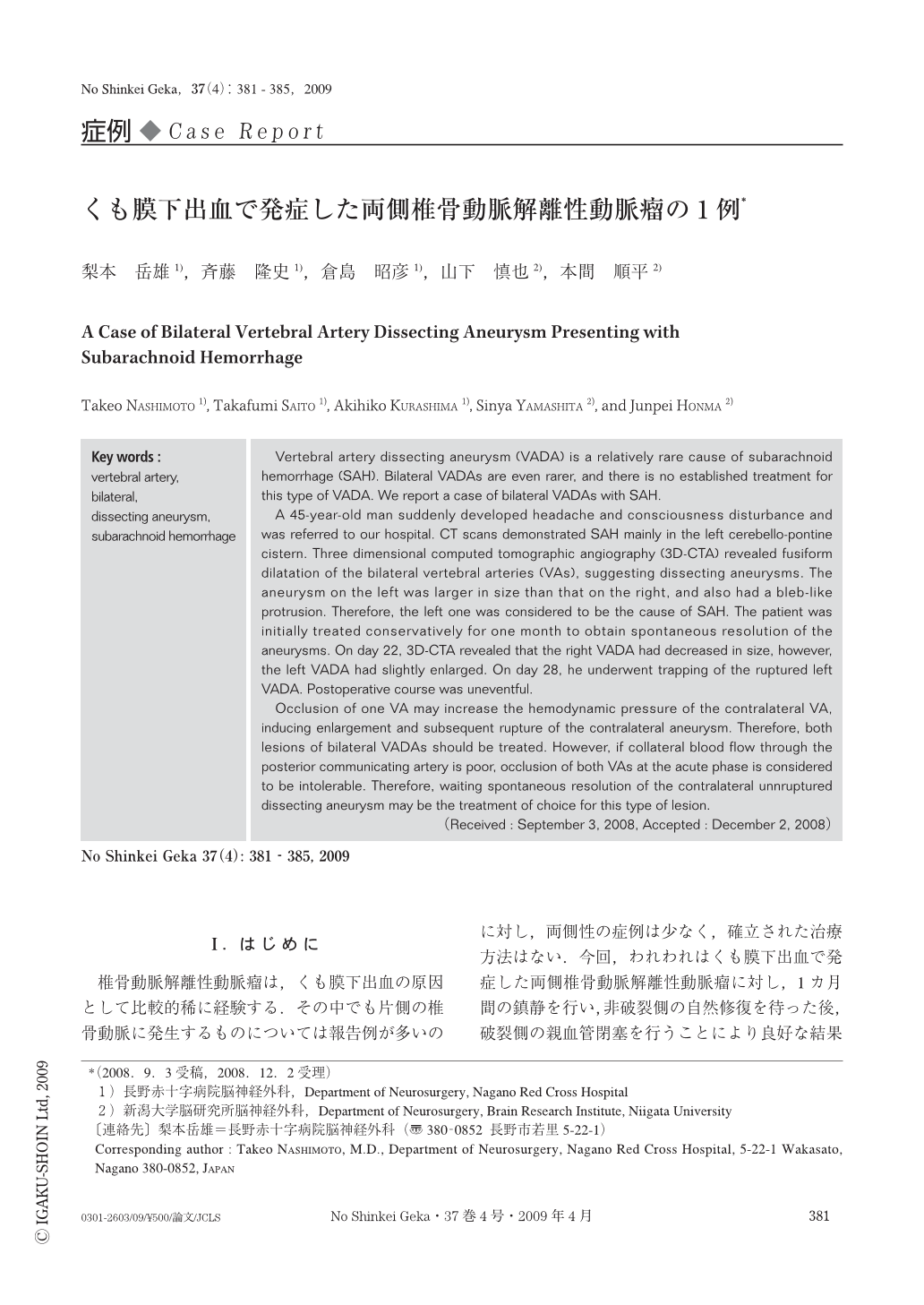
椎骨動脈解離性動脈瘤は,くも膜下出血の原因として比較的稀に経験する.その中でも片側の椎骨動脈に発生するものについては報告例が多いのに対し,両側性の症例は少なく,確立された治療方法はない.今回,われわれはくも膜下出血で発症した両側椎骨動脈解離性動脈瘤に対し,1カ月間の鎮静を行い,非破裂側の自然修復を待った後,破裂側の親血管閉塞を行うことにより良好な結果を得た症例を経験したので,若干の文献的考察を加えて報告する.
Vertebral artery dissecting aneurysm (VADA) is a relatively rare cause of subarachnoid hemorrhage (SAH). Bilateral VADAs are even rarer, and there is no established treatment for this type of VADA. We report a case of bilateral VADAs with SAH.
A 45-year-old man suddenly developed headache and consciousness disturbance and was referred to our hospital. CT scans demonstrated SAH mainly in the left cerebello-pontine cistern. Three dimensional computed tomographic angiography (3D-CTA) revealed fusiform dilatation of the bilateral vertebral arteries (VAs), suggesting dissecting aneurysms. The aneurysm on the left was larger in size than that on the right, and also had a bleb-like protrusion. Therefore, the left one was considered to be the cause of SAH. The patient was initially treated conservatively for one month to obtain spontaneous resolution of the aneurysms. On day 22, 3D-CTA revealed that the right VADA had decreased in size, however, the left VADA had slightly enlarged. On day 28, he underwent trapping of the ruptured left VADA. Postoperative course was uneventful.
Occlusion of one VA may increase the hemodynamic pressure of the contralateral VA, inducing enlargement and subsequent rupture of the contralateral aneurysm. Therefore, both lesions of bilateral VADAs should be treated. However, if collateral blood flow through the posterior communicating artery is poor, occlusion of both VAs at the acute phase is considered to be intolerable. Therefore, waiting spontaneous resolution of the contralateral unnruptured dissecting aneurysm may be the treatment of choice for this type of lesion.
Copyright © 2009, Igaku-Shoin Ltd. All rights reserved.