Japanese
English
- 有料閲覧
PPV購入案内
1,320円 (1,200円+税10%) こちらは、1139ページから1144ページの文献です。購入には医書.jp本会員登録が必要です。
会員登録完了後に改めて上記「購入サイトへ」を選択してください。
または「購入サイトへ」選択後に「購入ログイン」、「新規会員登録」の順に進んでください。
会員登録について詳しくはをご確認ください。
- Abstract 文献概要
- 1ページ目 Look Inside
- 参考文献 Reference
Ⅰ.はじめに
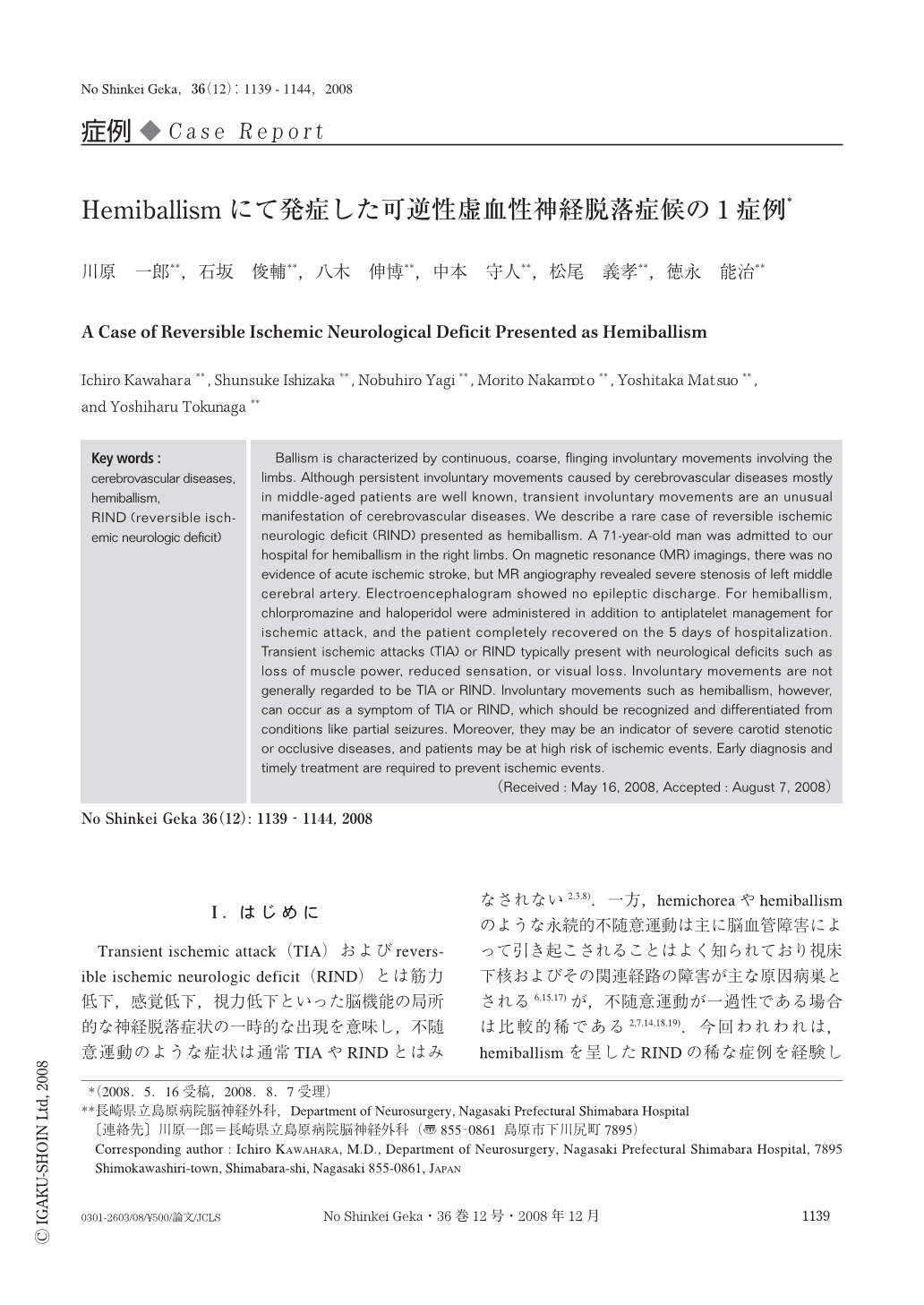
Transient ischemic attack(TIA)およびreversible ischemic neurologic deficit(RIND)とは筋力低下,感覚低下,視力低下といった脳機能の局所的な神経脱落症状の一時的な出現を意味し,不随意運動のような症状は通常TIAやRINDとはみなされない2,3,8).一方,hemichoreaやhemiballismのような永続的不随意運動は主に脳血管障害によって引き起こされることはよく知られており視床下核およびその関連経路の障害が主な原因病巣とされる6,15,17)が,不随意運動が一過性である場合は比較的稀である2,7,14,18,19).今回われわれは,hemiballismを呈したRINDの稀な症例を経験したので文献的考察を加え報告する.
Ballism is characterized by continuous, coarse, flinging involuntary movements involving the limbs. Although persistent involuntary movements caused by cerebrovascular diseases mostly in middle-aged patients are well known, transient involuntary movements are an unusual manifestation of cerebrovascular diseases. We describe a rare case of reversible ischemic neurologic deficit (RIND) presented as hemiballism. A 71-year-old man was admitted to our hospital for hemiballism in the right limbs. On magnetic resonance (MR) imagings, there was no evidence of acute ischemic stroke, but MR angiography revealed severe stenosis of left middle cerebral artery. Electroencephalogram showed no epileptic discharge. For hemiballism, chlorpromazine and haloperidol were administered in addition to antiplatelet management for ischemic attack, and the patient completely recovered on the 5 days of hospitalization. Transient ischemic attacks (TIA) or RIND typically present with neurological deficits such as loss of muscle power, reduced sensation, or visual loss. Involuntary movements are not generally regarded to be TIA or RIND. Involuntary movements such as hemiballism, however, can occur as a symptom of TIA or RIND, which should be recognized and differentiated from conditions like partial seizures. Moreover, they may be an indicator of severe carotid stenotic or occlusive diseases, and patients may be at high risk of ischemic events. Early diagnosis and timely treatment are required to prevent ischemic events.
Copyright © 2008, Igaku-Shoin Ltd. All rights reserved.