Japanese
English
- 有料閲覧
PPV購入案内
1,320円 (1,200円+税10%) こちらは、528ページから540ページの文献です。購入には医書.jp本会員登録が必要です。
会員登録完了後に改めて上記「購入サイトへ」を選択してください。
または「購入サイトへ」選択後に「購入ログイン」、「新規会員登録」の順に進んでください。
会員登録について詳しくはをご確認ください。
- Abstract 文献概要
- 1ページ目 Look Inside
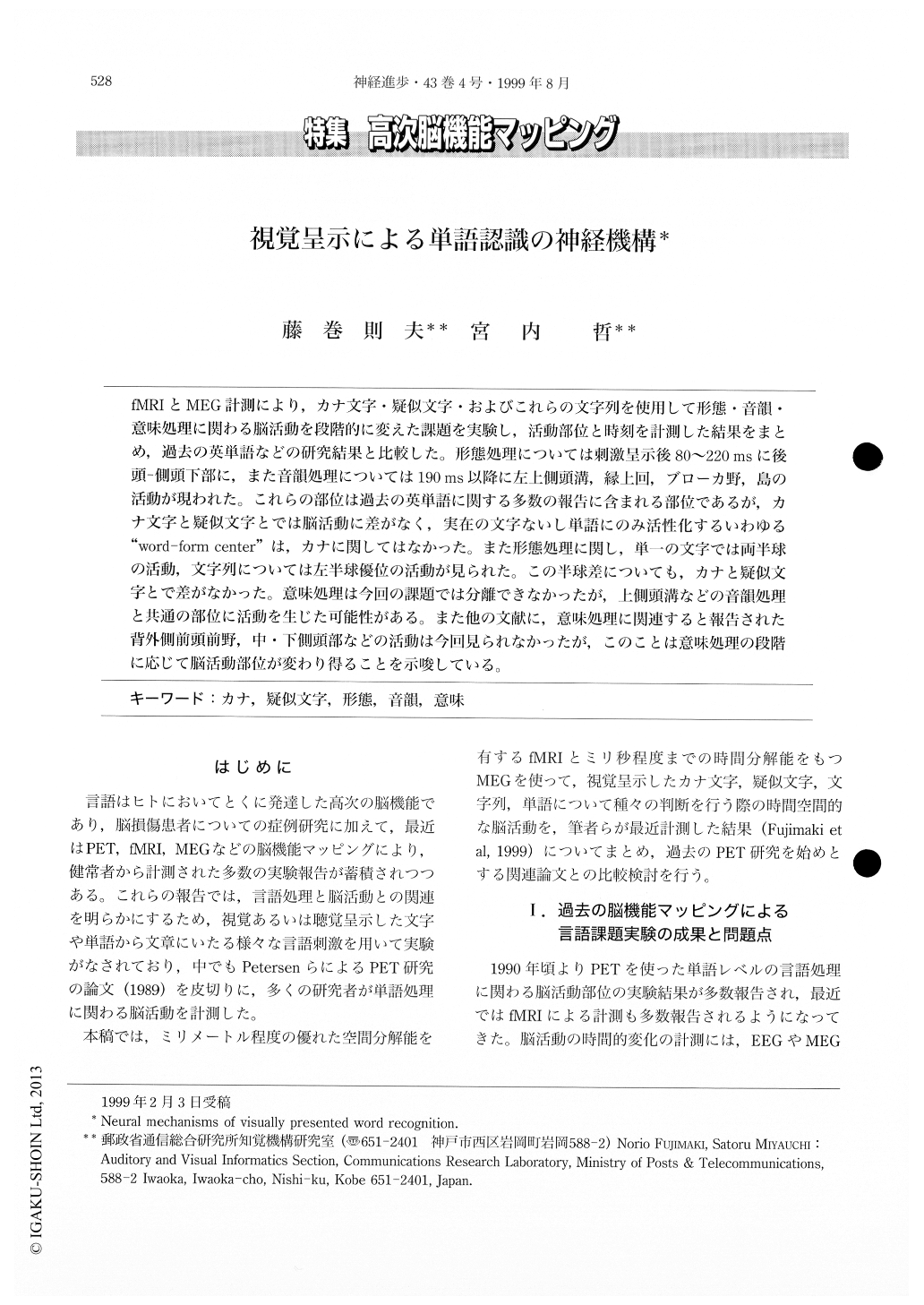
fMRIとMEG計測により,カナ文字・疑似文字・およびこれらの文字列を使用して形態・音韻・意味処理に関わる脳活動を段階的に変えた課題を実験し,活動部位と時刻を計測した結果をまとめ,過去の英単語などの研究結果と比較した。形態処理については刺激呈示後80~220msに後頭―側頭下部に,また音韻処理については190ms以降に左上側頭溝,縁上回,ブローカ野,島の活動が現われた。これらの部位は過去の英単語に関する多数の報告に含まれる部位であるが,カナ文字と疑似文字とでは脳活動に差がなく,実在の文字ないし単語にのみ活性化するいわゆる“word-form center”は,カナに関してはなかった。また形態処理に関し,単一の文字では両半球の活動,文字列については左半球優位の活動が見られた。この半球差についても,カナと疑似文字とで差がなかった。意味処理は今回の課題では分離できなかったが,上側頭溝などの音韻処理と共通の部位に活動を生じた可能性がある。また他の文献に,意味処理に関連すると報告された背外側前頭前野,中・下側頭部などの活動は今回見られなかったが,このことは意味処理の段階に応じて脳活動部位が変わり得ることを示唆している。
This review summarizes a recent experiment conducted using fMRI and MEG to measure neural activation related to lexico-semantic, phonological and orthographic (more generally visual form) processes for the visually presented Japanese katakana (phonogram) characters, pseudocharacters, and strings of them. It also compared the present results with other reports which describe experiments conducted mainly in English using PET, fMRI and MEG. Activity related to the visual form process was observed at a latency range of 80 to 220 ms in the occipital and ventral-temporal areas, while the activity related to the phonological process was observed at latencies later than 190 ms in the left superior temporal sulcus, supramarginal gyrus, and Broca's area. These activation foci were also reported for English letters and words in many references. The present activation was the same between katakana characters and pseudocharacters, and between katakana strings or words and pseudocharacter strings, thus suggesting that there is no “word-form center” specific to real katakana words. Further, the activation occurred in both hemispheres for single characters, but were left-lateralized for strings of characters. The activation for the semantic process could not be dissociated from that for the other processes; however, there is a possibility that the semantic process shared activation foci with the phonological process, e.g., near the superior temporal sulcus. The present experiment showed no activation in the dorsolateral prefrontal cortex or the middle or inferior temporal areas, which have been reported to be active for semantic processes, suggesting that neural activation varies depending on semantic task demands.
Copyright © 1999, Igaku-Shoin Ltd. All rights reserved.