Japanese
English
- 有料閲覧
PPV購入案内
1,320円 (1,200円+税10%) こちらは、833ページから841ページの文献です。購入には医書.jp本会員登録が必要です。
会員登録完了後に改めて上記「購入サイトへ」を選択してください。
または「購入サイトへ」選択後に「購入ログイン」、「新規会員登録」の順に進んでください。
会員登録について詳しくはをご確認ください。
- Abstract 文献概要
- 1ページ目 Look Inside
- 参考文献 Reference
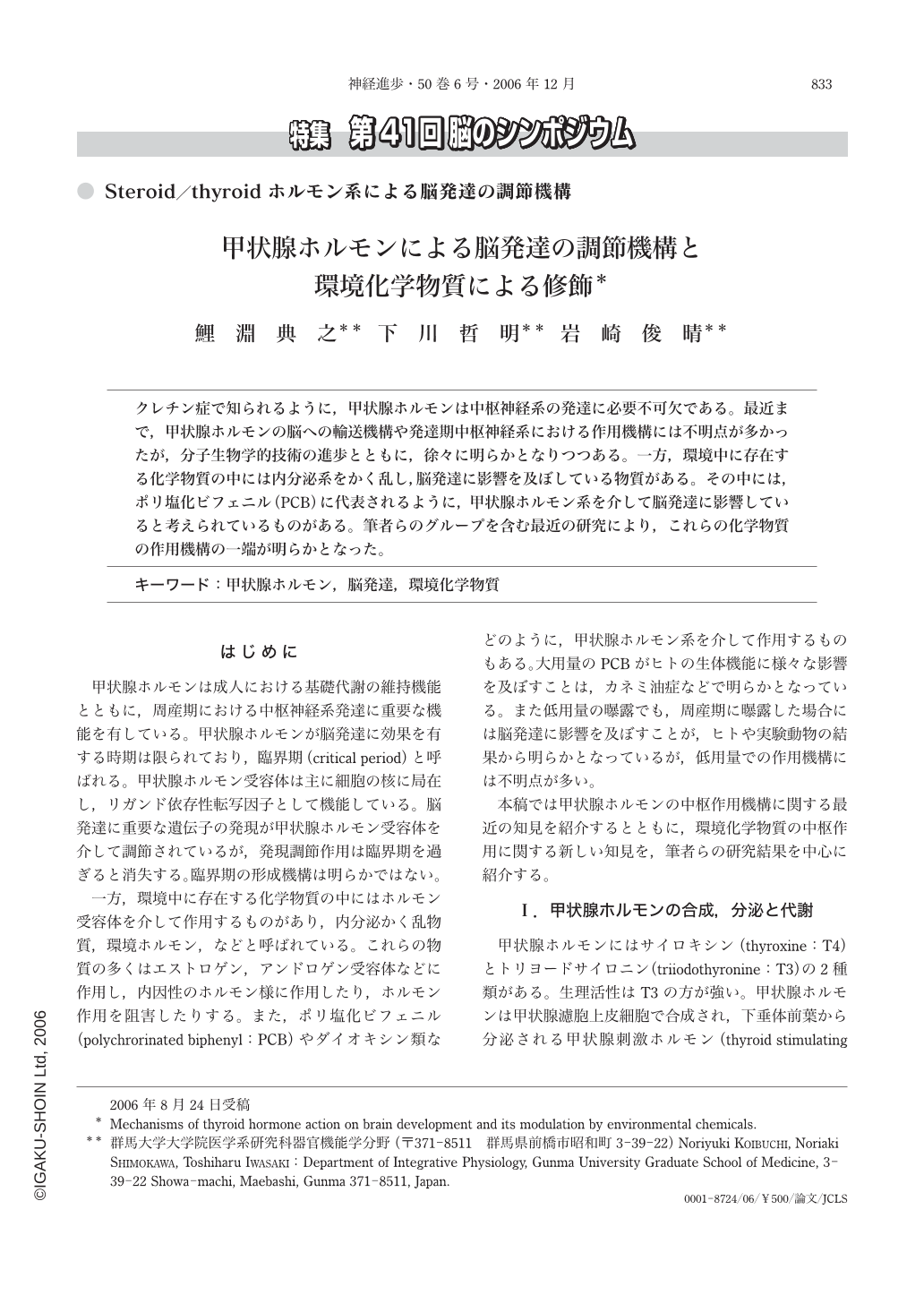
クレチン症で知られるように,甲状腺ホルモンは中枢神経系の発達に必要不可欠である。最近まで,甲状腺ホルモンの脳への輸送機構や発達期中枢神経系における作用機構には不明点が多かったが,分子生物学的技術の進歩とともに,徐々に明らかとなりつつある。一方,環境中に存在する化学物質の中には内分泌系をかく乱し,脳発達に影響を及ぼしている物質がある。その中には,ポリ塩化ビフェニル(PCB)に代表されるように,甲状腺ホルモン系を介して脳発達に影響していると考えられているものがある。筆者らのグループを含む最近の研究により,これらの化学物質の作用機構の一端が明らかとなった。
Thyroid hormone plays a critical role in development of the central nervous system. Deficiency of thyroid hormone during perinatal period results in abnormal brain development known as cretinism in human. However, molecular mechanisms of thyroid hormone action in developing brain have not yet been fully clarified. Thyroid hormone regulates brain development only during a limited period, which is called“critical period”of thyroid hormone action. Although the mechanisms generating such period has not yet been clear, recent findings have provided important clues to clarify such mechanism. On the other hand, several environmental chemicals seem to affect brain development through thyroid hormone system. One such example is polychlorinated biphenyl(PCB). Our recent studies have shown that PCB acts not only through thyroid hormone receptor(TR)to suppress TR-mediated transcription, but also through neuronal membrane to alter excitability. These results have greatly contributed to understand further the molecular mechanisms of PCB influence on brain development.
Copyright © 2006, Igaku-Shoin Ltd. All rights reserved.