Japanese
English
- 有料閲覧
PPV購入案内
1,320円 (1,200円+税10%) こちらは、557ページから566ページの文献です。購入には医書.jp本会員登録が必要です。
会員登録完了後に改めて上記「購入サイトへ」を選択してください。
または「購入サイトへ」選択後に「購入ログイン」、「新規会員登録」の順に進んでください。
会員登録について詳しくはをご確認ください。
- Abstract 文献概要
- 1ページ目 Look Inside
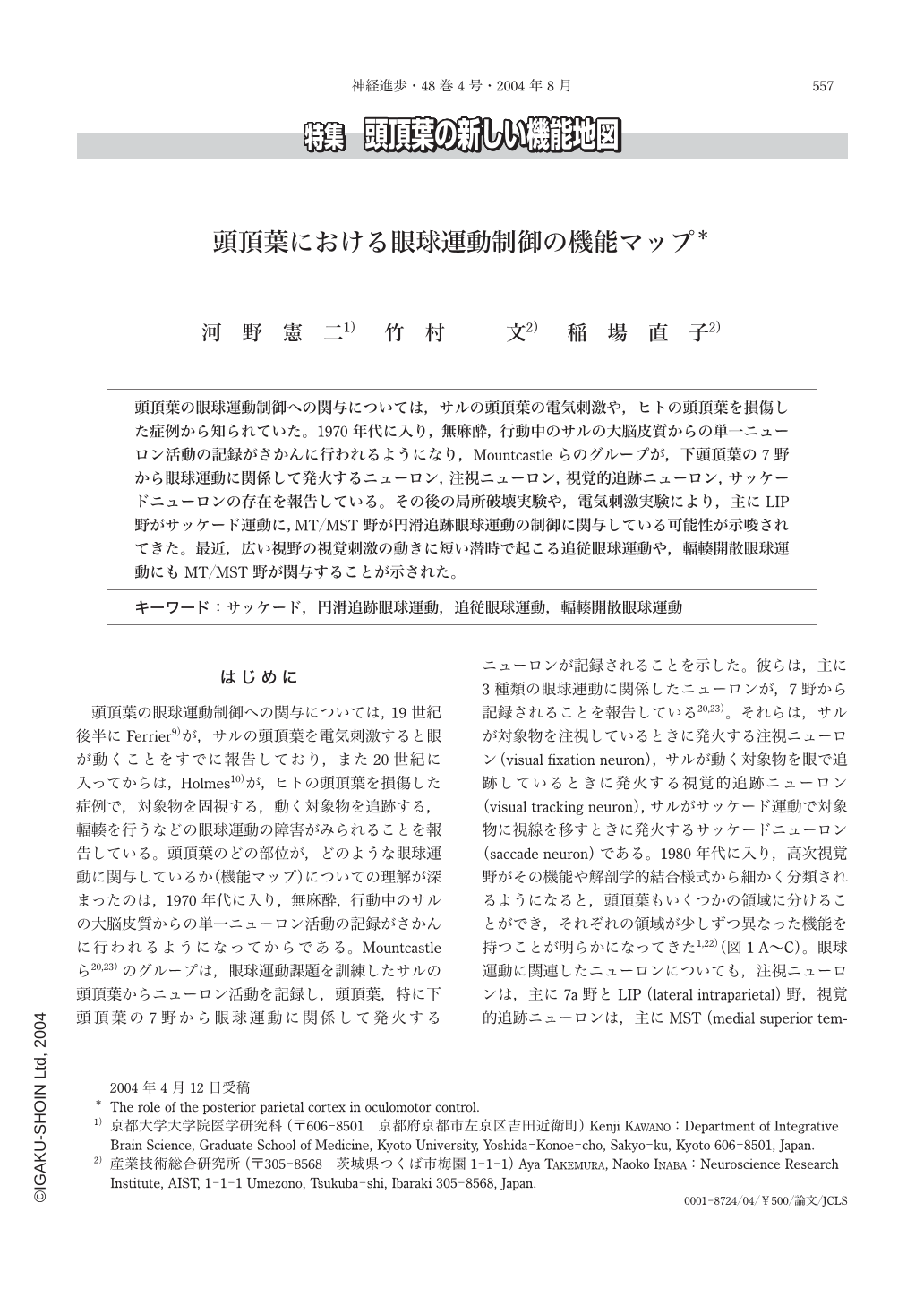
頭頂葉の眼球運動制御への関与については,サルの頭頂葉の電気刺激や,ヒトの頭頂葉を損傷した症例から知られていた。1970年代に入り,無麻酔,行動中のサルの大脳皮質からの単一ニューロン活動の記録がさかんに行われるようになり,Mountcastleらのグループが,下頭頂葉の7野から眼球運動に関係して発火するニューロン,注視ニューロン,視覚的追跡ニューロン,サッケードニューロンの存在を報告している。その後の局所破壊実験や,電気刺激実験により,主にLIP野がサッケード運動に,MT/MST野が円滑追跡眼球運動の制御に関与している可能性が示唆されてきた。最近,広い視野の視覚刺激の動きに短い潜時で起こる追従眼球運動や,輻輳開散眼球運動にもMT/MST野が関与することが示された。
It has been known in clinical studies that lesions of the parietal cortex cause disturbances of ocular motility. Using behaving awake monkeys, Mountcastle and his colleagues revealed that in the posterior parietal cortex there are neurons whose activities are related to eye movements and are classified into three groups:visual fixation neurons, visual tracking neurons, and saccade neurons. Later, local chemical lesion studies and electrical stimulation studies were conducted in the posterior parietal cortex and revealed that the LIP area is engaged in controlling saccadic eye movements and the MT/MST area in smooth pursuit eye movements. Recent electrophysiological and chemical-lesion studies of using sudden movements of large-field visual stimuli revealed a possible role of the MT/MST area in short-latency ocular tracking responses, i. e. ocular following responses, disparity-vergence, and optic-flow vergence eye movements.
Copyright © 2004, Igaku-Shoin Ltd. All rights reserved.