Japanese
English
- 有料閲覧
PPV購入案内
1,320円 (1,200円+税10%) こちらは、137ページから143ページの文献です。購入には医書.jp本会員登録が必要です。
会員登録完了後に改めて上記「購入サイトへ」を選択してください。
または「購入サイトへ」選択後に「購入ログイン」、「新規会員登録」の順に進んでください。
会員登録について詳しくはをご確認ください。
- Abstract 文献概要
- 1ページ目 Look Inside
- 参考文献 Reference
はじめに
PET(positron emission tomography;陽電子放射断層撮影法)は短半減期のポジトロン放出核種(11C,18F,15O)で標識した放射性プローブを生体内に投与し,その分布と経時的変化をポジトロンカメラにより検出して画像化する核医学的手法である。PETでは投与する放射性プローブの性質に応じて,臓器の血流や代謝,受容体やトランスポーターなどの標的分子への特異結合など,さまざまな生体機能の評価が可能である。今日では腫瘍や循環器疾患の診断のほか,精神神経疾患の病態研究や脳機能研究など,幅広く利用されている。
血液脳関門はこれまで内皮細胞間あるいは上皮細胞間のタイトジャンクションなどに由来するものと解釈されてきたが,最近の速度論的,分子生物学的研究により,いったん脳内皮細胞に取り込まれた異物が,P糖蛋白などのトランスポーターの働きにより能動的に血液中に汲み出されているために正味の脳移行が制限されていることが明らかにされている。関門における排出輸送の個人差は,脳内濃度の個人差ひいては薬効・副作用の個人差の一因となりうる。PETによる血液脳関門の評価は,血液脳関門に発現している薬物排泄トランスポーターの基質をポジトロン標識し,脳への移行の程度からトランスポーター機能を測定する方法が主に用いられている。一方,薬物の脳移行という観点からは,薬物を直接標識してその移行の程度を測定したり,脳内の薬物の標的部位での受容体占有率などから薬物の脳への移行の程度を間接的に評価したりするなどの方法も用いられている。
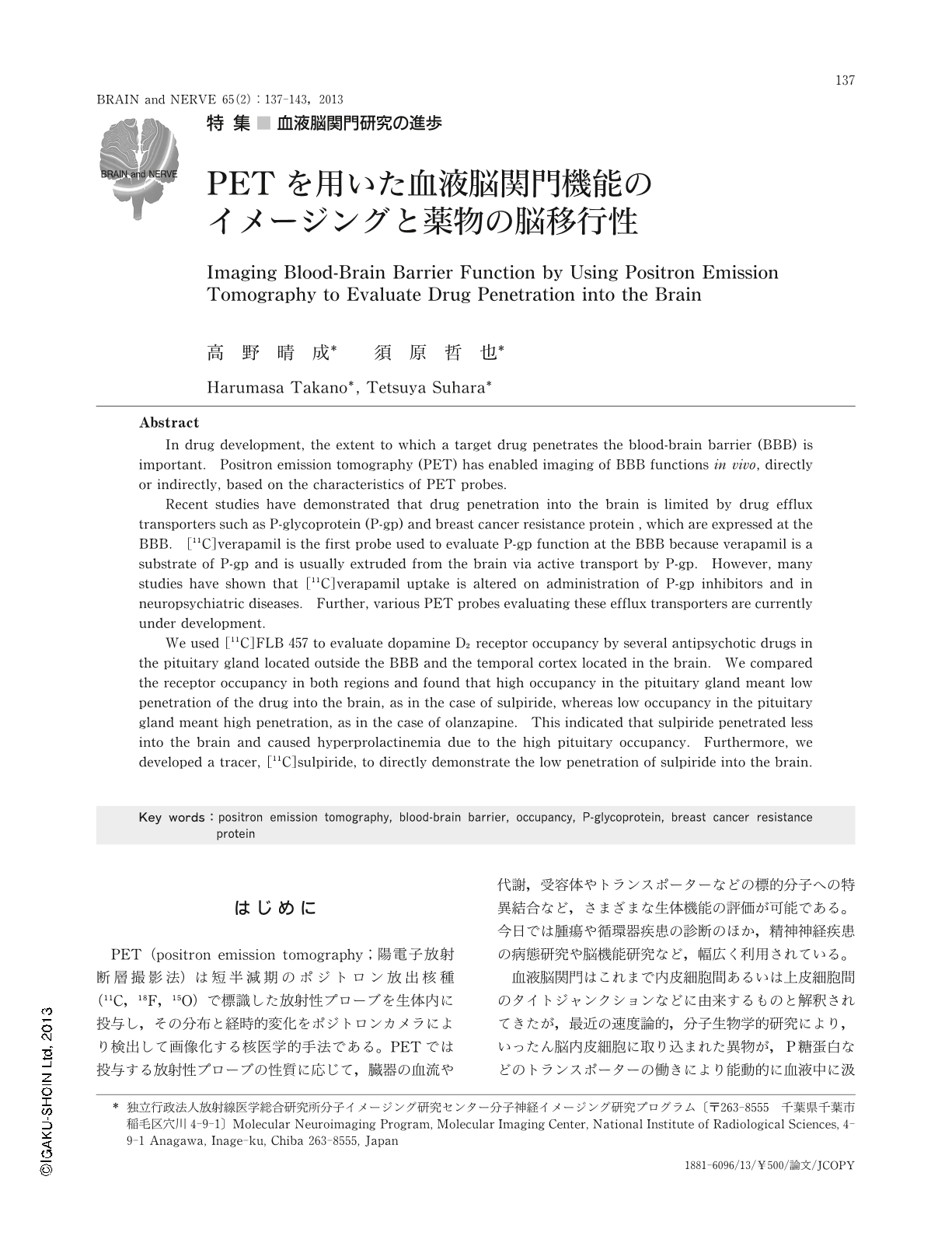
Abstract
In drug development, the extent to which a target drug penetrates the blood-brain barrier (BBB) is important. Positron emission tomography (PET) has enabled imaging of BBB functions in vivo, directly or indirectly, based on the characteristics of PET probes.
Recent studies have demonstrated that drug penetration into the brain is limited by drug efflux transporters such as P-glycoprotein (P-gp) and breast cancer resistance protein , which are expressed at the BBB. [11C]verapamil is the first probe used to evaluate P-gp function at the BBB because verapamil is a substrate of P-gp and is usually extruded from the brain via active transport by P-gp. However, many studies have shown that [11C]verapamil uptake is altered on administration of P-gp inhibitors and in neuropsychiatric diseases. Further, various PET probes evaluating these efflux transporters are currently under development.
We used [11C]FLB 457 to evaluate dopamine D2 receptor occupancy by several antipsychotic drugs in the pituitary gland located outside the BBB and the temporal cortex located in the brain. We compared the receptor occupancy in both regions and found that high occupancy in the pituitary gland meant low penetration of the drug into the brain, as in the case of sulpiride, whereas low occupancy in the pituitary gland meant high penetration, as in the case of olanzapine. This indicated that sulpiride penetrated less into the brain and caused hyperprolactinemia due to the high pituitary occupancy. Furthermore, we developed a tracer, [11C]sulpiride, to directly demonstrate the low penetration of sulpiride into the brain.
Copyright © 2013, Igaku-Shoin Ltd. All rights reserved.