Japanese
English
- 有料閲覧
PPV購入案内
1,320円 (1,200円+税10%) こちらは、1001ページから1012ページの文献です。購入には医書.jp本会員登録が必要です。
会員登録完了後に改めて上記「購入サイトへ」を選択してください。
または「購入サイトへ」選択後に「購入ログイン」、「新規会員登録」の順に進んでください。
会員登録について詳しくはをご確認ください。
- Abstract 文献概要
- 1ページ目 Look Inside
- 参考文献 Reference
はじめに
ヒト高次脳機能は,複数の脳領域活動が複雑に連動しているものと考えられている。脳は機能ダイナミクスが複雑であるため,生物の単一臓器として唯一,“脳-科学(neuroscience)”という探求すべき科学分野として注目されている。そこには臨床医,基礎医学者,さらに工学系などの異なるバックグランドを持つ科学研究者が集い,さまざまな手法を用いて脳機能解析に挑んでいる。
そのアプローチ法は侵襲的手法と非侵襲的手法に分かれるが,特にヒト脳機能局在方法としては,主に患者を対象とするため,臨床的目的で確実なマッピング法である侵襲的手法がゴールドスタンダードとなっている。この侵襲的手法は開頭して直接脳皮質を電気刺激する脳皮質電気刺激法(electrocortical stimulation:ECS)が代表的である。また,難治性てんかん患者において焦点同定のために硬膜下電極を留置して,異常脳発射源の同定,ECSによる機能マッピングを行う試み,さらに近年ではさまざまな認知課題を行いながら脳皮質電位(electrocorticography:ECoG)を計測する認知ECoG研究が報告されている。ECoGは従来の脳波とは異なり脳深部の電位や60Hz以上の高周波成分の検出も可能になった1-4)。その一方で,侵襲的手法から非侵襲的手法の代表である機能的MRI(functional magnetic resonance imaging:fMRI)とECSとの比較検討も散見されるようになりつつあるが5,6),いまだ十分な結論は得られていない。臨床研究で培われた検証手法を,基礎科学に応用できるようにより侵襲の少ないものにし両者の橋渡しを目指すことは,neuroscienceの今後の発展に寄与するものと考えられる。
ECSによる脳機能マッピングの代表的な仕事は1954年にPenfieldとJasperらにより行われ,一次運動・感覚野における詳細な機能局在は大脳皮質小人間像(cortical homunculus)として広く知られている7)。その一方で本手法は開頭術が必要であり,また電気刺激は常に痙攣発作誘発のリスクがあるため,いまだに適応は極めて限られている。また,電気刺激強度,認知課題の選択,検査時間の制限なども本手法をより困難なものにしている。
近年は硬膜下電極より計測したECoGから,さまざまな脳信号抽出法が試みられている。Croneら1),Towleら8)は10例ほどの患者の限定した脳領域において,文字読み課題ECoGで80Hz程度の高周波成分(γ帯域)変動の報告をした1,8)。彼らはγ成分増加領域にECSを行うことによって発語停止を誘発することで,γ帯域の臨床的重要性を示唆した。しかし,いまだに非侵襲的脳機能画像との比較はほとんどなく,ECoG計測,ECSにおいて,言語,記憶などの複数の高次認知課題は用いていないため高次脳機能ネットワークの解明には言及していない。
臨床用1.5T装置で行うことができるfMRIは,比較的簡便に,かつ高い信号・雑音比を有する信号を得ることができる。これにより単純な運動,視覚などの一次脳機能に加え,言語など高次脳機能の局在研究に応用されるようになった9)。fMRIは主に脳組織内血流の変化に伴う酸化ヘモグロビン/還元型ヘモグロビン比(blood oxygenation level dependent:BOLD)を捉えているため,電気的な脳活動を直接反映しているわけではない。PET,NIRSもfMRIとは感度や時間分解能の違いはあるが,原理的には脳血流変化に基づいた信号を捉えている。
本稿では頭蓋内電極留置下の患者にさまざまな課題を行うことで,運動,言語関連,記憶関連機能の画像化を試みた例を紹介する。個々の患者において行った課題,提示刺激で誘発されたECoGの時間的・空間的広がりのパターン化を行った。特に記憶関連ECoGの有無と手術による記憶障害出現程度について比較した。また,電極留置前に行った認知関連課題fMRIとECSの結果との比較により,その精度,信頼性に関する検討も行った。
さらに複数の自動判別関数を用いて課題別ECoG反応のクラス分けに応用し,より効率的な脳信号の抽出を試みた。また,患者間で留置電極位置にばらつきがあるため,標準脳にECoG電極位置座標を変換・重畳した。これにより標準脳上に高解像度のECoGの時間的変化過程を描画した。これらを組み合わせることにより,言語,記憶機能野の同定,および典型的な認知ECoG反応ダイナミクスを解析する方法を開発したので報告する。
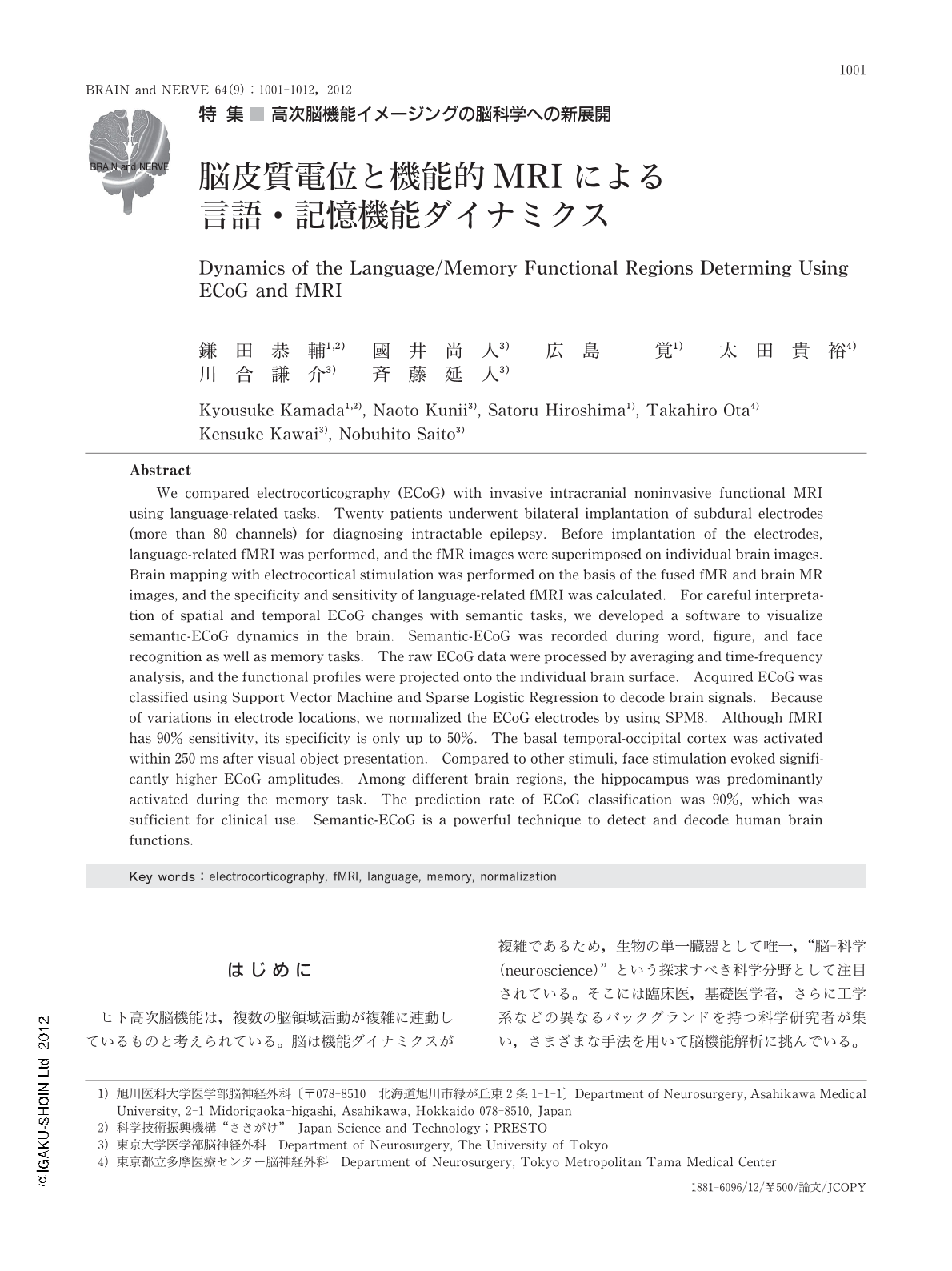
Abstract
We compared electrocorticography (ECoG) with invasive intracranial noninvasive functional MRI using language-related tasks. Twenty patients underwent bilateral implantation of subdural electrodes (more than 80 channels) for diagnosing intractable epilepsy. Before implantation of the electrodes, language-related fMRI was performed, and the fMR images were superimposed on individual brain images. Brain mapping with electrocortical stimulation was performed on the basis of the fused fMR and brain MR images, and the specificity and sensitivity of language-related fMRI was calculated. For careful interpretation of spatial and temporal ECoG changes with semantic tasks, we developed a software to visualize semantic-ECoG dynamics in the brain. Semantic-ECoG was recorded during word, figure, and face recognition as well as memory tasks. The raw ECoG data were processed by averaging and time-frequency analysis, and the functional profiles were projected onto the individual brain surface. Acquired ECoG was classified using Support Vector Machine and Sparse Logistic Regression to decode brain signals. Because of variations in electrode locations, we normalized the ECoG electrodes by using SPM8. Although fMRI has 90% sensitivity, its specificity is only up to 50%. The basal temporal-occipital cortex was activated within 250 ms after visual object presentation. Compared to other stimuli, face stimulation evoked significantly higher ECoG amplitudes. Among different brain regions, the hippocampus was predominantly activated during the memory task. The prediction rate of ECoG classification was 90%, which was sufficient for clinical use. Semantic-ECoG is a powerful technique to detect and decode human brain functions.
Copyright © 2012, Igaku-Shoin Ltd. All rights reserved.