Japanese
English
- 有料閲覧
PPV購入案内
1,320円 (1,200円+税10%) こちらは、1003ページから1012ページの文献です。購入には医書.jp本会員登録が必要です。
会員登録完了後に改めて上記「購入サイトへ」を選択してください。
または「購入サイトへ」選択後に「購入ログイン」、「新規会員登録」の順に進んでください。
会員登録について詳しくはをご確認ください。
- Abstract 文献概要
- 1ページ目 Look Inside
- 参考文献 Reference
はじめに
1993年,発症6時間以内の超急性期脳塞栓症に対するデュテプラーゼを用いたrecombinant tissue-type plasminogen activator(rt-PA)静注療法の有効性が世界に先駆けて日本から発表された1)。続いて,1995年にNINDS(National Institute of Neurological Disorder and Stroke)rt-PA Stroke Studyによって,発症3時間以内の虚血性脳血管障害に対するアルテプラーゼ静注法の有効性が示され2),その翌年には米国食品医薬品局(Food and Drug Administration:FDA)によって,世界初の脳卒中特効薬として承認された。その後,欧州,カナダ,アジアの世界40カ国以上で承認され,臨床使用されてきた。
一方,日本では,特許権の問題からデュテプラーゼが製造販売中止となり,国内でのrt-PA静注療法は長らく未承認のままであった。2002年から2003年にかけて,発症3時間以内の虚血性脳血管障害に対するrt-PA(アルテプラーゼ)静注療法のオープン試験(第Ⅲ相治験,Japan Alteplase Clinical Trial:J-ACT)が行われ3),本薬は2005年10月に厚生労働省から発症3時間以内の脳梗塞への適応拡大承認を得た。承認後のrt-PAの国内での年間使用症例数は推定4,000例以上であり,既に超急性期虚血性脳血管障害治療の柱になったと言っても過言ではない。
本稿では超急性期虚血性脳血管障害に対する血栓溶解療法の現況,最新の動向,当院におけるrt-PA静注療法の治療成績について報告し,今後の展望を述べることとする。
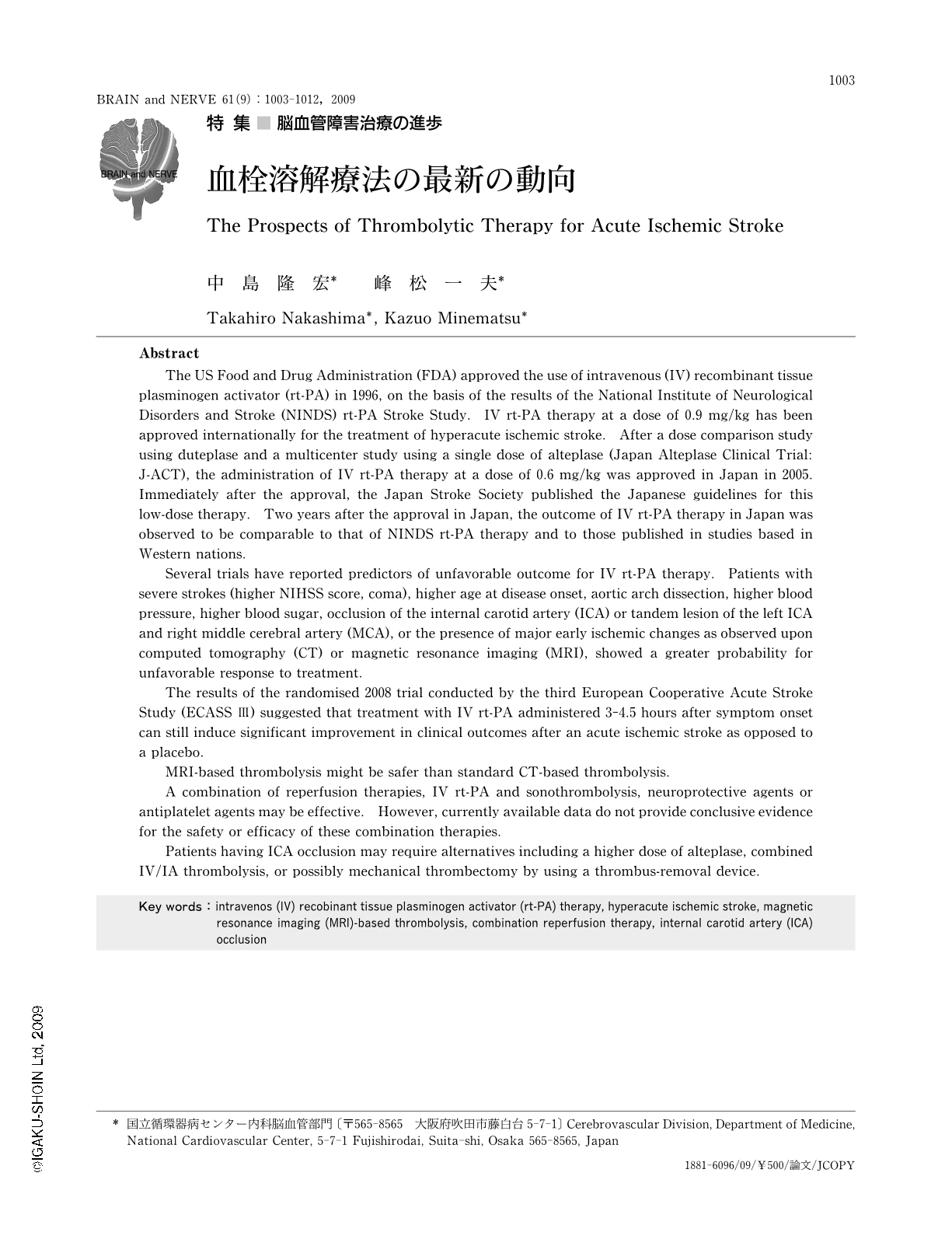
Abstract
The US Food and Drug Administration (FDA) approved the use of intravenous (IV) recombinant tissue plasminogen activator (rt-PA) in 1996, on the basis of the results of the National Institute of Neurological Disorders and Stroke (NINDS) rt-PA Stroke Study. IV rt-PA therapy at a dose of 0.9 mg/kg has been approved internationally for the treatment of hyperacute ischemic stroke. After a dose comparison study using duteplase and a multicenter study using a single dose of alteplase (Japan Alteplase Clinical Trial: J-ACT), the administration of IV rt-PA therapy at a dose of 0.6 mg/kg was approved in Japan in 2005. Immediately after the approval, the Japan Stroke Society published the Japanese guidelines for this low-dose therapy. Two years after the approval in Japan, the outcome of IV rt-PA therapy in Japan was observed to be comparable to that of NINDS rt-PA therapy and to those published in studies based in Western nations.
Several trials have reported predictors of unfavorable outcome for IV rt-PA therapy. Patients with severe strokes (higher NIHSS score, coma), higher age at disease onset, aortic arch dissection, higher blood pressure, higher blood sugar, occlusion of the internal carotid artery (ICA) or tandem lesion of the left ICA and right middle cerebral artery (MCA), or the presence of major early ischemic changes as observed upon computed tomography (CT) or magnetic resonance imaging (MRI), showed a greater probability for unfavorable response to treatment.
The results of the randomised 2008 trial conducted by the third European Cooperative Acute Stroke Study (ECASS Ⅲ) suggested that treatment with IV rt-PA administered 3-4.5 hours after symptom onset can still induce significant improvement in clinical outcomes after an acute ischemic stroke as opposed to a placebo.
MRI-based thrombolysis might be safer than standard CT-based thrombolysis.
A combination of reperfusion therapies, IV rt-PA and sonothrombolysis, neuroprotective agents or antiplatelet agents may be effective. However, currently available data do not provide conclusive evidence for the safety or efficacy of these combination therapies.
Patients having ICA occlusion may require alternatives including a higher dose of alteplase,combined IV/IA thrombolysis,or possibly mechanical thrombectomy by using a thrombus-removal device.
Copyright © 2009, Igaku-Shoin Ltd. All rights reserved.