Japanese
English
- 有料閲覧
PPV購入案内
1,320円 (1,200円+税10%) こちらは、569ページから574ページの文献です。購入には医書.jp本会員登録が必要です。
会員登録完了後に改めて上記「購入サイトへ」を選択してください。
または「購入サイトへ」選択後に「購入ログイン」、「新規会員登録」の順に進んでください。
会員登録について詳しくはをご確認ください。
- Abstract 文献概要
- 1ページ目 Look Inside
- 参考文献 Reference
はじめに
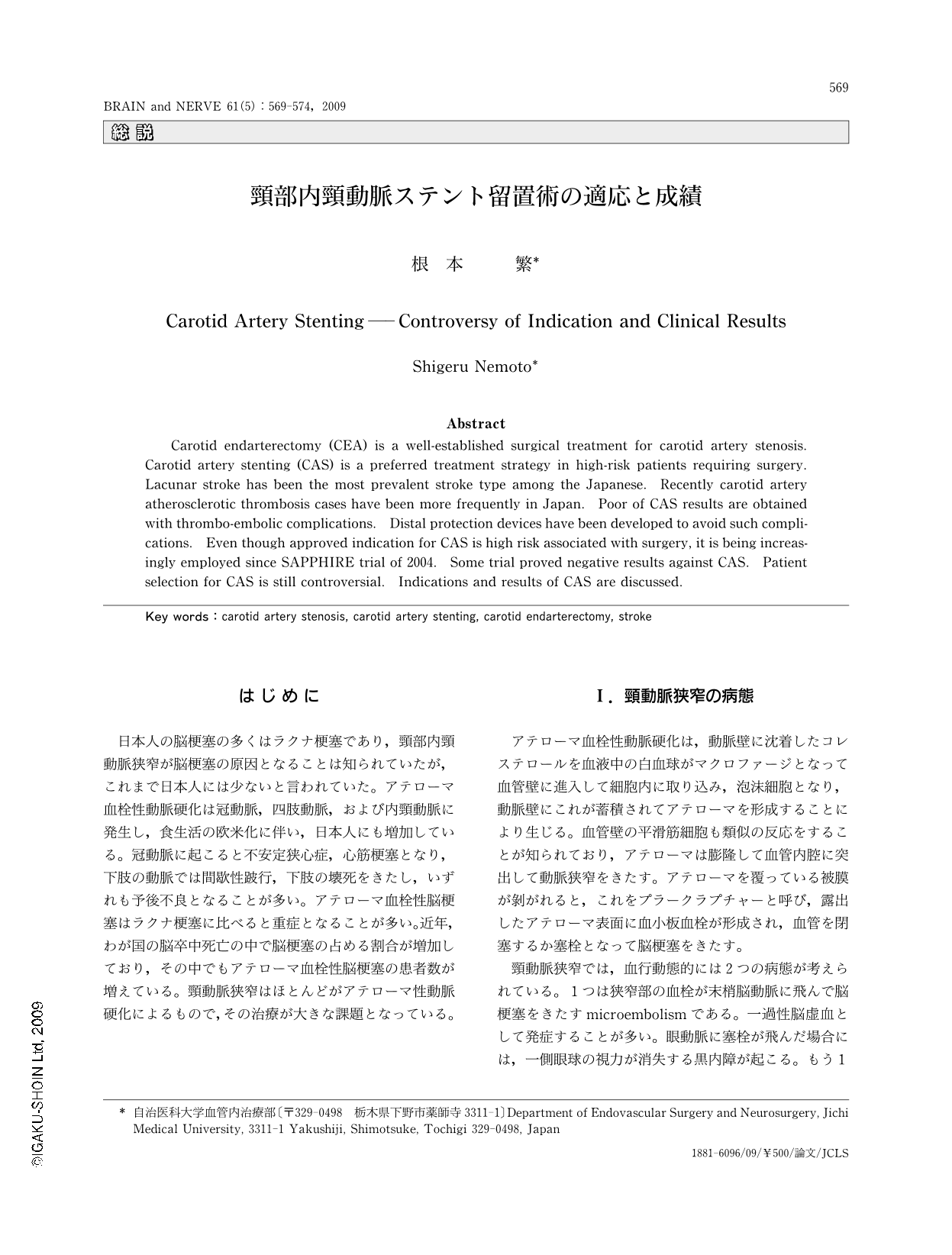
日本人の脳梗塞の多くはラクナ梗塞であり,頸部内頸動脈狭窄が脳梗塞の原因となることは知られていたが,これまで日本人には少ないと言われていた。アテローマ血栓性動脈硬化は冠動脈,四肢動脈,および内頸動脈に発生し,食生活の欧米化に伴い,日本人にも増加している。冠動脈に起こると不安定狭心症,心筋梗塞となり,下肢の動脈では間歇性跛行,下肢の壊死をきたし,いずれも予後不良となることが多い。アテローマ血栓性脳梗塞はラクナ梗塞に比べると重症となることが多い。近年,わが国の脳卒中死亡の中で脳梗塞の占める割合が増加しており,その中でもアテローマ血栓性脳梗塞の患者数が増えている。頸動脈狭窄はほとんどがアテローマ性動脈硬化によるもので,その治療が大きな課題となっている。
Abstract
Carotid endarterectomy (CEA) is a well-established surgical treatment for carotid artery stenosis. Carotid artery stenting (CAS) is a preferred treatment strategy in high-risk patients requiring surgery. Lacunar stroke has been the most prevalent stroke type among the Japanese. Recently carotid artery atherosclerotic thrombosis cases have been more frequently in Japan. Poor of CAS results are obtained with thrombo-embolic complications. Distal protection devices have been developed to avoid such complications. Even though approved indication for CAS is high risk associated with surgery,it is being increasingly employed since SAPPHIRE trial of 2004. Some trial proved negative results against CAS. Patient selection for CAS is still controversial. Indications and results of CAS are discussed.
Copyright © 2009, Igaku-Shoin Ltd. All rights reserved.