Japanese
English
- 有料閲覧
PPV購入案内
1,320円 (1,200円+税10%) こちらは、1187ページから1192ページの文献です。購入には医書.jp本会員登録が必要です。
会員登録完了後に改めて上記「購入サイトへ」を選択してください。
または「購入サイトへ」選択後に「購入ログイン」、「新規会員登録」の順に進んでください。
会員登録について詳しくはをご確認ください。
- Abstract 文献概要
- 1ページ目 Look Inside
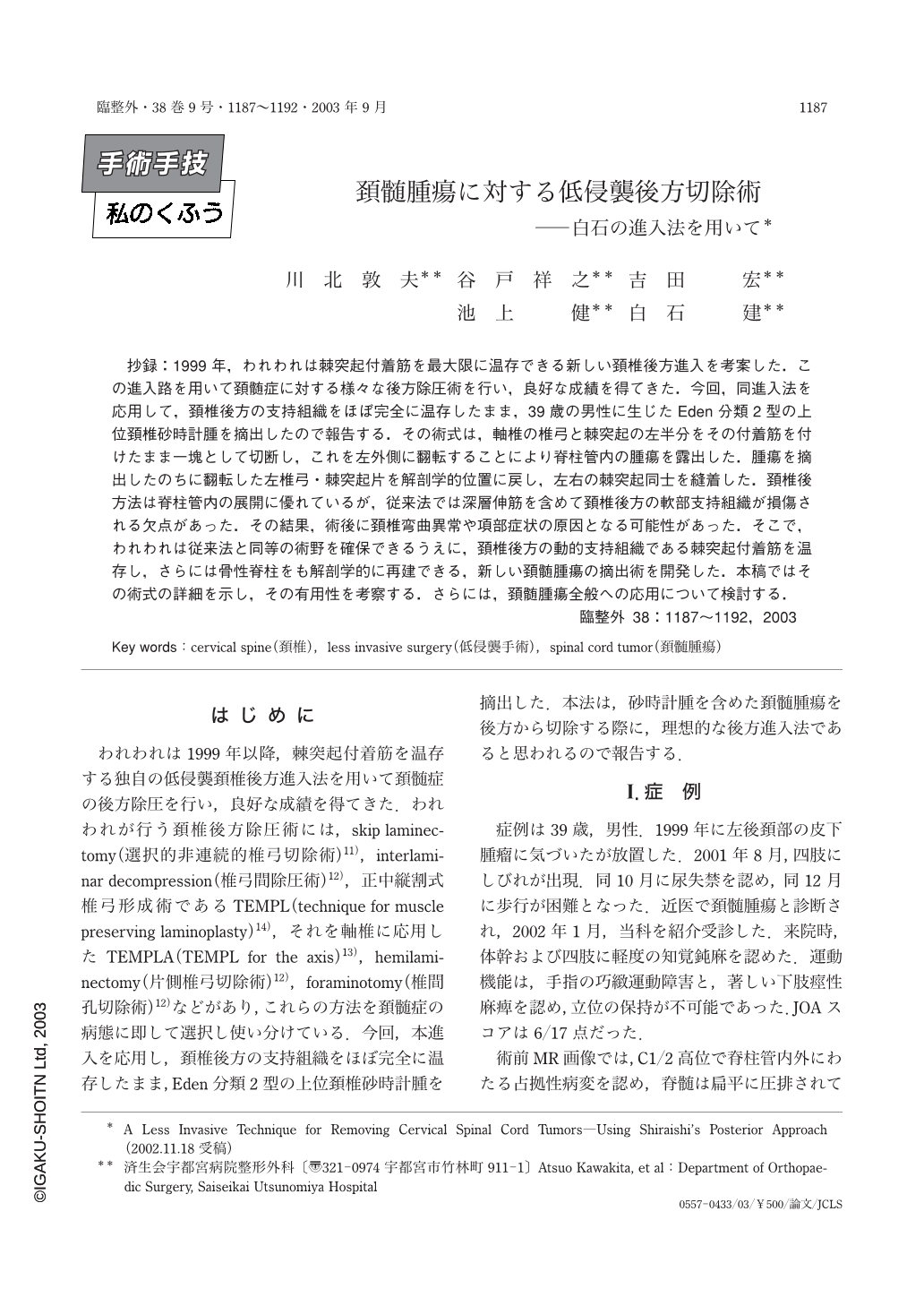
抄録:1999年,われわれは棘突起付着筋を最大限に温存できる新しい頚椎後方進入を考案した.この進入路を用いて頚髄症に対する様々な後方除圧術を行い,良好な成績を得てきた.今回,同進入法を応用して,頚椎後方の支持組織をほぼ完全に温存したまま,39歳の男性に生じたEden分類2型の上位頚椎砂時計腫を摘出したので報告する.その術式は,軸椎の椎弓と棘突起の左半分をその付着筋を付けたまま一塊として切断し,これを左外側に翻転することにより脊柱管内の腫瘍を露出した.腫瘍を摘出したのちに翻転した左椎弓・棘突起片を解剖学的位置に戻し,左右の棘突起同士を縫着した.頚椎後方法は脊柱管内の展開に優れているが,従来法では深層伸筋を含めて頚椎後方の軟部支持組織が損傷される欠点があった.その結果,術後に頚椎弯曲異常や項部症状の原因となる可能性があった.そこで,われわれは従来法と同等の術野を確保できるうえに,頚椎後方の動的支持組織である棘突起付着筋を温存し,さらには骨性脊柱をも解剖学的に再建できる,新しい頚髄腫瘍の摘出術を開発した.本稿ではその術式の詳細を示し,その有用性を考察する.さらには,頚髄腫瘍全般への応用について検討する.
We describe a new technique for removing cervical spinal cord tumors that uses Shiraishi's posterior approach to the cervical spine, and we discuss its significance. The new technique was used to excise an Eden type 2 dumbbell-shaped neurinoma of the upper cervical spine.
[Surgical technique]A longitudinal midline incision was made, and the deep extensor muscles and the spinous processes were exposed. After sagittaly splitting the C2 spinous process in the midline, the left lamina-facet junction of the C2 was divided to make a free fragment of the left half of the C2 posterior arch while preserving all five muscles that attached to the C2 spinous process. The fragment was retracted laterally to expose the intraspinal portion of the dumbbell tumor, and after removing the tumor, the fragment was replaced in its anatomical position and firmly sutured to its counterpart.
The use of posterior approaches to remove cervical spinal cord tumors has the advantage of exposing the intraspinal space with less damage to the bony spine than by the anterior or anterolateral approaches. However, the deep extensor muscles that attach to the spinous processes are invariably neglected in conventional posterior approaches to the cervical spine, leading to postoperative problems such as cervical malalignment and axial symptoms. The procedure described here enabled preservation of the deep extensor musculature as a dynamic stabilizer of the cervical spine and reconstruction of the posterior bony arch anatomically as a static stabilizer. We consider this technique to be a useful alternative to conventional posterior methods, and it should be regarded as an approach of first choice when excision of a cervical spinal cord tumor is planned.
Copyright © 2003, Igaku-Shoin Ltd. All rights reserved.