Japanese
English
- 有料閲覧
PPV購入案内
1,320円 (1,200円+税10%) こちらは、405ページから413ページの文献です。購入には医書.jp本会員登録が必要です。
会員登録完了後に改めて上記「購入サイトへ」を選択してください。
または「購入サイトへ」選択後に「購入ログイン」、「新規会員登録」の順に進んでください。
会員登録について詳しくはをご確認ください。
- Abstract 文献概要
- 1ページ目 Look Inside
- 参考文献 Reference
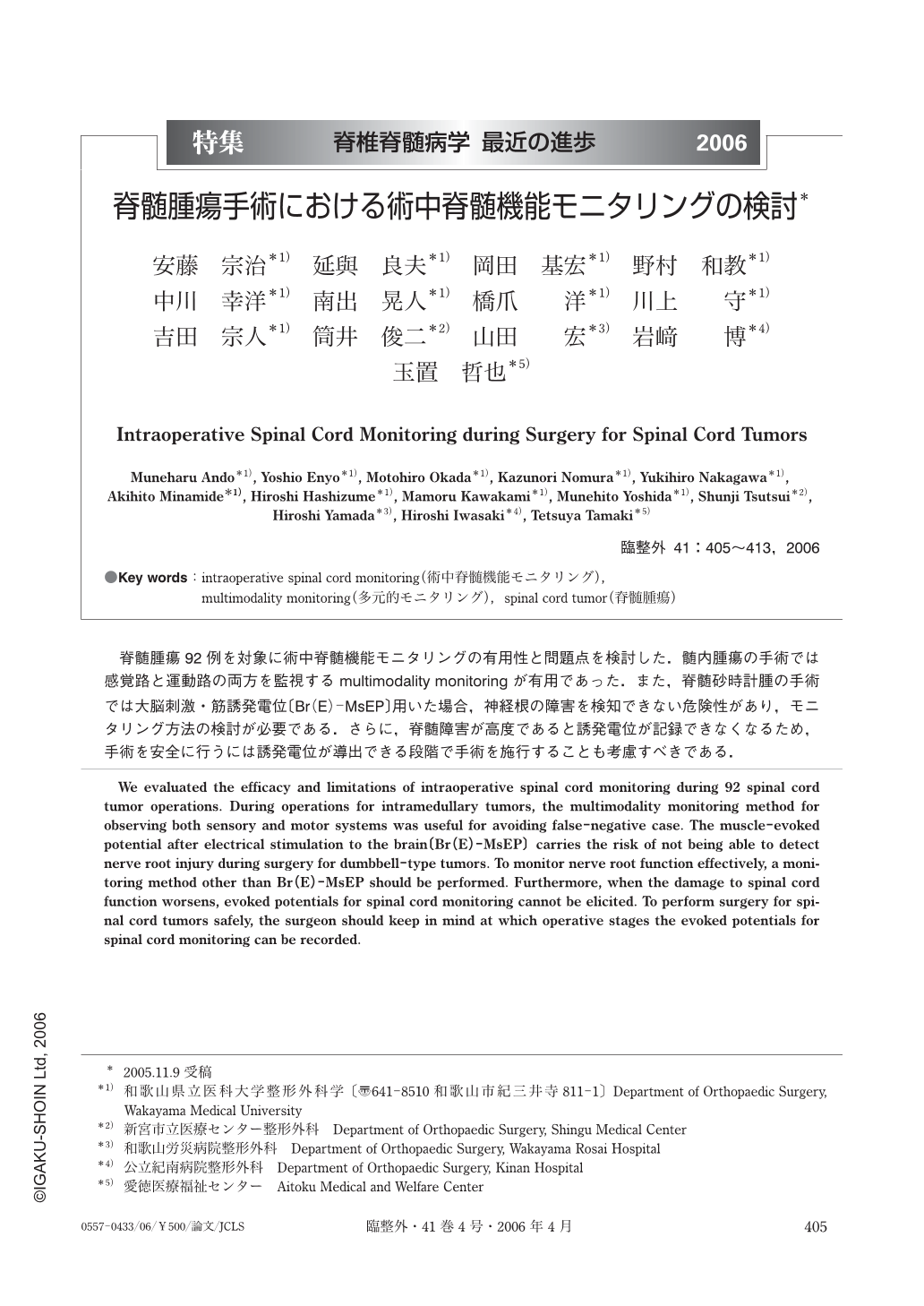
脊髄腫瘍92例を対象に術中脊髄機能モニタリングの有用性と問題点を検討した.髄内腫瘍の手術では感覚路と運動路の両方を監視するmultimodality monitoringが有用であった.また,脊髄砂時計腫の手術では大脳刺激・筋誘発電位〔Br(E)-MsEP〕用いた場合,神経根の障害を検知できない危険性があり,モニタリング方法の検討が必要である.さらに,脊髄障害が高度であると誘発電位が記録できなくなるため,手術を安全に行うには誘発電位が導出できる段階で手術を施行することも考慮すべきである.
We evaluated the efficacy and limitations of intraoperative spinal cord monitoring during 92 spinal cord tumor operations. During operations for intramedullary tumors, the multimodality monitoring method for observing both sensory and motor systems was useful for avoiding false-negative case. The muscle-evoked potential after electrical stimulation to the brain 〔Br(E)-MsEP〕 carries the risk of not being able to detect nerve root injury during surgery for dumbbell-type tumors. To monitor nerve root function effectively, a monitoring method other than Br(E)-MsEP should be performed. Furthermore, when the damage to spinal cord function worsens, evoked potentials for spinal cord monitoring cannot be elicited. To perform surgery for spinal cord tumors safely, the surgeon should keep in mind at which operative stages the evoked potentials for spinal cord monitoring can be recorded.
Copyright © 2006, Igaku-Shoin Ltd. All rights reserved.