Japanese
English
- 有料閲覧
PPV購入案内
1,320円 (1,200円+税10%) こちらは、329ページから332ページの文献です。購入には医書.jp本会員登録が必要です。
会員登録完了後に改めて上記「購入サイトへ」を選択してください。
または「購入サイトへ」選択後に「購入ログイン」、「新規会員登録」の順に進んでください。
会員登録について詳しくはをご確認ください。
- Abstract 文献概要
- 1ページ目 Look Inside
- 参考文献 Reference
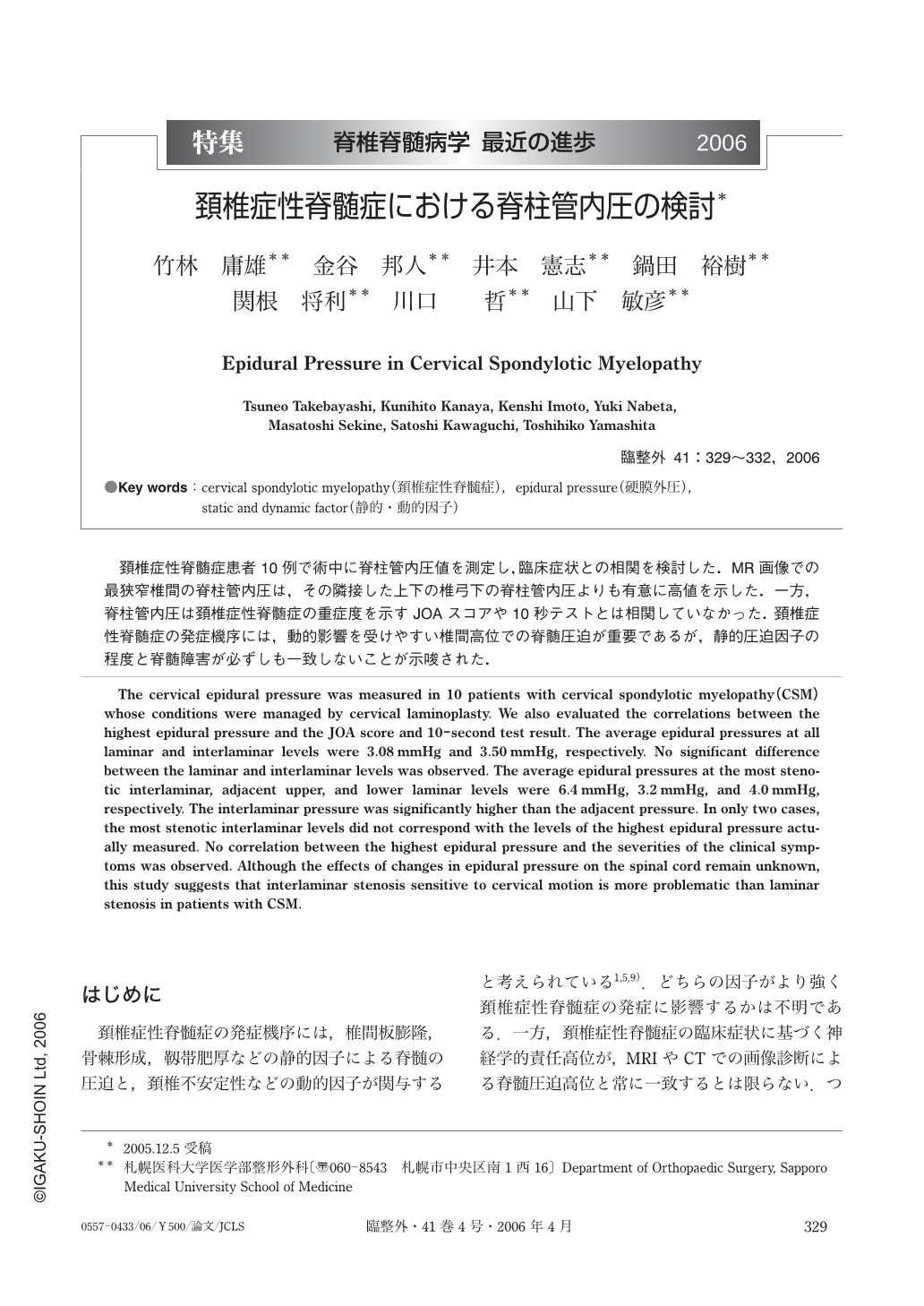
頚椎症性脊髄症患者10例で術中に脊柱管内圧値を測定し,臨床症状との相関を検討した.MR画像での最狭窄椎間の脊柱管内圧は,その隣接した上下の椎弓下の脊柱管内圧よりも有意に高値を示した.一方,脊柱管内圧は頚椎症性脊髄症の重症度を示すJOAスコアや10秒テストとは相関していなかった.頚椎症性脊髄症の発症機序には,動的影響を受けやすい椎間高位での脊髄圧迫が重要であるが,静的圧迫因子の程度と脊髄障害が必ずしも一致しないことが示唆された.
The cervical epidural pressure was measured in 10 patients with cervical spondylotic myelopathy (CSM) whose conditions were managed by cervical laminoplasty. We also evaluated the correlations between the highest epidural pressure and the JOA score and 10-second test result. The average epidural pressures at all laminar and interlaminar levels were 3.08mmHg and 3.50mmHg, respectively. No significant difference between the laminar and interlaminar levels was observed. The average epidural pressures at the most stenotic interlaminar, adjacent upper, and lower laminar levels were 6.4mmHg, 3.2mmHg, and 4.0mmHg, respectively. The interlaminar pressure was significantly higher than the adjacent pressure. In only two cases, the most stenotic interlaminar levels did not correspond with the levels of the highest epidural pressure actually measured. No correlation between the highest epidural pressure and the severities of the clinical symptoms was observed. Although the effects of changes in epidural pressure on the spinal cord remain unknown, this study suggests that interlaminar stenosis sensitive to cervical motion is more problematic than laminar stenosis in patients with CSM.
Copyright © 2006, Igaku-Shoin Ltd. All rights reserved.