Japanese
English
- 有料閲覧
PPV購入案内
1,320円 (1,200円+税10%) こちらは、121ページから128ページの文献です。購入には医書.jp本会員登録が必要です。
会員登録完了後に改めて上記「購入サイトへ」を選択してください。
または「購入サイトへ」選択後に「購入ログイン」、「新規会員登録」の順に進んでください。
会員登録について詳しくはをご確認ください。
- Abstract 文献概要
- 1ページ目 Look Inside
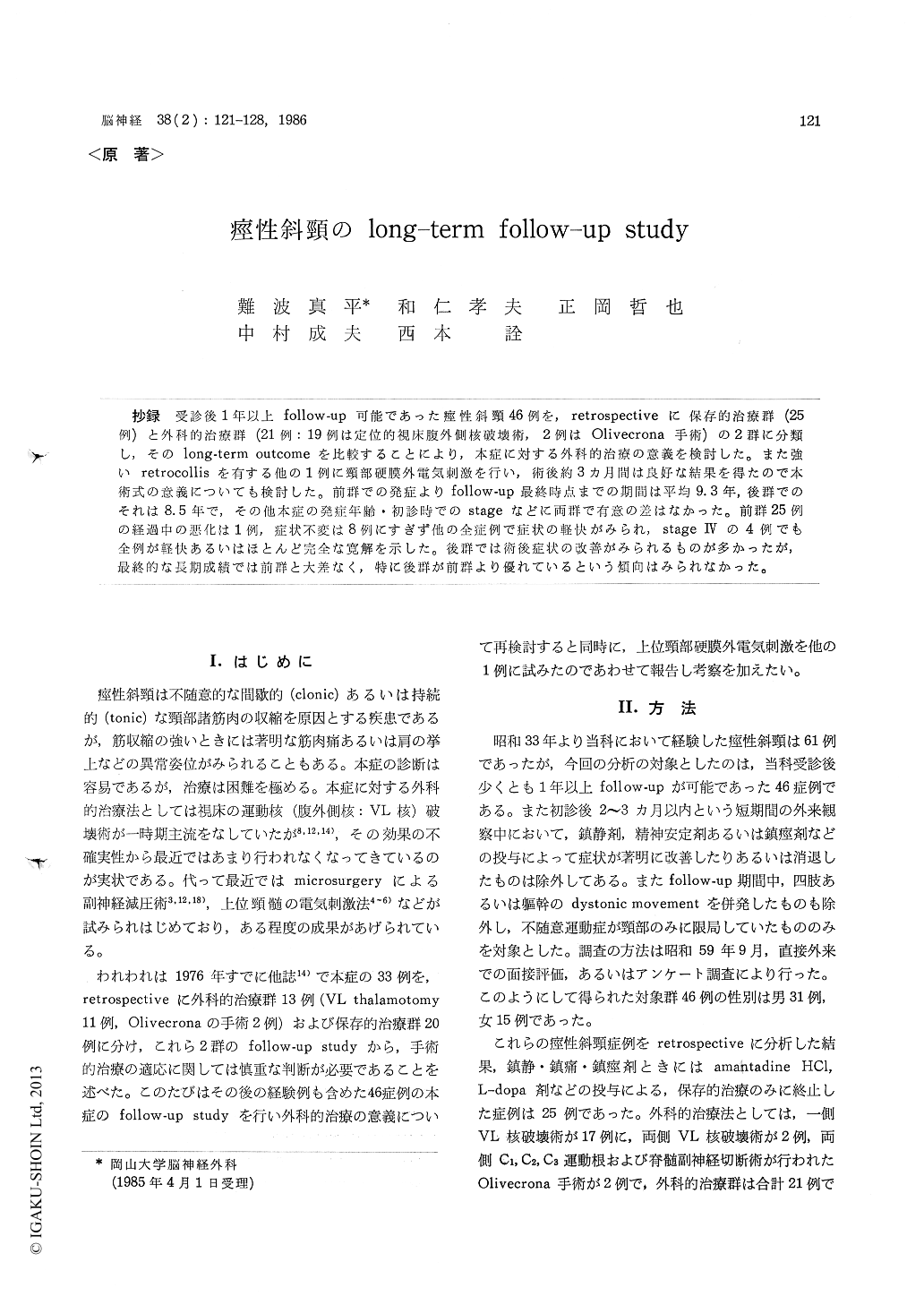
抄録 受診後1年以上follow-up可能であった痙性斜頸46例を,retrospectiveに保存的治療群(25例)と外科的治療群(21例:19例は定位的視床腹外側核破壊術,2例はOlivecrona手術)の2群に分類し,そのlong-term outcomeを比較することにより,本症に対する外科的治療の意義を検討した。また強いretrocollisを有する他の1例に頸部硬膜外電気刺激を行い,術後約3ヵ月間は良好な結果を得たので本術式の意義についても検討した。前群での発症よりfollow-up最終時点までの期間は平均9.3年,後群でのそれは8.5年で,その他本症の発症年齢・初診時でのstageなどに両群で有意の差はなかった。前群25例の経過中の悪化は1例,症状不変は8例にすぎず他の全症例で症状の軽快がみられ,stage IVの4例でも全例が軽快あるいはほとんど完全な寛解を示した。後群では術後症状の改善がみられるものが多かったが,最終的な長期成績では前群と大差なく,特に後群が前群より優れているという傾向はみられなかった。
Since 1958, 61 patients with spasmodic torticol-lis, 46 of whom did not develop other kinds ofinvoluntary movements, have been experienced in our neurosurgical clinic. The course of these 46 patients was followed for more than one year. The retrospective analysis revealed 25 patients were treated conservatively, and 21 patients were treated surgically. Surgical treatment consisted of stereotactic ventrolateral thalamotomy in 19 pa-tients, and Olivecrona's operation in the other 2. The long-term outcome of conservative therapy was compared to that of surgical therapy. One patient with severe retrocollis with horizontal components was treated successfully but transiently by implantation of stimulating electrodes in the cervical epidural spinal cord.
The peak incidence of the onset of the disease was in the fourth decade ; however, the time of onset ranged from 7 to 55 years of age. The pe-riod from disease onset to the final evaluation in the follow-up was 9.3 years (mean) in the conser-vative group, and 8.5 years in the surgically treated group (no significant difference). There were no significant differences between the groups in the interval from the time of disease onset to the initial evaluation in our clinic, stage determined at evaluation, and follow-up period after the ini-tial evaluation. Of the 25 conservatively treated patients, symptoms and signs remained unchanged in 8, deteriorated in one, but improved significant-ly in most of the remaining patients. Many of the surgically treated patients showed improve-ment one week after surgery, but the long-term outcome was not significantly better than that of the conservatively treated patients.
A 43-year-old female developed severe retro-collis accompanied by rotatory, tilting and ante-collie movements of the neck. Two stimulating electrodes were placed epidurally after partial resection of the C 1 and C 2 lamina. Retrocollis disappeared 1-2 days postoperatively but reap-peared 5-6 days after the operation. However, it disappeared soon in a few weeks. At 400-800 Hz, the patient sensed being stimulated, but at 1,200-1,400 Hz, the feeling of being stimulated was abolished. Although retrocollis recurred post-operative 3 months in this patient, spinal cord stimulation might provide some efficacy in such cases.
Copyright © 1986, Igaku-Shoin Ltd. All rights reserved.