Japanese
English
- 有料閲覧
PPV購入案内
1,320円 (1,200円+税10%) こちらは、167ページから174ページの文献です。購入には医書.jp本会員登録が必要です。
会員登録完了後に改めて上記「購入サイトへ」を選択してください。
または「購入サイトへ」選択後に「購入ログイン」、「新規会員登録」の順に進んでください。
会員登録について詳しくはをご確認ください。
- Abstract 文献概要
- 1ページ目 Look Inside
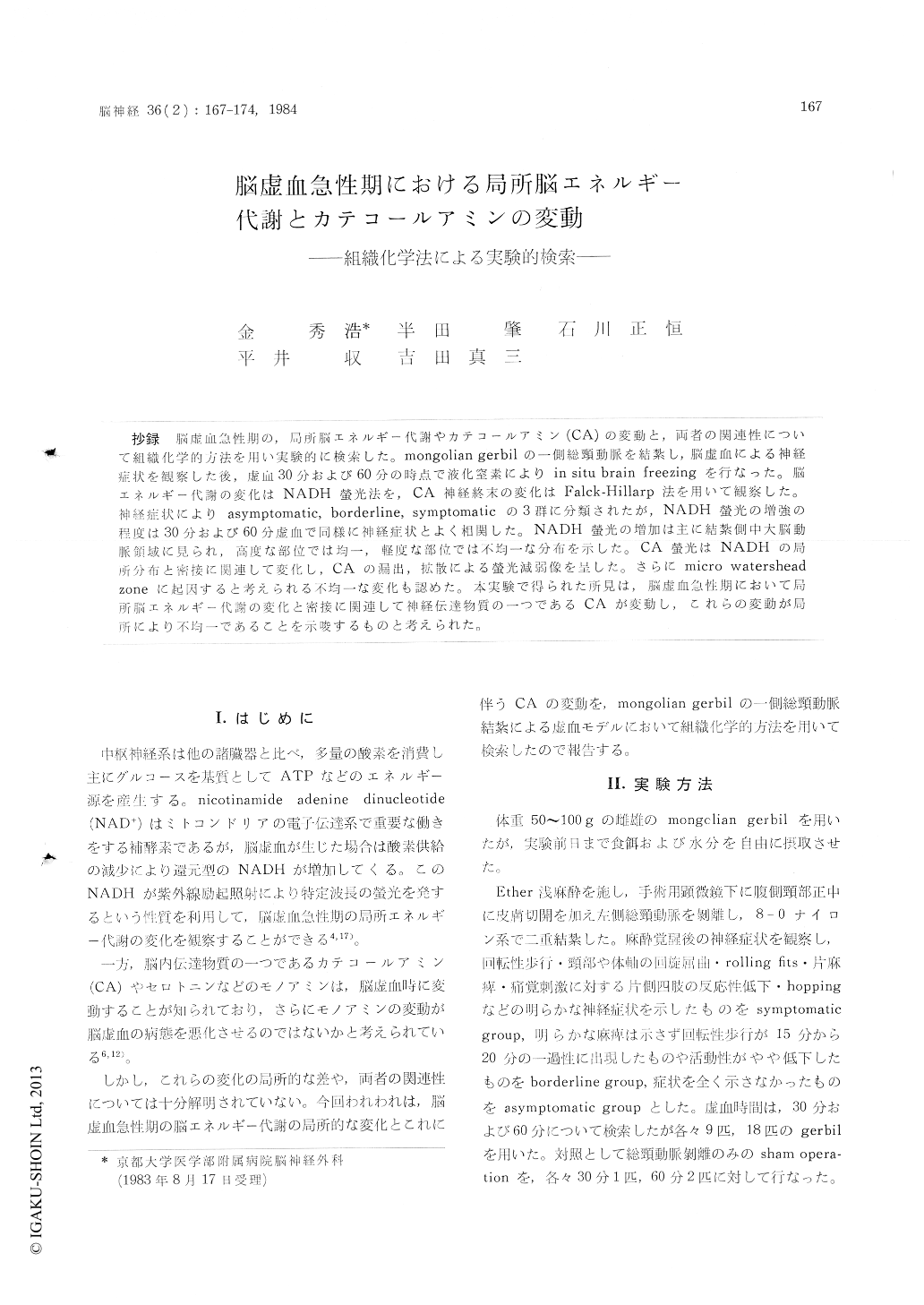
抄録 脳虚血急性期の,局所脳エネルギー代謝やカテコールアミン(CA)の変動と、両者の関連性について組織化学的方法を用い実験的に検索した。mongolian gerbilの一側総頸動脈を結紮し,脳虚血による神経症状を観察した後,虚血30分および60分の時点で液化窒素によりin situ brain freezingを行なった。脳エネルギー代謝の変化はNADH螢光法を,CA神経終末の変化はFalck-Hillarp法を用いて観察した。神経症状によりasymptomatic, borderline, symptomaticの3群に分類されたが,NADH螢光の増強の程度は30分および60分虚血で同様に神経症状とよく相関した。NADH螢光の増加は主に結紮側中大脳動脈領域に見られ,高度な部位では均一,軽度な部位では不均一な分布を示した。CA螢光はNADHの局所分布と密接に関連して変化し,CAの漏出,拡散による螢光減弱像を呈した。さらにmicro watersheadzoneに起因すると考えられる不均一な変化も認めた。本実験で得られた所見は,脳虚血急性期において局所脳エネルギー代謝の変化と密接に関連して神経伝達物質の一つであるCAが変動し,これらの変動が局所により不均一であることを示唆するものと考えられた。
Ischemic change of cerebral energy metabolism and catecholamine have already been discussed largely using biochemical quantitative assay. How-ever, regional change and their correlation are not well understood. In the present study, the ischemic regional change of cerebral energy meta-bolism and catecholamine were investigated in gerbils with histochemical method.
Adult either sex mongolian gerbils, weighing 50-100g, were anesthetized with ether and the left carotid artery was ligated. After observation of clinical symptoms, the brain was frozen in situ by pouring liquid N2 after 30 min and 60 min of ischemic insult. The frozen brain was sectioned with precooled saw in the corona] plane. The brain section were placed in liquid N2 bath and illuminated with 366 nm light (UV) from a 200 watt merculy lamp and Corning filter 5840. NADI-I fluorescence was recorded photographycally through Corning filter 3387 and 5562. Also UV reflectance was recorded through Corning filter 5840 to observe quenching effect of hemoglobin. Regional change of catecholamine was observed in the same frozen brain processed with Falck-Hillarp method.
According to neurological abnormalities follow-ing left carotid ligation, animals were divided into three groups ; symptomatic, borderline and asymptomatic.
The intensity and distribution of tissue NADH fluorescence were closely correlated to the clinical symptoms. In the symptomatic group, both in 30 min and 60 min of ischemia, homogenously and markedly increased fluorescence was observed in the ipsilateral temporal cortex, caudate nucleus, hypothalamus and dorsolateral thalamus. Columnar mild increase of NADH fluorescence was seen in the ipsilateral parietal cortex. In borderline group, the mild and inhomogenous increase were scat-terd in the ipsilateral caudate nucleus, while in the parietal cortex, columnar increase was noted. Mild or minimal increase of fluorescence was seen in the contralateral parietal and temporal cortex, hippocampus and thalamus in some cases of both 30 min and 60 min of ischemia. No increase was observed in asymptomatic group and sham opera-tion.
The intensity of green fluorescence of catecho-lamine nerve terminals were closely correlated to the change of the distribution and the intensity of NADH fluorescence. Diffuse green fluorescence of dopamine was decreased in the ipsilateral cau-date nucleus, where NADH was increased, in symptomatic group. Glia, myelinated fibers in the caudate nucleus and white matter became fluores-cent, which were normally non-fluorescent, and these findings seemed to derive from extraneuronal leakage and diffusion of dopamine from nerve terminals. Varicose green fluorescence of noradre-naline terminals showed mild decrease in the ipsi-lateral hypothalamus. These change were more ap-patent in 60 min of ischemia than 30 min of ische-mia. In borderline group, dopamine fluorescence reduced inhomogenously in the ipsilateral caudate nucleus where NADH fluorescence was increased mildly and inhomogenously. Preservation of dopa-mine around the thick-walled vessels was noted in contrast to decrease of dopamine around the thin-walled vessels, which may indicate the pre-sence of micro-watershead zone on the metabolic aspect.
Thus, regional change of energy state and cate-cholamine metabolism are well correlated. Micro-heterogeneity of dopamine in the early stage of cerebral ischemia may indicate importance of arte-riole as an nutrient vessel.
Copyright © 1984, Igaku-Shoin Ltd. All rights reserved.