Japanese
English
- 有料閲覧
PPV購入案内
1,320円 (1,200円+税10%) こちらは、399ページから406ページの文献です。購入には医書.jp本会員登録が必要です。
会員登録完了後に改めて上記「購入サイトへ」を選択してください。
または「購入サイトへ」選択後に「購入ログイン」、「新規会員登録」の順に進んでください。
会員登録について詳しくはをご確認ください。
- Abstract 文献概要
- 1ページ目 Look Inside
I.はじめに
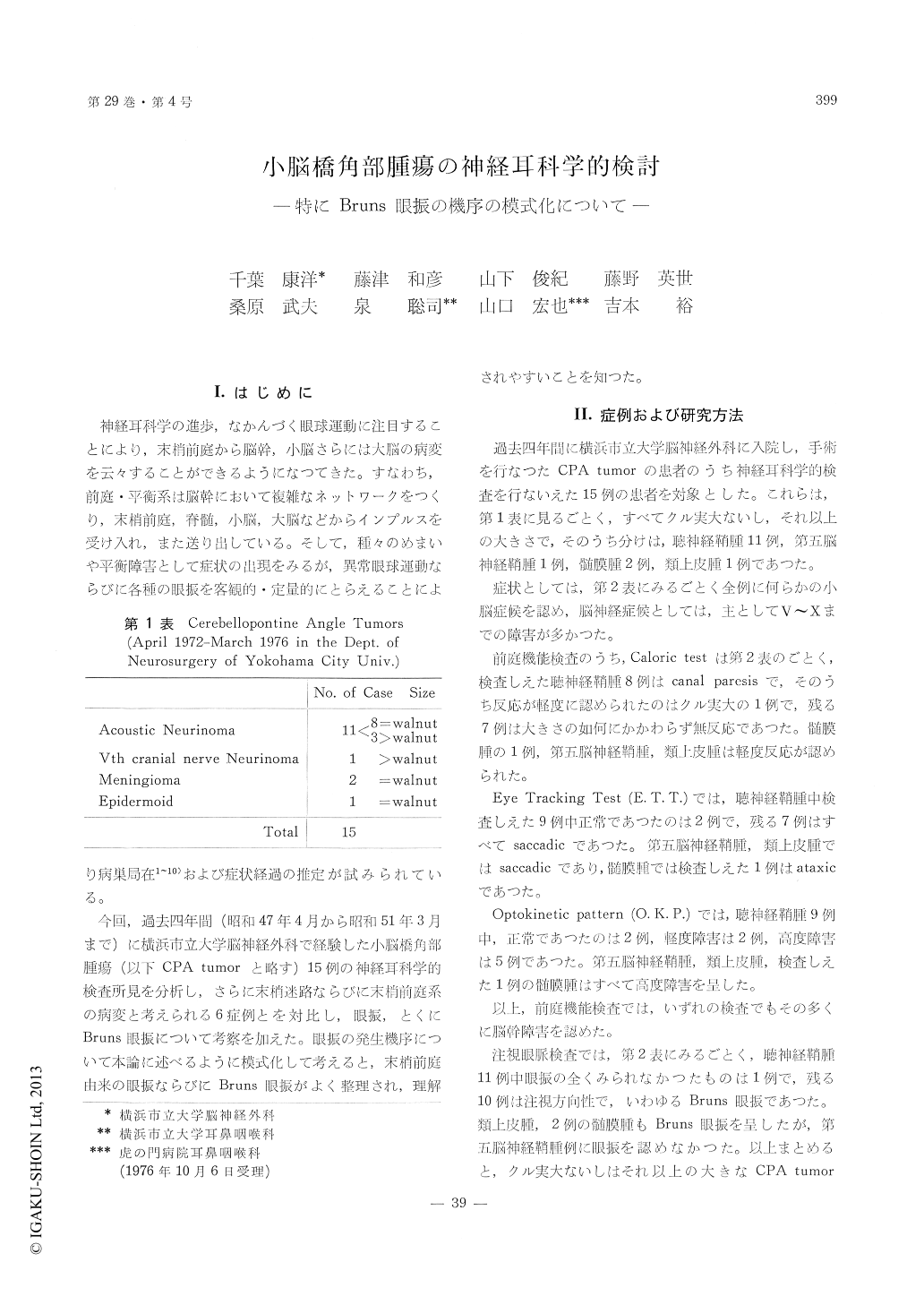
神経耳科学の進歩,なかんづく眼球運動に注目することにより,末梢前庭から脳幹,小脳さらには大脳の病変を云々することができるようになつてきた。すなわち,前庭・平衡系は脳幹において複雑なネットワークをつくり,末梢前庭,脊髄,小脳,大脳などからインプルスを受け入れ,また送り出している。そして,種々のめまいや平衡障害として症状の出現をみるが,異常眼球運動ならびに各種の眼振を客観的・定量的にとらえることにより病巣局在1〜10)および症状経過の推定が試みられている。
今回,過去四年間(昭和47年4月から昭和51年3月まで)に横浜市立大学脳神経外科で経験した小脳橋角部腫瘍(以下CPA tumorと略す)15例の神経耳科学的検査所見を分析し,さらに末梢迷路ならびに末梢前庭系の病変と考えられる6症例とを対比し,眼振,とくにBruns眼振について考察を加えた。眼振の発生機序について本論に述べるように模式化して考えると,末梢前庭由来の眼振ならびにBruns眼振がよく整理され,理解されやすいことを知つた。
Recent advances in neurotological studies made possible to determine the site of lesion either from peripheral vestibular, brain stem, cerebellar or cerebral region by careful examinations of ocular movements.
Authors investigated the pattern of nystagmus in fifteen cerebellopontine angle tumors (CPA tumors) and acute stage of six peripheral vestibular or labyrinth lesions during four years (from April 1972 to March 1976). Fifteen CPA tumors included eleven acoustic neurinomas, a trigeminal neurinoma, two meningiomas and an epidermoid tumor. Size of these CPA tumors was that of walnut or bigger.
The neurotological studies in most of fifteen CPA tumors also revealed the finding of brain stem lesions. Thirteen out of fifteen patients with CPA tumor were demonstrated Bruns nystagmus during lateral gaze: Bruns nystagmus was a coarse slow nystagmus and was elicited when a patient looked toward the site of lesion and a more fine rapid nystagmus when looked toward the opposite side. Three out of thirteen patients with CPA tumors (23.1%) demonstrated reversed Bruns nystagmus, which was a coarse slow nystagmus looking toward the opposite side and a more fine rapid nystagmus looking toward the side of lesion.
The developmental mechanism of Bruns nystag-mus was explained by the balance, shown in figures, which was controlled by two kinds of action. One was the action of vestibular organ. The other was the action of the central parts of the oculomotor system containing of paramedian pontine reticular formation (PPRF). PPRF was seemed to have an important role of the development of Bruns nystag-mus.
Copyright © 1977, Igaku-Shoin Ltd. All rights reserved.