Japanese
English
- 有料閲覧
PPV購入案内
1,320円 (1,200円+税10%) こちらは、1213ページから1221ページの文献です。購入には医書.jp本会員登録が必要です。
会員登録完了後に改めて上記「購入サイトへ」を選択してください。
または「購入サイトへ」選択後に「購入ログイン」、「新規会員登録」の順に進んでください。
会員登録について詳しくはをご確認ください。
- Abstract 文献概要
- 1ページ目 Look Inside
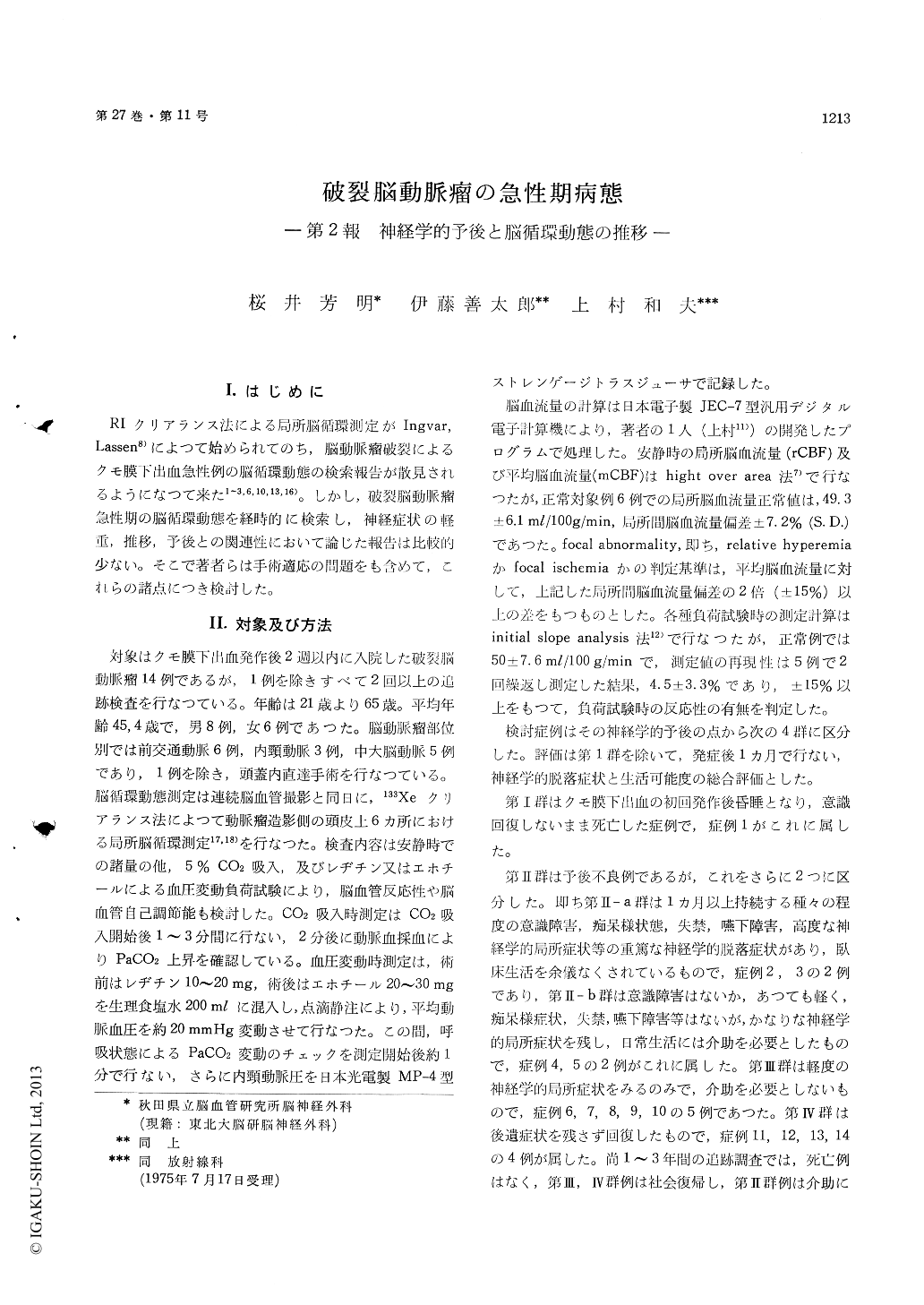
I.はじめに
RIクリアランス法による局所脳循環測定がIngvar,Lassen8)によつて始められてのち,脳動脈瘤破裂によるクモ膜下出血急性例の脳循環動態の検索報告が散見されるようになつて来た1〜3,6,10,13,16)。しかし,破裂脳動脈瘤急性期の脳循環動態を経時的に検索し,神経症状の軽重,推移,予後との関連性において論じた報告は比較的少ない。そこで著者らは手術適応の問題をも含めて,これらの諸点につき検討した。
Relationships between cerebral blood fiow (CBF)dynamics and neurological deficits were studied in14 patients with subarachnoid hemorrhage due toruptured intracranial aneurysm.
CBF in acute stage of the subjects was examinedby 133Xe clearance method using a 6 channel detectorunit. Mean hemispheric CBF, regional CBF, vascularresponse for hypercapnea and function of auto-regulation was evaluated in reference to neurologicalsymptoms.
The sites of their ruptured aneurysms wereanterior communicating artery in 6 cases, internalcarotid artery in 3, and middle cerebral artery in5. In thirteen cases of them, intracranial directoperations were performed.
The materials could be devided into 4 groupswith 2 subgroups by their neurological prognosis.Group I was a severe case, who was died soonafter bleeding. Mean CBF of the case was 20.6 ml/100g/min. with diffuse ischemia.
Group II was cases with poor prognosis. Further-more, this group was devided into 2 subgroups(group II-a, and group II-b). The prognosis ofgroup II-a was evaluated as severe neurologicaldeficit and vegetative state in chronic stage, butpatients belonging to group II-b were resulted tosevere neurological deficit without vegetative state.
In group II-a, the CBF pattern showed "globalluxury perfusion" in acute state, followed bycontinous vasomotor paralysis and diffuse ischemiain chronic stage. In group II-b, "global luxuryperfusion" and chronic diffuse ischemia was notrecognized, but vasomotor paralysis persisted longtime.
Group III left slight neurological deficit, but groupIV had not any neurological abnormality. Thevalues of the mean CBF of group III and IV werealmost normal. In group III and IV, vasomotorparalysis was milder than group II. The differenceof hemodynamics in these two groups were severityand recovery pattern of focal abnormality andvascular response.
"Global luxury perfusion", which was frequentlyobserved in acute stage of the group II-a cases,was note worthy. It was discussed in the con-nection with severe brain damage and risk of re-rupture of the aneurysm.
From the clinical view points described above, itshould be apparent that the neurologinal prognosishas a close relation to sequential changes of CBFdynamics in acute stage patients with rupturedintracranial aneurysms. Furthermore, sequentialobservations of CBF dynamics shoud be needed todetermine the optimum timing and selection ofdirect operation from ruptured intracranial an-eurysms in acute stage.
Copyright © 1975, Igaku-Shoin Ltd. All rights reserved.