Japanese
English
- 有料閲覧
PPV購入案内
1,320円 (1,200円+税10%) こちらは、853ページから860ページの文献です。購入には医書.jp本会員登録が必要です。
会員登録完了後に改めて上記「購入サイトへ」を選択してください。
または「購入サイトへ」選択後に「購入ログイン」、「新規会員登録」の順に進んでください。
会員登録について詳しくはをご確認ください。
- Abstract 文献概要
- 1ページ目 Look Inside
- サイト内被引用 Cited by
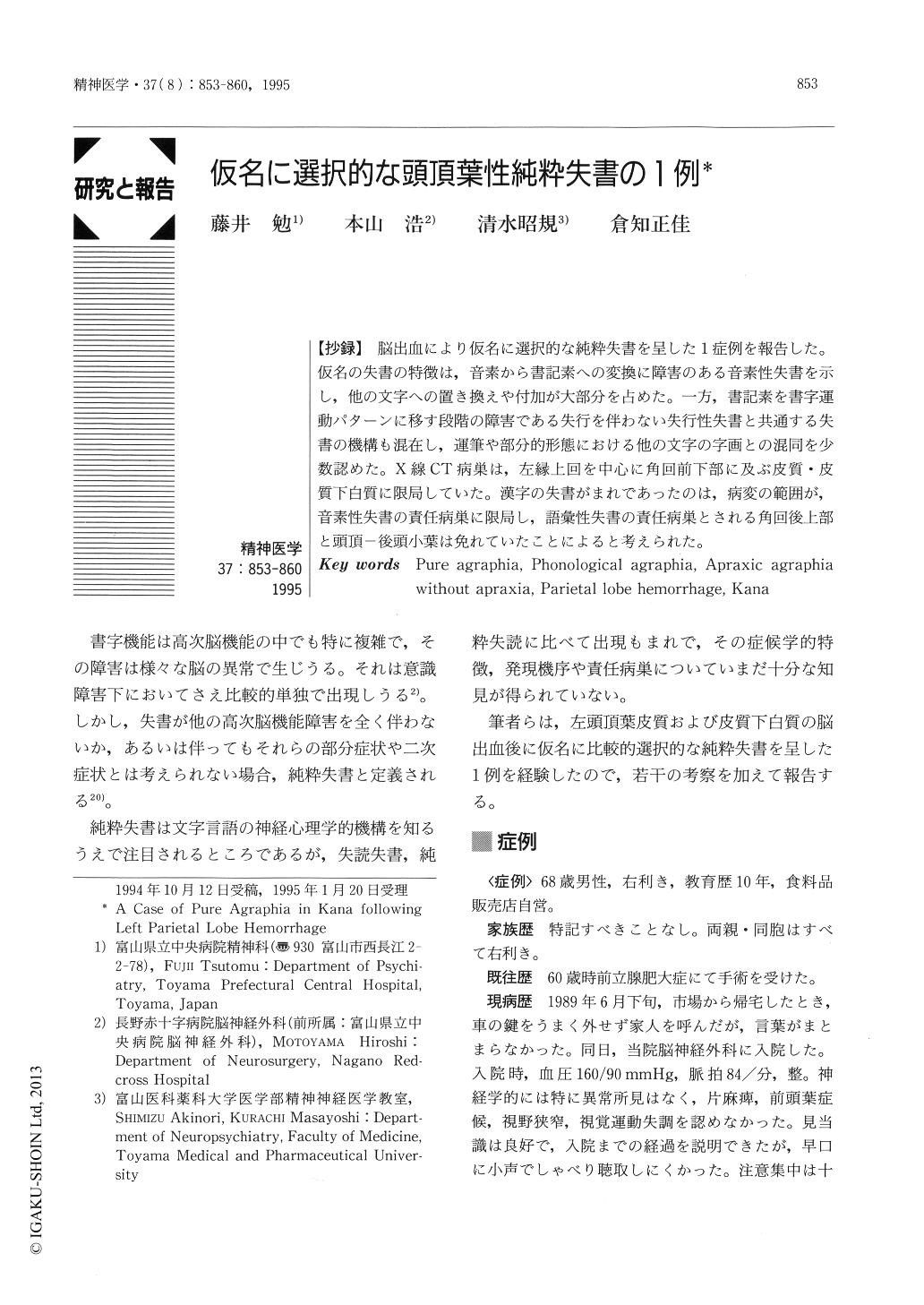
【抄録】脳出血により仮名に選択的な純粋失書を呈した1症例を報告した。仮名の失書の特徴は,音素から書記素への変換に障害のある音素性失書を示し,他の文字への置き換えや付加が大部分を占めた。一方,書記素を書字運動パターンに移す段階の障害である失行を伴わない失行性失書と共通する失書の機構も混在し,運筆や部分的形態における他の文字の字画との混同を少数認めた。X線CT病巣は,左縁上回を中心に角回前下部に及ぶ皮質・皮質下白質に限局していた。漢字の失書がまれであったのは,病変の範囲が,音素性失書の責任病巣に限局し,語彙性失書の責任病巣とされる角回後上部と頭頂一後頭小葉は免れていたことによると考えられた。
A case of pure agraphia following left parietal lobe hemorrhage is reported. A 68-year-old right handed man was admitted on June 29, 1989, because of sudden incoherent speech. Several days after onset, his consciousness disturbance was cleared and neurological examination showed no abnormality.
His intelligence and memory were fully preserved. Neither apraxia nor agnosia was present. Spontaneous speech, naming, repetition, and oral comprehension were not impaired. Reading comprehension and reading aloud were also well preserved. Difficulty was seen only in writing spontaneously and writing to dictation with both hands, whereas impairment in copying was not observed.
He made errors selectively in kana-writing (kana characters are phonetic symbols for syllables), and rarely in kanji-writing (kanji characters are essentially non-phonetic logographic symbols). The majority of his writing errors consisted of substitution for another letter and insertion of an unsuitable letter into correct letter strings. Word construction with kana-letter cards was correctly performed. These findings are of the nature of phonological agraphia, in which phoneme-grapheme conversion is disturbed. On the other hand, his handwriting movement was not always smooth and he was confused about the pen-strokes in kana letters which resemble each other in form. These findings suggest that our patient has potentially the same dysfunction as apraxic agraphia, without apraxia which is characterized by the production of illegibly formed graphemes. CT lesion in our case was localized in the supramarginal gyrus, the anteroinferior portion of which is an important anatomical sub-strate for phonological agraphia, and the anterior angular gyrus, while the posterior angular gyrus and parietooccipital lobule, an important anatomical substrate for lexical agraphia, were spared.
Copyright © 1995, Igaku-Shoin Ltd. All rights reserved.