Japanese
English
- 有料閲覧
PPV購入案内
1,320円 (1,200円+税10%) こちらは、105ページから111ページの文献です。購入には医書.jp本会員登録が必要です。
会員登録完了後に改めて上記「購入サイトへ」を選択してください。
または「購入サイトへ」選択後に「購入ログイン」、「新規会員登録」の順に進んでください。
会員登録について詳しくはをご確認ください。
- Abstract 文献概要
- 1ページ目 Look Inside
- 参考文献 Reference
- サイト内被引用 Cited by
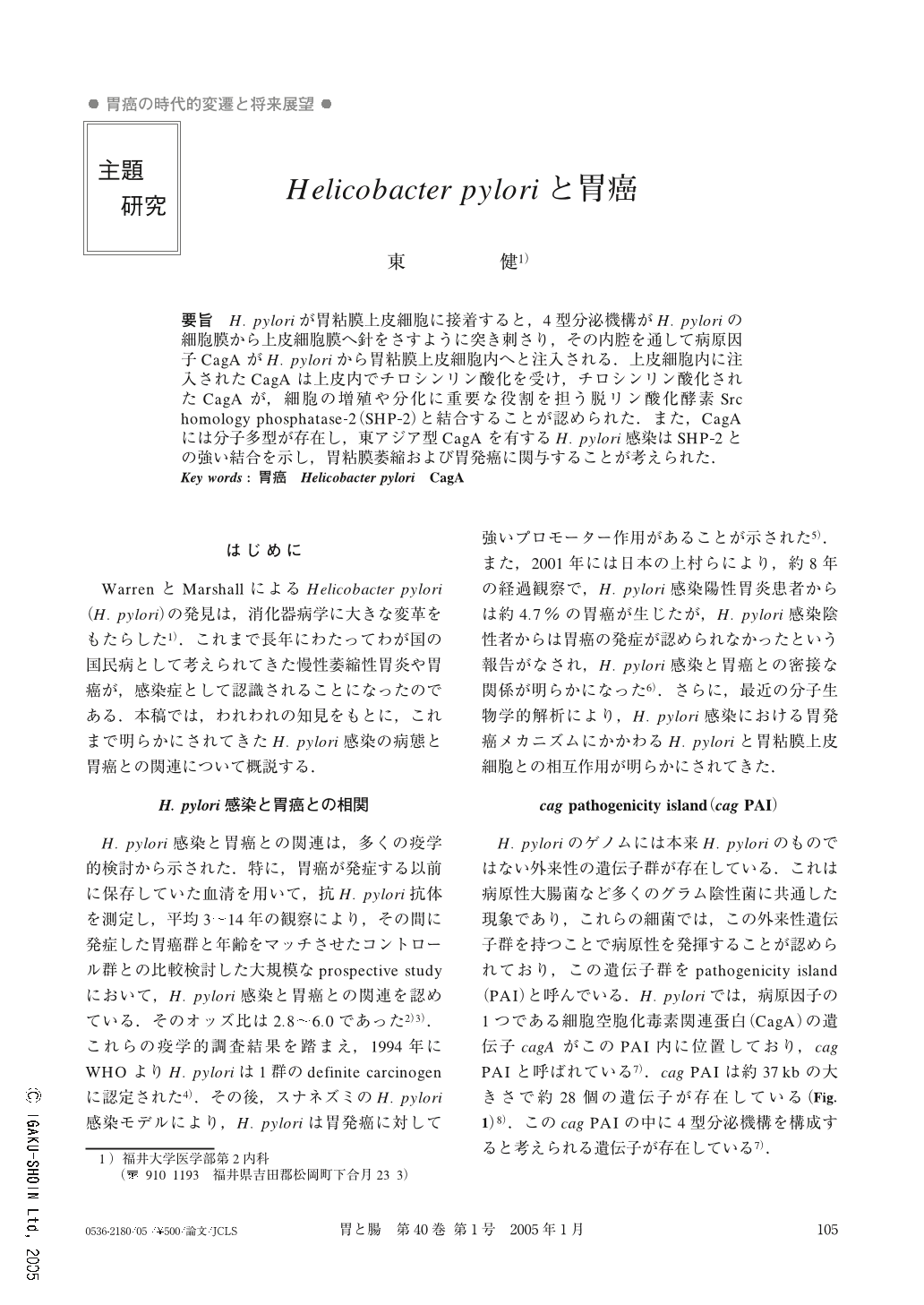
要旨 H.pyloriが胃粘膜上皮細胞に接着すると,4型分泌機構がH.pyloriの細胞膜から上皮細胞膜へ針をさすように突き刺さり,その内腔を通して病原因子CagAがH.pyloriから胃粘膜上皮細胞内へと注入される.上皮細胞内に注入されたCagAは上皮内でチロシンリン酸化を受け,チロシンリン酸化されたCagAが,細胞の増殖や分化に重要な役割を担う脱リン酸化酵素Srchomology phosphatase-2(SHP-2)と結合することが認められた.また,CagAには分子多型が存在し,東アジア型CagAを有するH.pylori感染はSHP-2との強い結合を示し,胃粘膜萎縮および胃発癌に関与することが考えられた.
Recent molecular analysis has revealed the pathological actions of CagA on gastric epithelial cells. CagA is injected into epithelial cells via the type IV secretion system and undergoes tyrosine phosphorylation in the cells. In addition, translocated CagA forms a physical complex with SHP-2. There are two major CagA subtypes ; the East Asian and the Western type. The East Asian CagA protein possesses stronger SHP-2 binding activity than the Western CagA. The grades of inflammation, activity of gastritis, and atrophy are significantly higher in gastritis patients infected with the East Asian CagA-positive strain than in gastritis patients infected with the cagA-negative or Western CagA-positive strains. The prevalence of the East Asian CagA-positive strain is associated with the mortality rate amongst patient of gastric cancer in Asia. These findings suggest that infection of East Asian CagA-positive H. pylori infection is substantially associated with atrophic gastritis and gastric cancer, and that persistent active inflammation induced by the East Asian CagA-positive strain, which possesses stronger SHP-2 binding activity than the Western type, may play a role in the pathogenesis of atrophic gastritis and gastric cancer.
Copyright © 2005, Igaku-Shoin Ltd. All rights reserved.