Japanese
English
- 有料閲覧
PPV購入案内
2,200円 (2,000円+税10%) こちらは、1063ページから1074ページの文献です。購入には医書.jp本会員登録が必要です。
会員登録完了後に改めて上記「購入サイトへ」を選択してください。
または「購入サイトへ」選択後に「購入ログイン」、「新規会員登録」の順に進んでください。
会員登録について詳しくはをご確認ください。
- Abstract 文献概要
- 1ページ目 Look Inside
- 参考文献 Reference
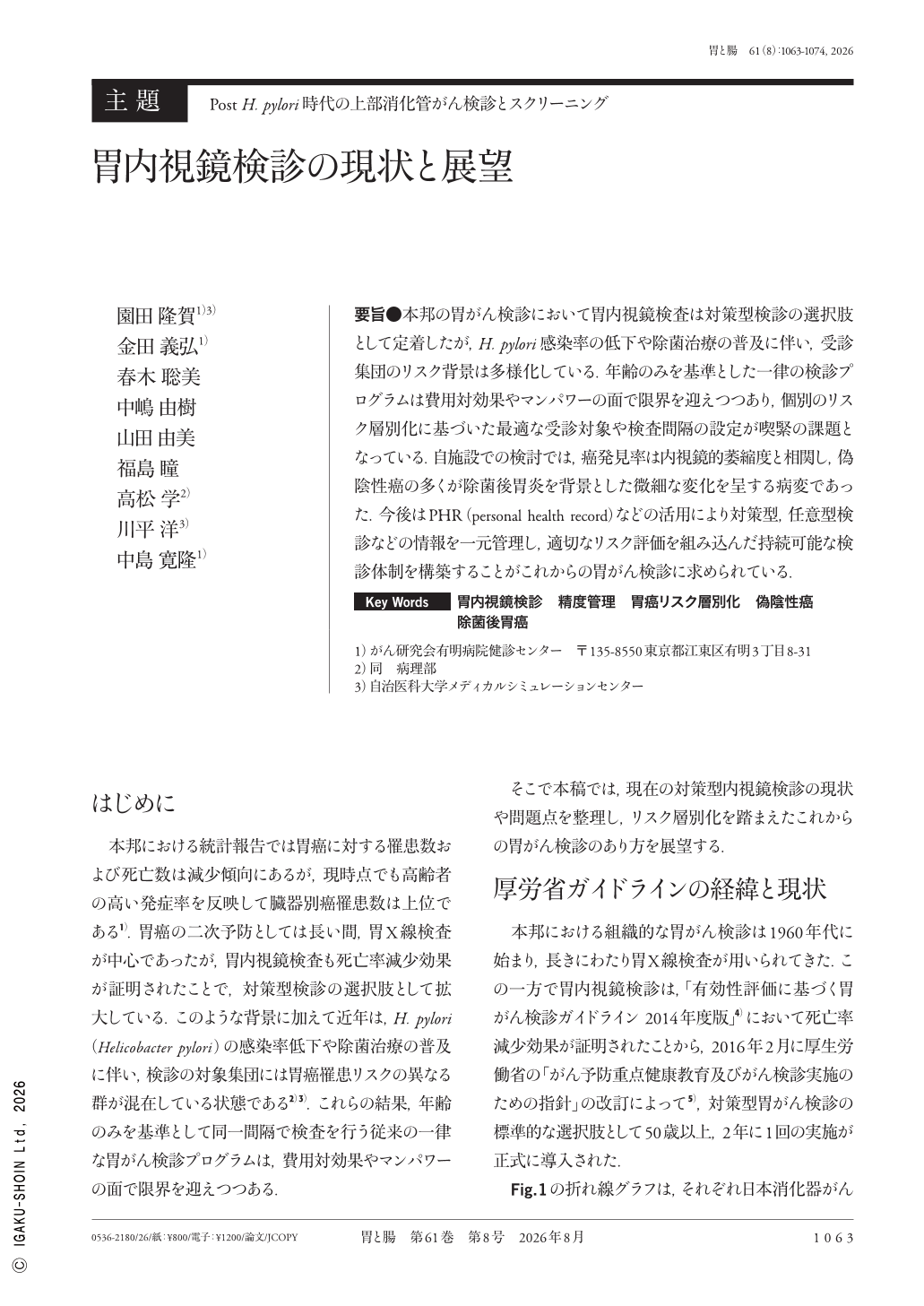
要旨●本邦の胃がん検診において胃内視鏡検査は対策型検診の選択肢として定着したが,H. pylori感染率の低下や除菌治療の普及に伴い,受診集団のリスク背景は多様化している.年齢のみを基準とした一律の検診プログラムは費用対効果やマンパワーの面で限界を迎えつつあり,個別のリスク層別化に基づいた最適な受診対象や検査間隔の設定が喫緊の課題となっている.自施設での検討では,癌発見率は内視鏡的萎縮度と相関し,偽陰性癌の多くが除菌後胃炎を背景とした微細な変化を呈する病変であった.今後はPHR(personal health record)などの活用により対策型,任意型検診などの情報を一元管理し,適切なリスク評価を組み込んだ持続可能な検診体制を構築することがこれからの胃がん検診に求められている.
In Japan, gastric endoscopy has been established as a standard modality for population-based screening of gastric cancer. However, the risk profile of the screened population is becoming increasingly diverse due to the decreasing prevalence of Helicobacter pylori infection and the widespread use of eradication therapy. Currently, uniform, age-based screening programs are facing limitations in clinical efficiency. Consequently, the development of optimal target populations and screening intervals based on individual risk stratification has emerged as an urgent priority.
Our institutional study demonstrated that cancer detection rates are correlated with the severity of endoscopic gastric atrophy. Notably, most false-negative cases involved lesions exhibiting subtle changes associated with post-eradication gastritis. Future gastric cancer screening should incorporate centralized data management systems using personal health records and similar platforms to establish sustainable screening programs that integrate appropriate risk assessment.
Copyright © 2026, Igaku-Shoin Ltd. All rights reserved.