Japanese
English
- 有料閲覧
- Abstract 文献概要
- 1ページ目 Look Inside
- 参考文献 Reference
はじめに
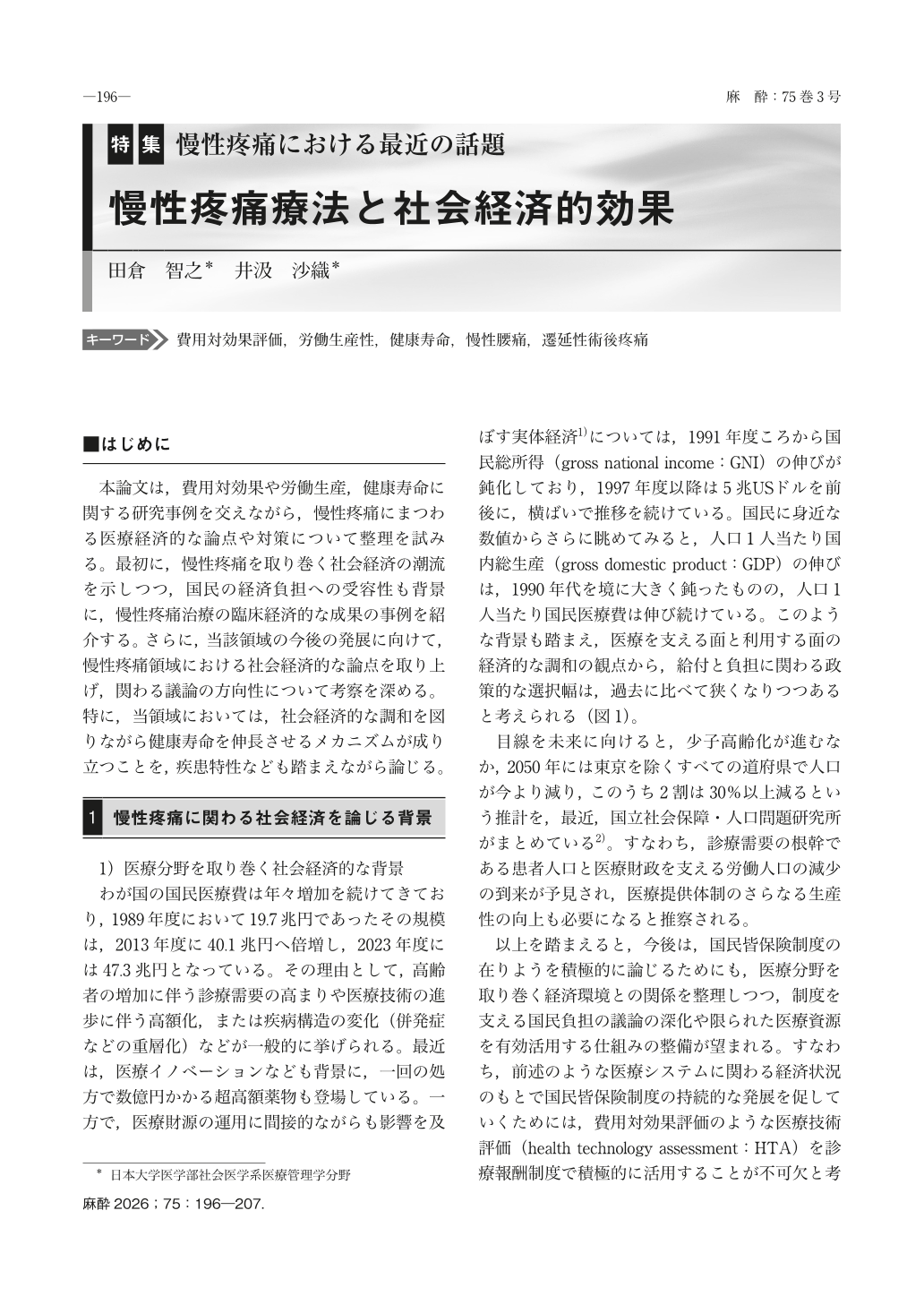
本論文は,費用対効果や労働生産,健康寿命に関する研究事例を交えながら,慢性疼痛にまつわる医療経済的な論点や対策について整理を試みる。最初に,慢性疼痛を取り巻く社会経済の潮流を示しつつ,国民の経済負担への受容性も背景に,慢性疼痛治療の臨床経済的な成果の事例を紹介する。さらに,当該領域の今後の発展に向けて,慢性疼痛領域における社会経済的な論点を取り上げ,関わる議論の方向性について考察を深める。特に,当領域においては,社会経済的な調和を図りながら健康寿命を伸長させるメカニズムが成り立つことを,疾患特性なども踏まえながら論じる。
This paper aims to elucidate key health economic challenges and strategic responses related to chronic pain, with a particular focus on case studies addressing cost-effectiveness, labor productivity, and healthy life expectancy. In Japan, the annual economic loss in labor productivity that is attributable to chronic pain is conservatively estimated at 2.27 trillion JPY. By contrast, annual public medical expenditures associated with all pain-related care, including chronic pain, have been reported to amount to 1.12 trillion JPY. An annual allocation of approx. 2 trillion JPY in new public medical spending to address the labor productivity losses associated with chronic pain in Japan could be considered a strategic public investment in pain management. According to a cost-effectiveness analysis using utility values, medical expenditures aimed at improving healthy life expectancy in individuals with chronic pain fall within a range that is considered economically acceptable from a national household perspective, and these expenditures may be offset by benefits such as increased productivity. These findings suggest that a mechanism for extending healthy lifespans while achieving socioeconomic harmony is possible. Looking ahead, improving the medical environment-while carefully weighing the balance between benefits and burdens across the population-is essential to further alleviate the disease burden experienced by individuals with chronic pain.
Copyright © 2026 KOKUSEIDO CO., LTD. All Rights Reserved.