Japanese
English
- 有料閲覧
- Abstract 文献概要
- 1ページ目 Look Inside
- 参考文献 Reference
はじめに
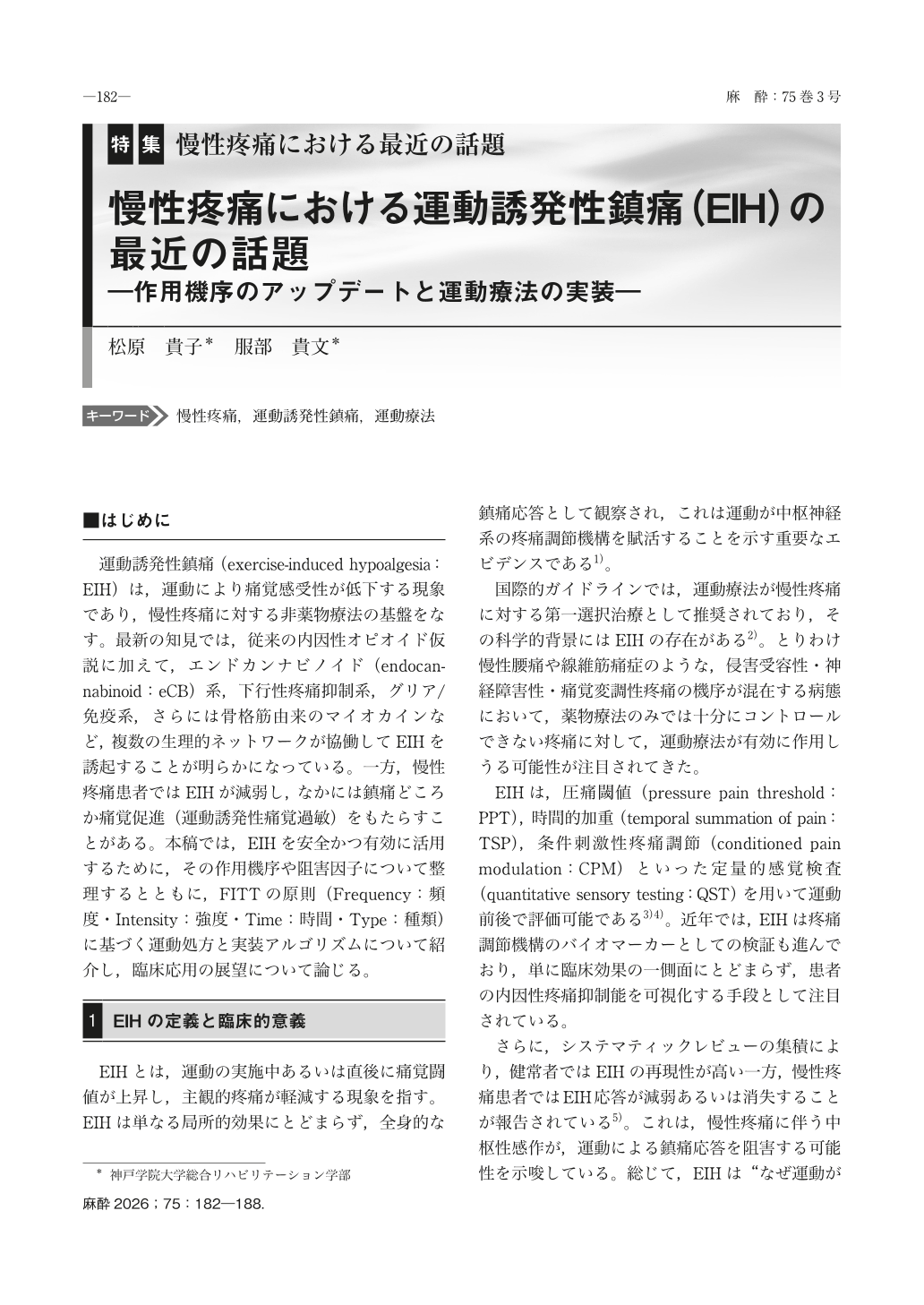
運動誘発性鎮痛(exercise-induced hypoalgesia:EIH)は,運動により痛覚感受性が低下する現象であり,慢性疼痛に対する非薬物療法の基盤をなす。最新の知見では,従来の内因性オピオイド仮説に加えて,エンドカンナビノイド(endocannabinoid:eCB)系,下行性疼痛抑制系,グリア/免疫系,さらには骨格筋由来のマイオカインなど,複数の生理的ネットワークが協働してEIHを誘起することが明らかになっている。一方,慢性疼痛患者ではEIHが減弱し,なかには鎮痛どころか痛覚促進(運動誘発性痛覚過敏)をもたらすことがある。本稿では,EIHを安全かつ有効に活用するために,その作用機序や阻害因子について整理するとともに,FITTの原則(Frequency:頻度・Intensity:強度・Time:時間・Type:種類)に基づく運動処方と実装アルゴリズムについて紹介し,臨床応用の展望について論じる。
Exercise-induced hypoalgesia(EIH), defined as reduced pain sensitivity during or following physical exercise, represents a core mechanism supporting exercise therapy as a first-line intervention for chronic pain. Recent advances have demonstrated that EIH arises from a multilayered network involving not only endogenous opioids but also mesocorticolimbic reward circuits, endocannabinoid signaling, descending pain inhibitory pathways, neuroimmune interactions, and skeletal muscle-derived myokines. However, EIH responses are frequently diminished or even paradoxically reversed in patients with chronic pain, reflecting impaired conditioned pain modulation(CPM), a facilitated temporal summation of pain(TSP), a reduced muscle mass, and/or psychosocial barriers such as catastrophizing and diminished self-efficacy. Quantitative sensory testing(QST)that includes measurements of the patient’s pressure pain threshold(PPT), TSP, and CPM enables the objective assessment of EIH and has emerged as a candidate biomarker for endogenous analgesic capacity and treatment stratification. Clinically, structured exercise programs guided by the FITT principle(frequency, intensity, time, type)provide a structured framework for the safe and effective implementation of exercise. Low-to-moderate intensity aerobic and mind-body exercises are particularly beneficial. Individualized programs and gradual progression are essential to avoid exercise-induced hyperalgesia. A stepwise clinical algorithm integrating patients’ baseline QST profile, the identification of individual risk factors, lifestyle modifications, and an iterative adjustment of the exercise prescription enhances both safety and efficacy. Ultimately, EIH represents a bridge between basic pain mechanisms and clinical application, highlighting its value as both a mechanistic model and a therapeutic target in precision rehabilitation for chronic pain.
Copyright © 2026 KOKUSEIDO CO., LTD. All Rights Reserved.