Japanese
English
- 有料閲覧
- Abstract 文献概要
- 1ページ目 Look Inside
- 参考文献 Reference
はじめに
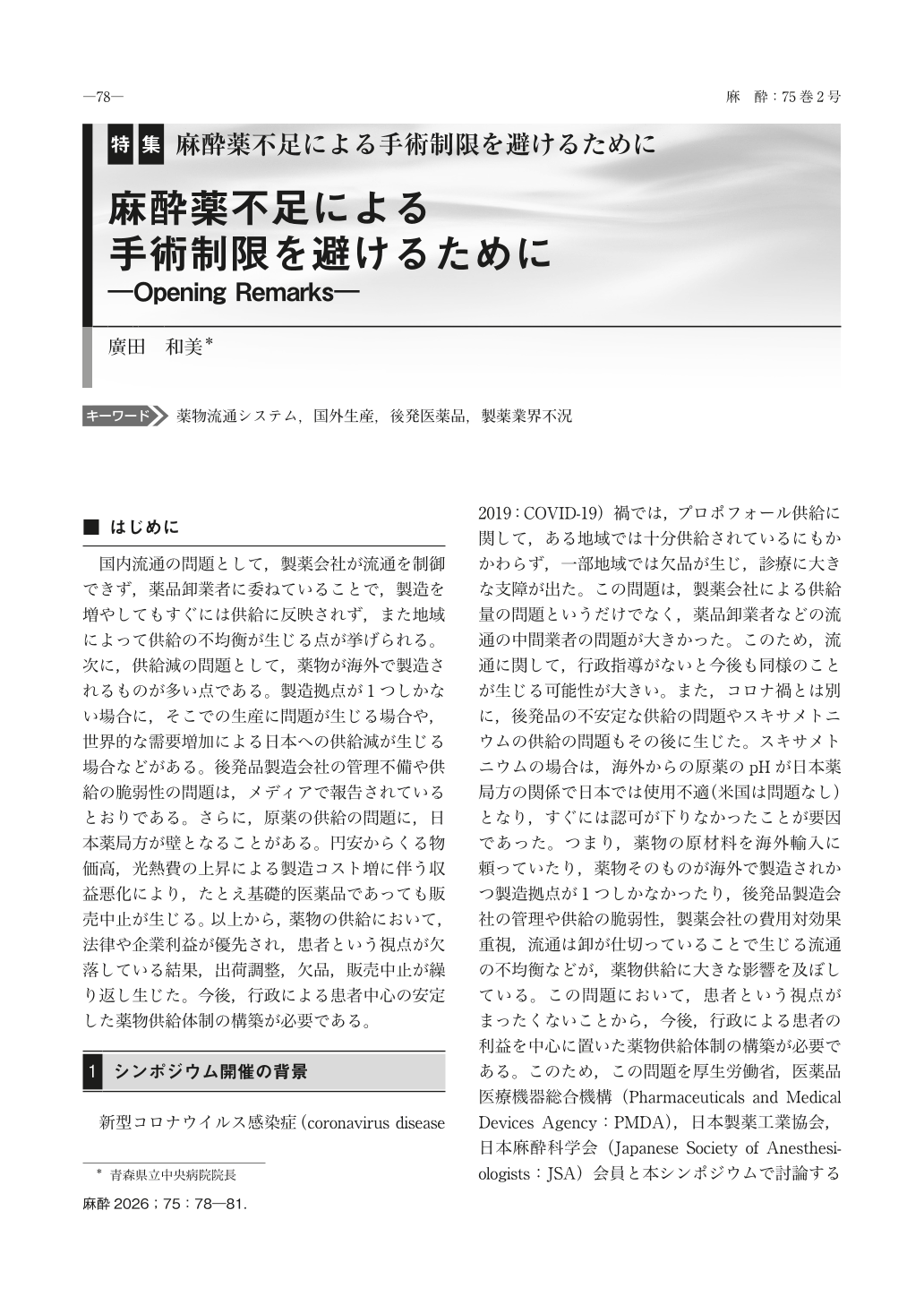
国内流通の問題として,製薬会社が流通を制御できず,薬品卸業者に委ねていることで,製造を増やしてもすぐには供給に反映されず,また地域によって供給の不均衡が生じる点が挙げられる。次に,供給減の問題として,薬物が海外で製造されるものが多い点である。製造拠点が1つしかない場合に,そこでの生産に問題が生じる場合や,世界的な需要増加による日本への供給減が生じる場合などがある。後発品製造会社の管理不備や供給の脆弱性の問題は,メディアで報告されているとおりである。さらに,原薬の供給の問題に,日本薬局方が壁となることがある。円安からくる物価高,光熱費の上昇による製造コスト増に伴う収益悪化により,たとえ基礎的医薬品であっても販売中止が生じる。以上から,薬物の供給において,法律や企業利益が優先され,患者という視点が欠落している結果,出荷調整,欠品,販売中止が繰り返し生じた。今後,行政による患者中心の安定した薬物供給体制の構築が必要である。
The causes of problems in the supply of anesthetic agents can be summarized as follows. Pharmaceutical companies have no control over the domestic distribution of anesthetics, as such distributions are handled by drug wholesalers. Thus, increased manufacturing of anesthetics is not immediately reflected in the supply, and a supply imbalance can then develop in different regions. A second problem is that many anesthetic drugs are manufactured outside of Japan, and this can lead to production problems at the manufacturer’s site(when there is only one manufacturing site)and/or a decrease in the anesthetic drugs’ supply to Japan due to an increase in global demand. Moreover, mismanagement and supply vulnerability have been documented among generic drug manufacturers, as reported in the media. The Japanese Pharmacopeia may also provide a barrier to the bulk-drug supply problem. Deterioration in profits due to higher prices resulting from the weak yen and increased manufacturing costs due to higher utility costs can result in the discontinuation of the sales of even basic pharmaceuticals listed by the World Health Organization. Due to the reasons described above, legal and corporate interests are prioritized in the supply of drugs without securing benefit to patients, resulting in repeated shipment adjustments, product shortages, and sales discontinuations. A stable patient-centered drug supply system established by the government is necessary.
Copyright © 2026 KOKUSEIDO CO., LTD. All Rights Reserved.