Japanese
English
- 有料閲覧
- Abstract 文献概要
- 1ページ目 Look Inside
- 参考文献 Reference
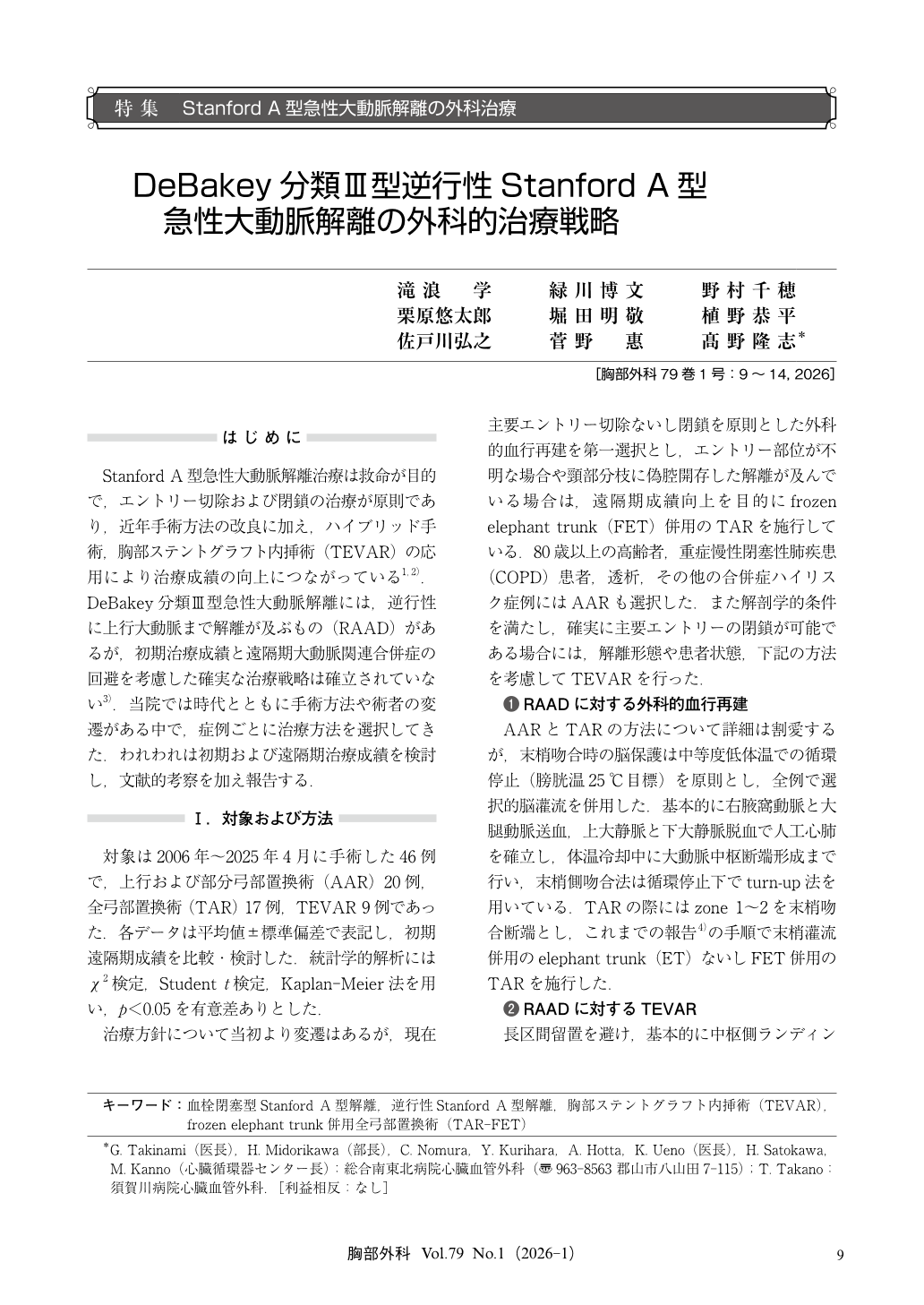
Stanford A型急性大動脈解離治療は救命が目的で,エントリー切除および閉鎖の治療が原則であり,近年手術方法の改良に加え,ハイブリッド手術,胸部ステントグラフト内挿術(TEVAR)の応用により治療成績の向上につながっている1,2).DeBakey分類Ⅲ型急性大動脈解離には,逆行性に上行大動脈まで解離が及ぶもの(RAAD)があるが,初期治療成績と遠隔期大動脈関連合併症の回避を考慮した確実な治療戦略は確立されていない3).当院では時代とともに手術方法や術者の変遷がある中で,症例ごとに治療方法を選択してきた.われわれは初期および遠隔期治療成績を検討し,文献的考察を加え報告する.
Objective:This study aimed to evaluate the outcomes of surgical strategies for DeBakey typeⅢ retrograde Stanford type A dissection (RAAD).
Methods:We retrospectively analyzed 46 patients with RAAD treated at our hospital. Surgical procedures included ascending aorta repair (AAR, n=20), total arch replacement (TAR, n=17), and thoracic endovascular aortic repair (TEVAR, n=9). Early and late outcomes were assessed.
Results:The AAR group had shorter operative times but a higher incidence of long-term aortic-related mortality. The TAR group showed no long-term aortic-related mortality but experienced early complications such as spinal ischemia. In the TEVAR group, several patients required early reintervention.
Conclusion:An individualized surgical strategy is essential for the management of RAAD. While secure entry closure may improve long-term outcomes, each approach carries specific risks. AAR and TEVAR remain appropriate options for selected cases.
© Nankodo Co., Ltd., 2026