Japanese
English
- 有料閲覧
- Abstract 文献概要
- 1ページ目 Look Inside
- 参考文献 Reference
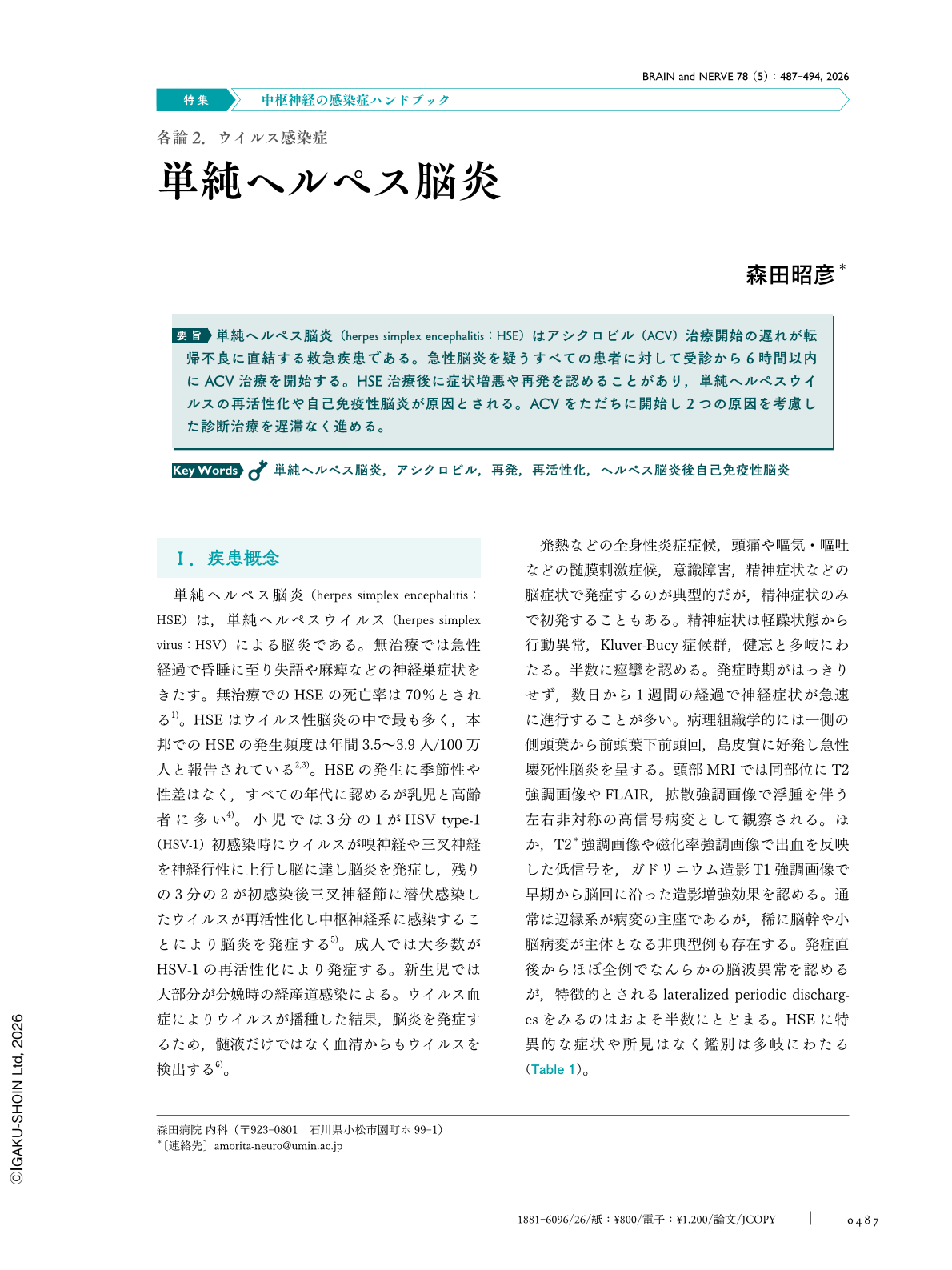
単純ヘルペス脳炎(herpes simplex encephalitis:HSE)はアシクロビル(ACV)治療開始の遅れが転帰不良に直結する救急疾患である。急性脳炎を疑うすべての患者に対して受診から6時間以内にACV治療を開始する。HSE治療後に症状増悪や再発を認めることがあり,単純ヘルペスウイルスの再活性化や自己免疫性脳炎が原因とされる。ACVをただちに開始し2つの原因を考慮した診断治療を遅滞なく進める。
Abstract
Herpes simplex encephalitis (HSE) is the most common cause of sporadic viral encephalitis and is associated with severe mortality and morbidity. No clinical features are pathognomonic for HSE. The gold standard for diagnosing HSE is a herpes simplex virus (HSV) DNA polymerase chain reaction (PCR) test on cerebrospinal fluid (CSF). Treatment with optimal intravenous aciclovir (ACV) can improve outcomes. After the first episode of HSE, neurological relapses or worsening of deficits occur in nearly 30% of patients. If the HSV DNA PCR on CSF is positive, the possibility of ACV-resistant HSE should be considered, and the addition of foscarnet to the ACV treatment may be warranted. If the HSV PCR in CSF is negative, autoimmune encephalitis (AE) post-HSE is considered. All patients with AE post-HSE are tested for one or more neuronal cell-surface and synaptic antibodies, primarily anti-N-methyl-d-aspartate receptor (NMDAR) antibodies, in serum or CSF. The clinical manifestations of AE post-HSE include choreoathetosis and seizures in children, while adults may experience altered consciousness and NMDAR-like symptoms. Most cases of AE post-HSE respond to first-line immunotherapies, which include corticosteroids, intravenous immunoglobulin or plasma exchange. If necessary, treatment can be escalated to second-line immunosuppressants such as rituximab and cyclophosphamide.
Copyright © 2026, Igaku-Shoin Ltd. All rights reserved.