Japanese
English
- 有料閲覧
- Abstract 文献概要
- 1ページ目 Look Inside
- 参考文献 Reference
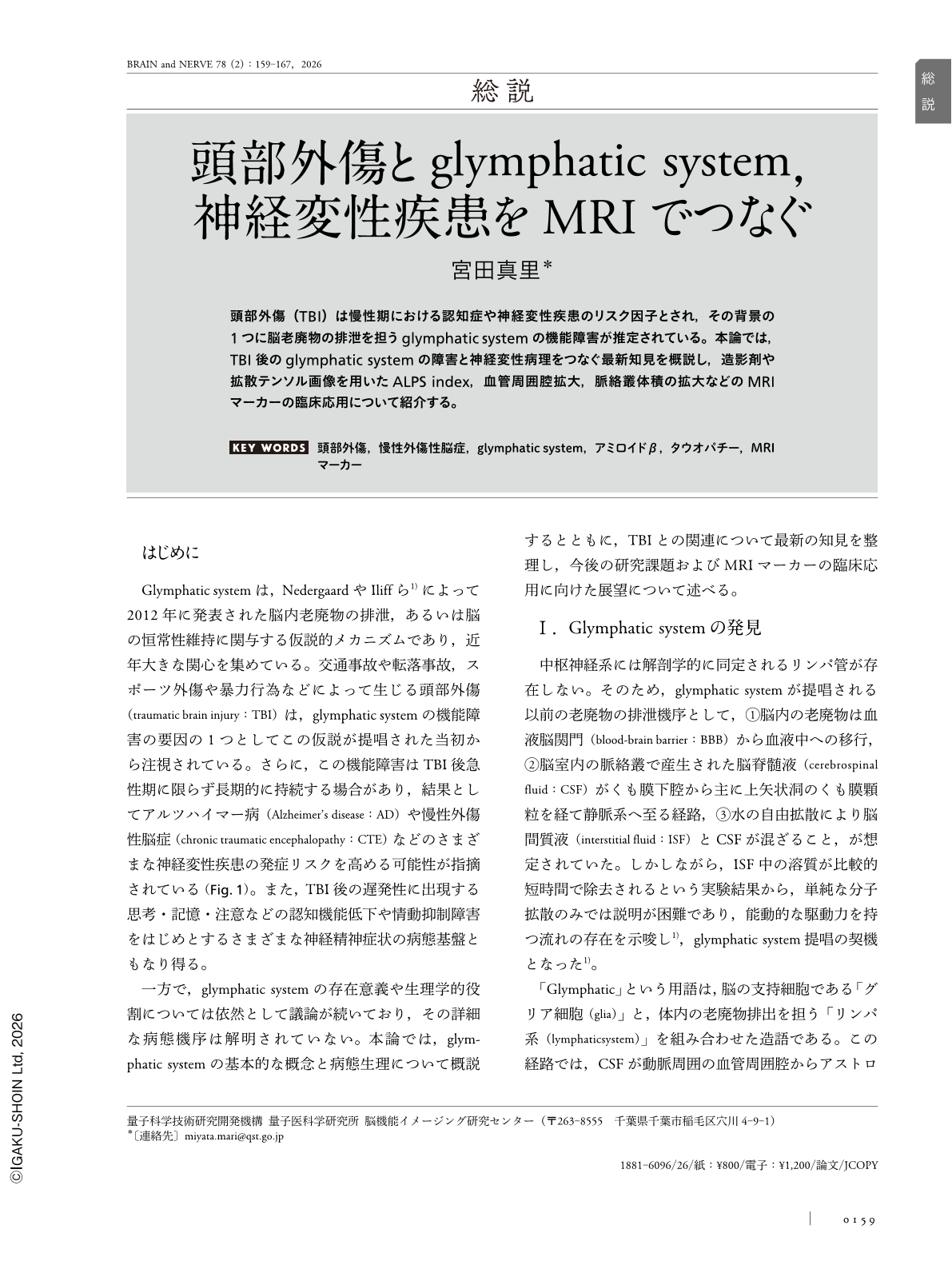
頭部外傷(TBI)は慢性期における認知症や神経変性疾患のリスク因子とされ,その背景の1つに脳老廃物の排泄を担うglymphatic systemの機能障害が推定されている。本論では,TBI後のglymphatic systemの障害と神経変性病理をつなぐ最新知見を概説し,造影剤や拡散テンソル画像を用いたALPS index,血管周囲腔拡大,脈絡叢体積の拡大などのMRIマーカーの臨床応用について紹介する。
Abstract
Traumatic brain injury (TBI) is a recognized risk factor for dementia and other neurodegenerative disorders in the chronic phase. Growing evidence indicates that dysfunction of the glymphatic system, which is a cerebrospinal fluid-driven waste-clearance pathway, may contribute to this association. Glymphatic dysfunction after TBI can promote the accumulation of pathogenic proteins, including amyloid-β and hyperphosphorylated tau, thereby accepting progressive neurodegeneration. This review synthesizes current knowledge on the link between TBI-induced glymphatic dysfunction and subsequent neurodegeneration. Particular emphasis is placed on recent advances in magnetic resonance imaging (MRI) that enable in vivo evaluation of glymphatic function and related structural changes. Key MRI approaches include contrast-enhanced including, diffusion tensor imaging-derived analysis along the perivascular space (ALPS) index, and volumetric evaluation of the enlarged perivascular spaces and the choroid plexus. These MRI biomarkers enable noninvasive measurement of glymphatic dysfunction and their potential contribution to neurodegenerative processes. By integrating evidence from preclinical models and clinical studies, this review highlights the role of glymphatic dysfunction in the link between TBI and neurodegeneration. This underscores the utility of MRI-based markers for early detection, mechanistic insight, and the development of targeted interventions for TBI-associated neurodegenerative disorders.
Copyright © 2026, Igaku-Shoin Ltd. All rights reserved.