Japanese
English
- 有料閲覧
- Abstract 文献概要
- 1ページ目 Look Inside
- 参考文献 Reference
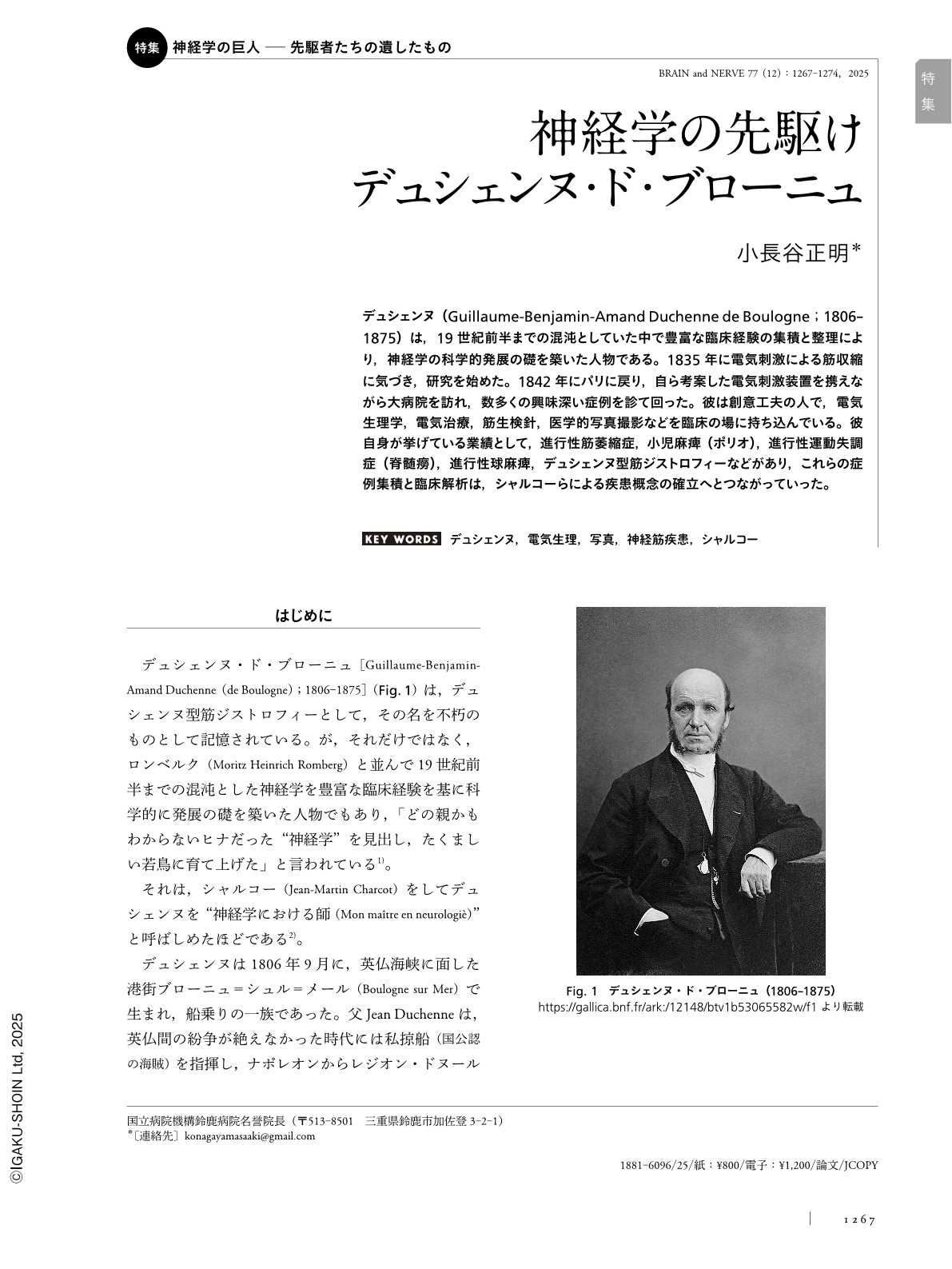
デュシェンヌ(Guillaume-Benjamin-Amand Duchenne de Boulogne;1806-1875)は,19世紀前半までの混沌としていた中で豊富な臨床経験の集積と整理により,神経学の科学的発展の礎を築いた人物である。1835年に電気刺激による筋収縮に気づき,研究を始めた。1842年にパリに戻り,自ら考案した電気刺激装置を携えながら大病院を訪れ,数多くの興味深い症例を診て回った。彼は創意工夫の人で,電気生理学,電気治療,筋生検針,医学的写真撮影などを臨床の場に持ち込んでいる。彼自身が挙げている業績として,進行性筋萎縮症,小児麻痺(ポリオ),進行性運動失調症(脊髄癆),進行性球麻痺,デュシェンヌ型筋ジストロフィーなどがあり,これらの症例集積と臨床解析は,シャルコーらによる疾患概念の確立へとつながっていった。
Abstract
Guillaume-Benjamin-Amand Duchenne de Boulogne once remarked that he found neurology “a sprawling infant of unknown parentage, which he succored to lusty youth.” He was born in the Boulogne-sur-Mer region of France in1806. He studied medicine in Paris from 1826 to 1831 and later established a practice in Boulogne. In 1835, he observed isolated muscular contractions produced by electropuncture and began investigating the electrical excitation of muscle. In 1842, he left Boulogne for Paris to continue medical research, often visiting hospitals with his electrical equipment to examine unusual cases. He was an inventive investigator who developed several technical innovations, including electrodiagnosis, electrotherapy, needle muscle biopsy, and medical photography. He enumerated his major discoveries in “L'Electrisation Localisee,” which included descriptions of progressive muscular atrophy (now called spinal muscular atrophy), atrophic paralysis of childhood (poliomyelitis), progressive locomotor ataxia (tabes dorsalis), glosso-labio-laryngeal paralysis (progressive bulbar palsy), and pseudohypertrophic paralysis (Duchenne muscular dystrophy). Based on Duchenne's intensive investigations, Jean-Martin Charcot refined his medical concepts and established nosological disease entities, calling Duchenne “mon maître en neurologie” (my master in neurology). Duchenne never held a hospital or university position. He died of cerebrovascular disease on September 17, 1875.
Copyright © 2025, Igaku-Shoin Ltd. All rights reserved.