Japanese
English
- 有料閲覧
- Abstract 文献概要
- 1ページ目 Look Inside
- 参考文献 Reference
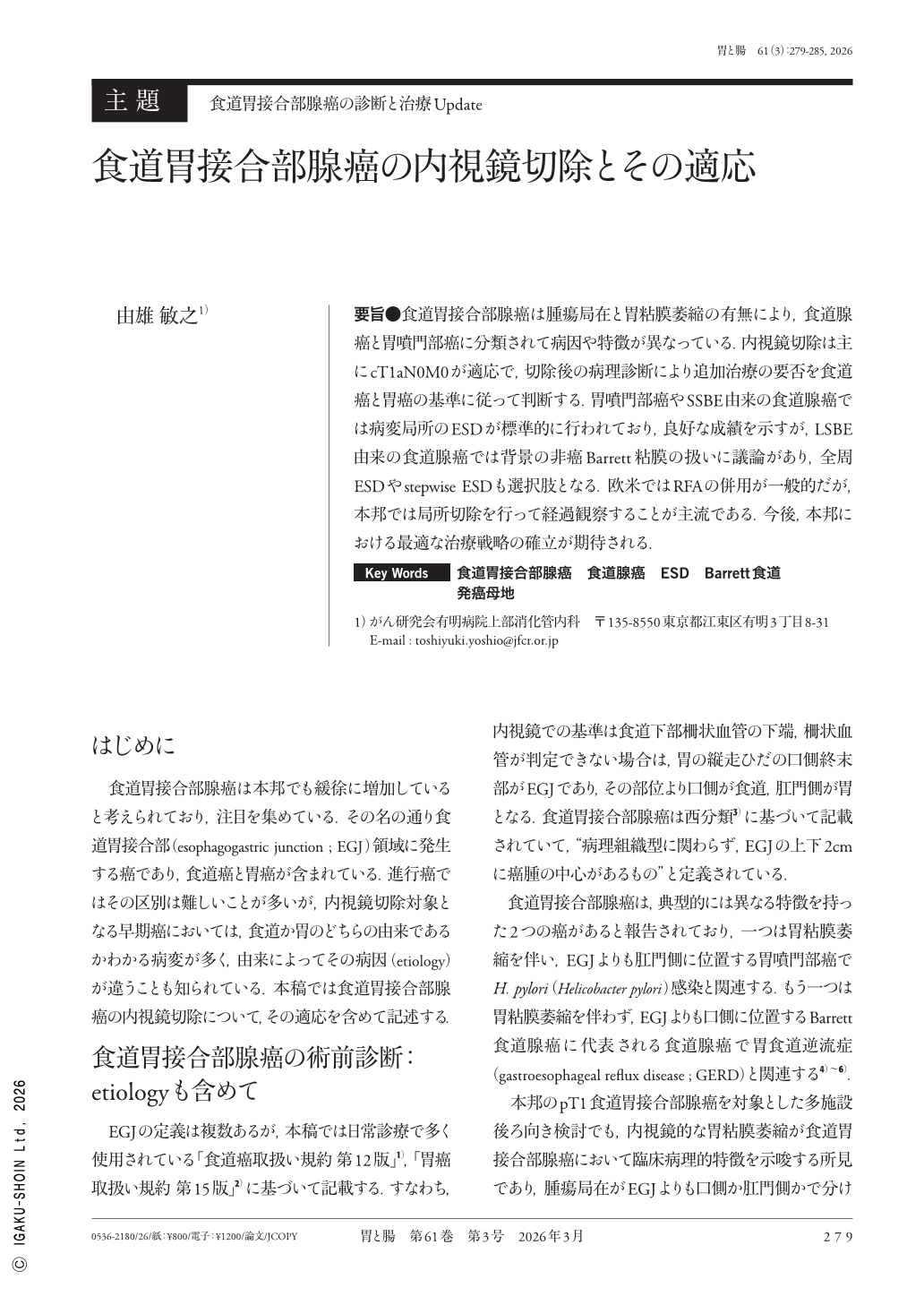
要旨●食道胃接合部腺癌は腫瘍局在と胃粘膜萎縮の有無により,食道腺癌と胃噴門部癌に分類されて病因や特徴が異なっている.内視鏡切除は主にcT1aN0M0が適応で,切除後の病理診断により追加治療の要否を食道癌と胃癌の基準に従って判断する.胃噴門部癌やSSBE由来の食道腺癌では病変局所のESDが標準的に行われており,良好な成績を示すが,LSBE由来の食道腺癌では背景の非癌Barrett粘膜の扱いに議論があり,全周ESDやstepwise ESDも選択肢となる.欧米ではRFAの併用が一般的だが,本邦では局所切除を行って経過観察することが主流である.今後,本邦における最適な治療戦略の確立が期待される.
Esophagogastric junction(EGJ)cancer is classified into esophageal adenocarcinoma and gastric cardia cancer based on tumor location and the status of gastric mucosal atrophy, with these subtypes exhibiting distinct etiologies and clinical features. Endoscopic resection is primarily indicated for cT1aN0M0 lesions. The need for additional treatment is determined according to pathological findings and the respective guidelines for esophageal and gastric cancers. Localized endoscopic submucosal dissection(ESD)is the standard approach for gastric cardia cancer and esophageal adenocarcinoma arising from short-segment Barrett's esophagus, with favorable outcomes. In contrast, for esophageal adenocarcinoma arising from long-segment Barrett's esophagus, the management of residual non-neoplastic Barrett's mucosa remains controversial, with options including circumferential or stepwise ESD. In Western countries, radiofrequency ablation is frequently used in combination with resection ; however, in Japan, the standard of care is localized resection followed by surveillance. Ongoing multicenter studies aim to establish the optimal treatment strategy, particularly with respect to indications for Barrett's mucosa eradication in Japan.
Copyright © 2026, Igaku-Shoin Ltd. All rights reserved.