Japanese
English
- 有料閲覧
- Abstract 文献概要
- 1ページ目 Look Inside
- 参考文献 Reference
- サイト内被引用 Cited by
抄録
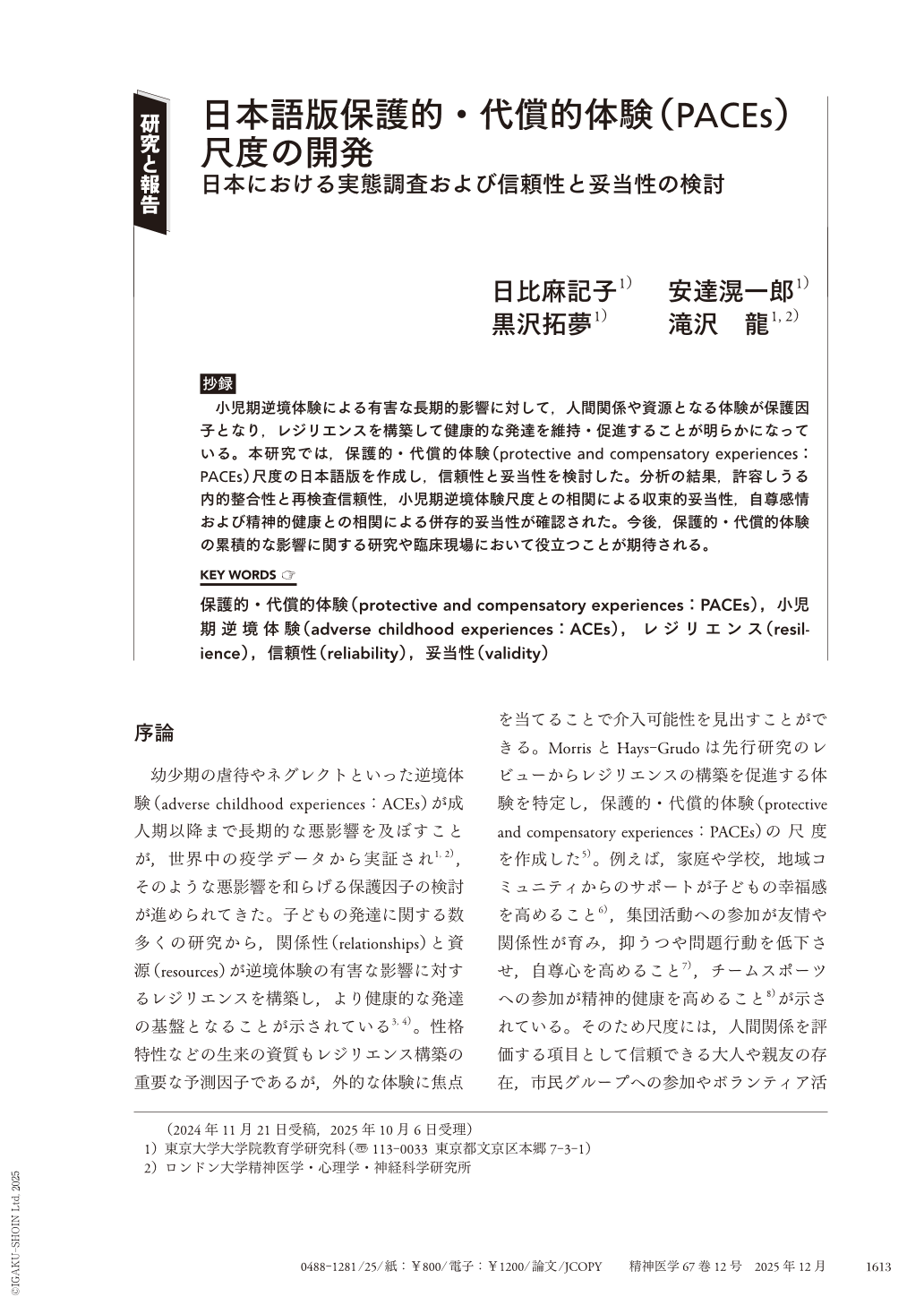
小児期逆境体験による有害な長期的影響に対して,人間関係や資源となる体験が保護因子となり,レジリエンスを構築して健康的な発達を維持・促進することが明らかになっている。本研究では,保護的・代償的体験(protective and compensatory experiences:PACEs)尺度の日本語版を作成し,信頼性と妥当性を検討した。分析の結果,許容しうる内的整合性と再検査信頼性,小児期逆境体験尺度との相関による収束的妥当性,自尊感情および精神的健康との相関による併存的妥当性が確認された。今後,保護的・代償的体験の累積的な影響に関する研究や臨床現場において役立つことが期待される。
Experiences of relationships and fulfilling resources are protective factors that moderate the harmful long-term effects of childhood adversity experiences, build resilience, and promote healthy development. This study examined the reliability and validity of the Japanese version of the Protective and Compensatory Experiences(PACEs)scale. Study 1 collected data from 2462 participants(age:37.54 ± 8.39). The omega coefficient was calculated, and although the value was smaller than that of previous studies, it was acceptable, so internal consistency was confirmed. Convergent validity was confirmed by a negative correlation with the number of childhood adversity experiences(r=−0.303, p<0.001). Concurrent validity was also confirmed by the results showing positive correlations with self-esteem(r=0.281, p<0.001), and negative correlations with mental health problems(r=−0.269, p<0.001). Study 2 asked 221 participants(age:35.65 ± 9.12)to complete the questionnaire twice, with a one-month interval, and the stability of the responses was examined using the kappa coefficient. The results showed that there was generally good agreement overall, indicating that this scale had good test-retest reliability. However, the average for PACEs among the 2462 people surveyed in Study 1 was 5.78 ± 1.87, which was lower than the average for the US(8.5 ± 1.7). 89.6% of people had not experienced Item 3(volunteer activities)and 89.2% had not experienced Item 5(activities in civic groups), suggesting that these items may not be common experiences in Japan. These indicated that the Japanese version of the PACEs scale is reliable and valid for assessing the protective relationships and resources experienced during childhood. This scale is useful in research on the cumulative effects of protective and compensatory experiences and clinical interventions.
Copyright © 2025, Igaku-Shoin Ltd. All rights reserved.