Japanese
English
- 有料閲覧
PPV購入案内
2,750円 (2,500円+税10%) こちらは、682ページから687ページの文献です。購入には医書.jp本会員登録が必要です。
会員登録完了後に改めて上記「購入サイトへ」を選択してください。
または「購入サイトへ」選択後に「購入ログイン」、「新規会員登録」の順に進んでください。
会員登録について詳しくはをご確認ください。
- Abstract 文献概要
- 1ページ目 Look Inside
- 参考文献 Reference
要旨
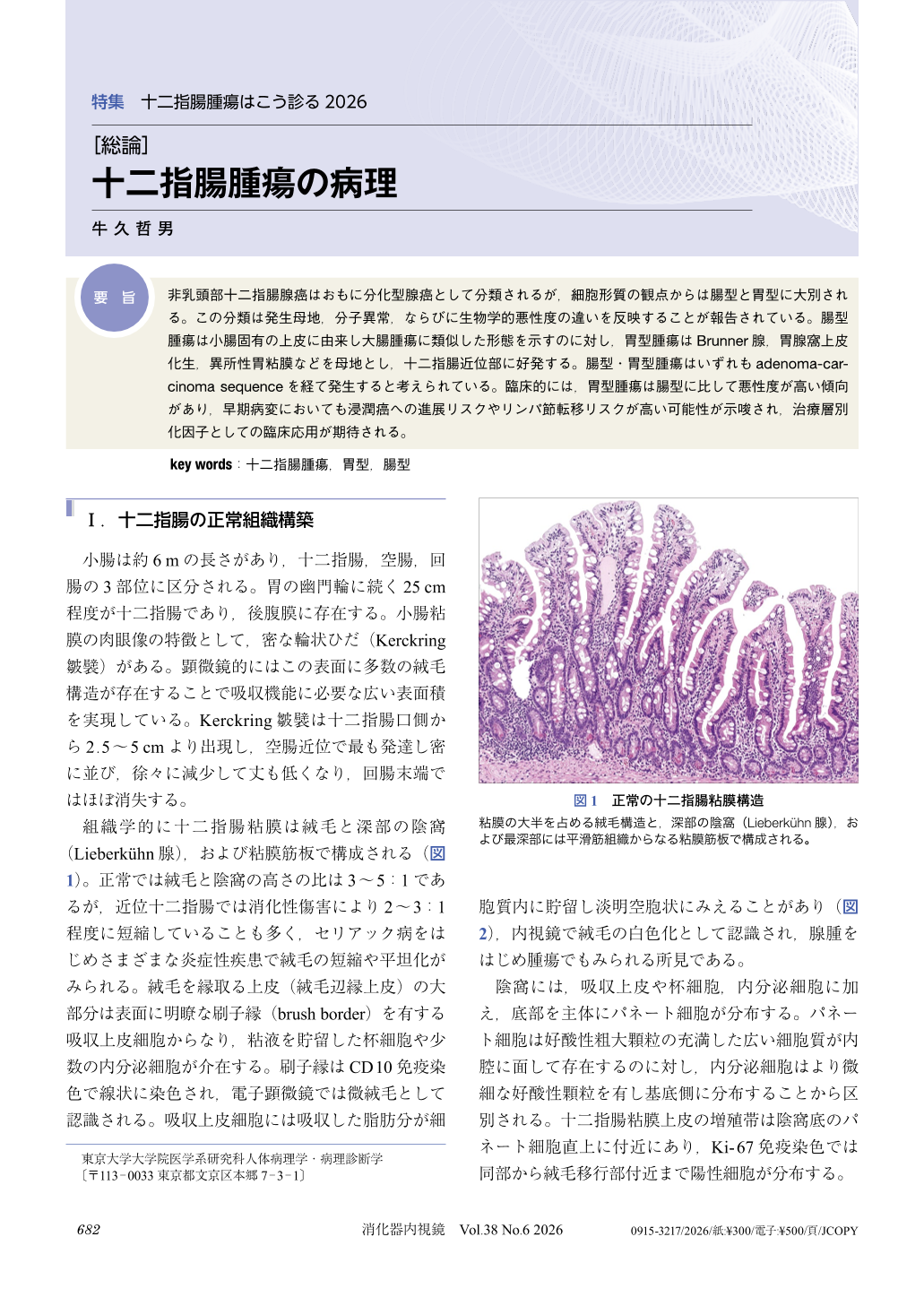
非乳頭部十二指腸腺癌はおもに分化型腺癌として分類されるが,細胞形質の観点からは腸型と胃型に大別される。この分類は発生母地,分子異常,ならびに生物学的悪性度の違いを反映することが報告されている。腸型腫瘍は小腸固有の上皮に由来し大腸腫瘍に類似した形態を示すのに対し,胃型腫瘍はBrunner腺,胃腺窩上皮化生,異所性胃粘膜などを母地とし,十二指腸近位部に好発する。腸型・胃型腫瘍はいずれもadenoma-carcinoma sequenceを経て発生すると考えられている。臨床的には,胃型腫瘍は腸型に比して悪性度が高い傾向があり,早期病変においても浸潤癌への進展リスクやリンパ節転移リスクが高い可能性が示唆され,治療層別化因子としての臨床応用が期待される。
Non-ampullary duodenal adenocarcinoma is predominantly classified as well-differentiated adenocarcinoma. However, from the perspective of cellular phenotype, it can be divided into intestinal-type and gastric-type. This classification has been reported to reflect differences in histogenesis, molecular alterations, and biological behavior. Intestinal-type tumors arise from native intestinal epithelium and exhibit morphological features similar to colorectal neoplasms. In contrast, gastric-type tumors are thought to originate from Brunner glands, gastric foveolar metaplasia, or ectopic gastric mucosa, and are more frequently located in the proximal duodenum. Both intestinal- and gastric-type tumors are considered to develop through an adenoma-carcinoma sequence. Clinically, gastric-type tumors tend to show higher malignant potential than intestinal-type tumors. Even in early lesions, they are associated with an increased risk of progression to invasive carcinoma and lymph node metastasis, suggesting their potential utility as a factor for therapeutic stratification.
© tokyo-igakusha.co.jp. All right reserved.