Japanese
English
- 有料閲覧
PPV購入案内
1,650円 (1,500円+税10%) こちらは、418ページから421ページの文献です。購入には医書.jp本会員登録が必要です。
会員登録完了後に改めて上記「購入サイトへ」を選択してください。
または「購入サイトへ」選択後に「購入ログイン」、「新規会員登録」の順に進んでください。
会員登録について詳しくはをご確認ください。
- Abstract 文献概要
- 1ページ目 Look Inside
- 参考文献 Reference
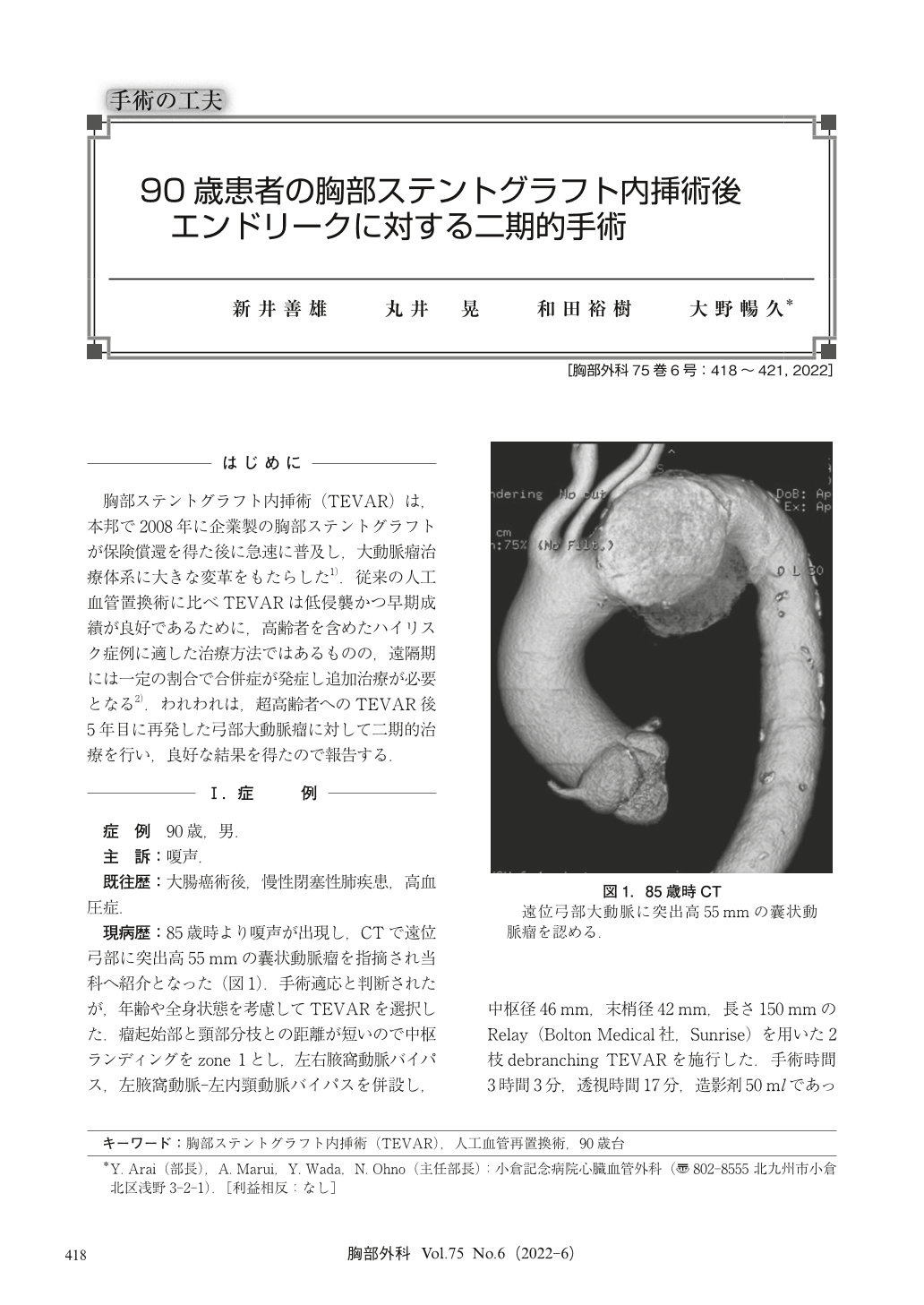
胸部ステントグラフト内挿術(TEVAR)は,本邦で2008年に企業製の胸部ステントグラフトが保険償還を得た後に急速に普及し,大動脈瘤治療体系に大きな変革をもたらした1).従来の人工血管置換術に比べTEVARは低侵襲かつ早期成績が良好であるために,高齢者を含めたハイリスク症例に適した治療方法ではあるものの,遠隔期には一定の割合で合併症が発症し追加治療が必要となる2).われわれは,超高齢者へのTEVAR後5年目に再発した弓部大動脈瘤に対して二期的治療を行い,良好な結果を得たので報告する.
A 85-year old male with hoarseness due to distal aortic arch aneurysm underwent zone 1 thoracic endovascular aortic repair (TEVAR) with two-debranching at our hospital. Five years after the TEVAR (90 years old), computed tomography (CT) revealed typeⅠa endoleak due to migration of proximal end of the graft. Anatomically, additional TEVAR was impossible. To minimize the invasiveness, a two-stage surgery was planned. First, under deep hypothermic circulatory arrest, the ascending aorta was replaced with the brachiocephalic artery reconstruction and insertion of a stented vascular prosthesis distally through partial sternotomy to preserve the debranching bypass. Six days after the surgery, a transcatheter stent graft was placed from the stented vascular prosthesis to the native descending aorta. Postoperative course was uneventful, and CT scan showed no endoleak.
© Nankodo Co., Ltd., 2022