Japanese
English
- 有料閲覧
PPV購入案内
1,320円 (1,200円+税10%) こちらは、47ページから51ページの文献です。購入には医書.jp本会員登録が必要です。
会員登録完了後に改めて上記「購入サイトへ」を選択してください。
または「購入サイトへ」選択後に「購入ログイン」、「新規会員登録」の順に進んでください。
会員登録について詳しくはをご確認ください。
- Abstract 文献概要
- 1ページ目 Look Inside
I.はじめに
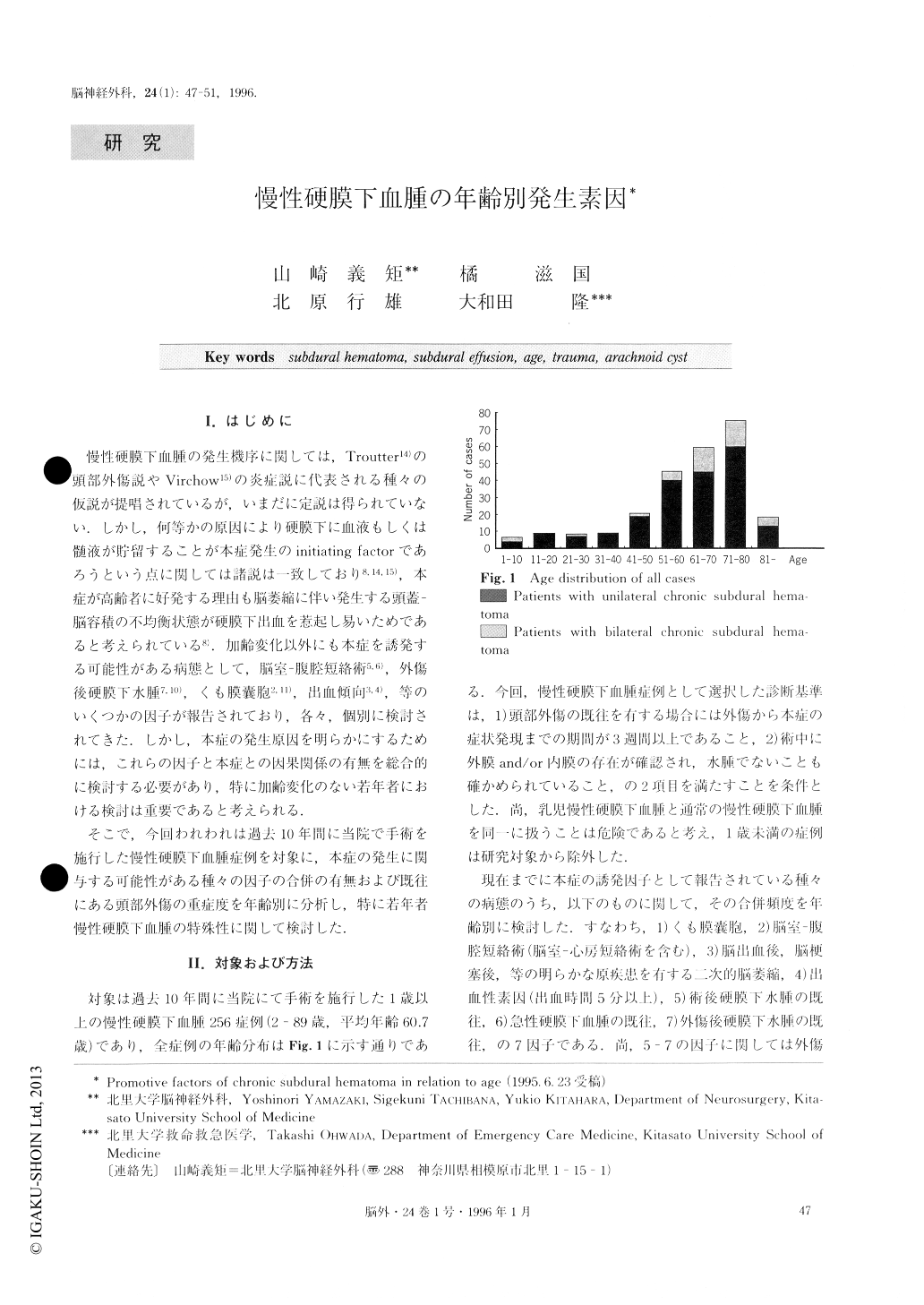
慢性硬膜下血腫の発生機序に関しては,Troutter14)の頭部外傷説やVirchow15)の炎症説に代表される種々の仮説が提唱されているが,いまだに定説は得られていない.しかし,何等かの原因により硬膜下に血液もしくは髄液が貯留することが本症発生のinitiating factorであろうという点に関しては諸説は一致しており8,14,15),本症が高齢者に好発する理由も脳萎縮に伴い発生する頭蓋—脳容積の不均衡状態が硬膜下出血を惹起し易いためであると考えられている8).加齢変化以外にも本症を誘発する可能性がある病態として,脳室—腹腔短絡術5,6),外傷後硬膜下水腫7,10),くも膜嚢胞2,11),出血傾向3,4),等のいくつかの因子が報告されており,各々,個別に検討されてきた.しかし,本症の発生原因を明らかにするためには,これらの因子と本症との因果関係の有無を総合的に検討する必要があり,特に加齢変化のない若年者における検討は重要であると考えられる.
そこで,今回われわれは過去10年間に当院で手術を施行した慢性硬膜下血腫症例を対象に,本症の発生に関与する可能性がある種々の因子の合併の有無および既往にある頭部外傷の重症度を年齢別に分析し,特に若年者慢性硬膜下血腫の特殊性に関して検討した.
To reveal the pathogenesis of chronic subdural hematoma (CSDH), 256 patients with CSDH over 1 year of age were studied in relation to various trauma-tic or nontraumatic promotive factors of CSDH includ-ing arachnoid cyst, implantation of a cerebrospinal fluid shunt, secondary cerebral atrophy, coagulopathies and past history of acute subdural hematoma or effusion.
All patients were grouped according to decade of age. The incidences of associated promotive factors were individually analyzed in each group. The inci-dences of associated promotive factors in the 1st, 2nd, 3rd, 9th, 5th, 6th, 7th, 8th, 9th decades of life were 71%, 89% 56%, 33%, 9%, 11%, 8%, 8% and 5%, respectively. Thus, they were divided into two groups; youth (1st to 4th decade: n=34) and elder (5th to 9th decade: n=222). The incidences of associated promotive factors were 62% and 8%, respectively (P<0.001). Severity of head injury received was also evaluated in these two groups. In the youth group, 15 out of 34 patients (44.1%) had received severe head injuries with loss of consciousness, while in the elder group, only 22 out of 222 patients (9.9%) had received severe head injuries (P<0.001). The analysis was repeated after each group was divided into two subgroups regarding the coexistence of promotive factors. Among the youth group, 13 patients had no promotive factors and 21 had one or more promotive factors. In those without any promotive factor, 9 out of 13 had received severe head injuries with loss of consciousness, while in those with promotive factors, 6 out of 21 had received severe head injuries. On the other hand, majority of the elder group had not received severe head injuries irrespective of whether patients had promotive factors or not. The present study revealed that majority of young CSDH patient had some promotive factors or severe head injuries with loss of consciousness, and that majority of patients aged over 40 years had no promo-tive factors and did not receive severe head injuries.
Copyright © 1996, Igaku-Shoin Ltd. All rights reserved.