Japanese
English
- 有料閲覧
PPV購入案内
1,320円 (1,200円+税10%) こちらは、503ページから507ページの文献です。購入には医書.jp本会員登録が必要です。
会員登録完了後に改めて上記「購入サイトへ」を選択してください。
または「購入サイトへ」選択後に「購入ログイン」、「新規会員登録」の順に進んでください。
会員登録について詳しくはをご確認ください。
- Abstract 文献概要
- 1ページ目 Look Inside
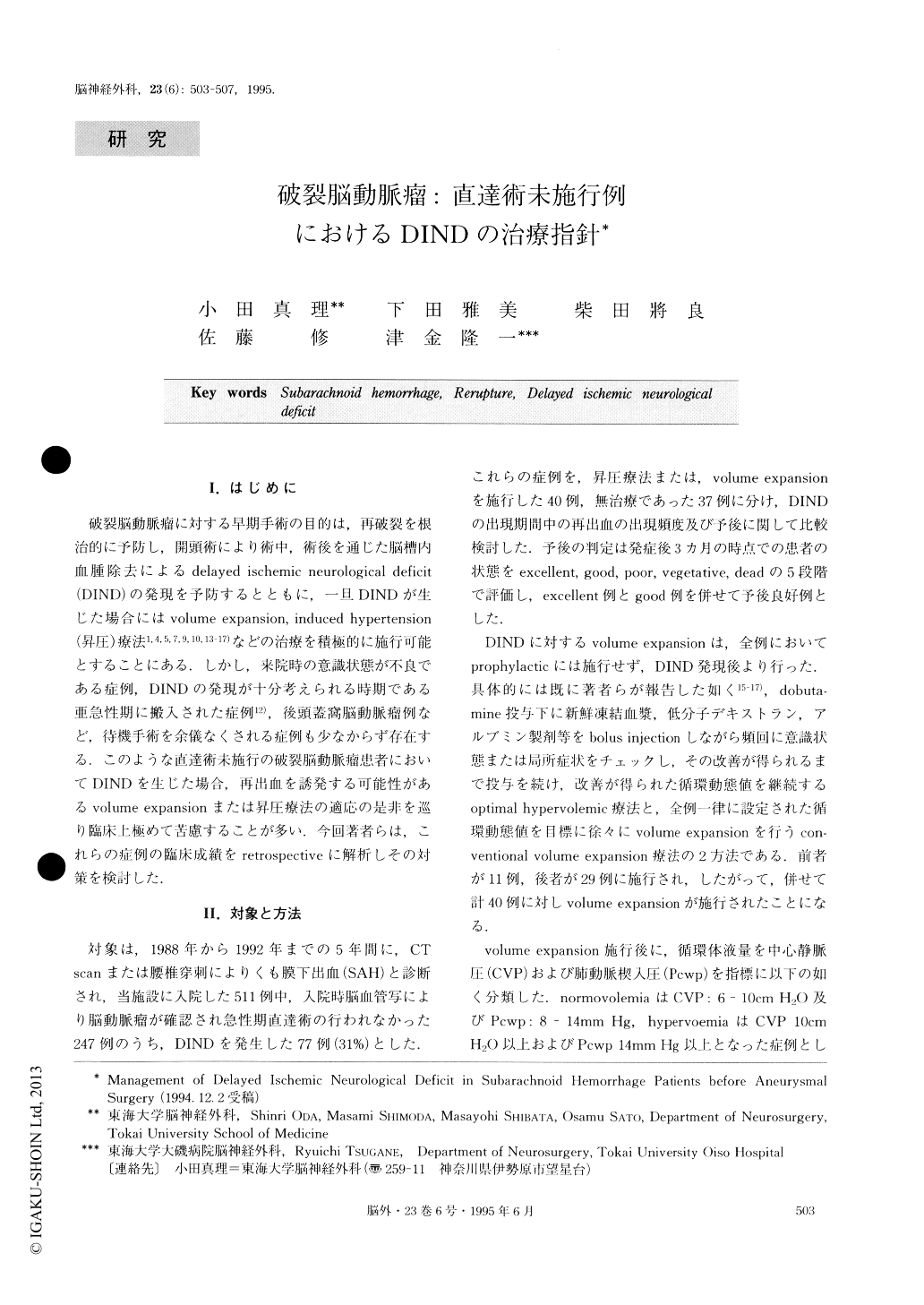
I.はじめに
破裂脳動脈瘤に対する早期手術の目的は,再破裂を根治的に予防し,開頭術により術中,術後を通じた脳槽内血腫除去によるdelayed ischemic neurological deficit(DIND)の発現を予防するとともに,一旦DINDが生じた場合にはvolume expansion,induced hypertension(昇圧)療法1,4,5,7,9,10,13-17)などの治療を積極的に施行可能とすることにある.しかし,来院時の意識状態が不良である症例,DINDの発現が十分考えられる時期である亜急性期に搬入された症例12),後頭蓋窩脳動脈瘤例など,待機手術を余儀なくされる症例も少なからず存在する.このような直達術未施行の破裂脳動脈瘤患者においてDINDを生じた場合,再出血を誘発する可能性があるvolume expansionまたは昇圧療法の適応の是非を巡り臨床上極めて苦慮することが多い.今回著者らは,これらの症例の臨床成績をretrospectiveに解析しその対策を検討した.
The incidence of rerupture during the period of de-layed ischemic neurological deficit (DIND) was studied in patients with aneurysmal subarachnoid hemorrhage (SAH) before surgical aneurysmal obliteration, and optimal management of DIND for preventing rerupture is discussed.
At Tokai University Hospital, 511 patients with SAH were admitted during the 5-year period from 1988 to 1992. Of these, 247 had not undergone obliteration of the aneurysm neck within 3 days after SAH. In this group, 31% (77 patients) developed DIND. Of these 77 patients, 40 were managed with induced hypertension and/or hypervolemic therapy for DIND (25 with both (group 1), 15 with normotensive hypervolemic therapy (group 2)), and 37 did not receive either kind of the-rapy (group 3). The incidences of rerupture were as follows: all SAH patients: 11.5%; group 1: 48%; group 2: 7%; group 3: 11%. The incidence of rerup-ture in group 1 was significantly higher than that in the other groups. On the other hand, the favorable outcome rate (excellent and good) was as follows: group 1: 40%; group 2: 73%; group 3: 22%. This rate was sig-nificantly higher in patients who received normotensive hypervolemic therapy, than in other groups.
This study suggests that, to avoid rerupture and un-favorable outcome, normotensive hypervolemic therapy is the optimal management approach in patients with DIND after SAH who have not undergone obliteration of the aneurysmal neck.
Copyright © 1995, Igaku-Shoin Ltd. All rights reserved.