Japanese
English
- 有料閲覧
PPV購入案内
1,320円 (1,200円+税10%) こちらは、826ページから838ページの文献です。購入には医書.jp本会員登録が必要です。
会員登録完了後に改めて上記「購入サイトへ」を選択してください。
または「購入サイトへ」選択後に「購入ログイン」、「新規会員登録」の順に進んでください。
会員登録について詳しくはをご確認ください。
- Abstract 文献概要
- 1ページ目 Look Inside
- 参考文献 Reference
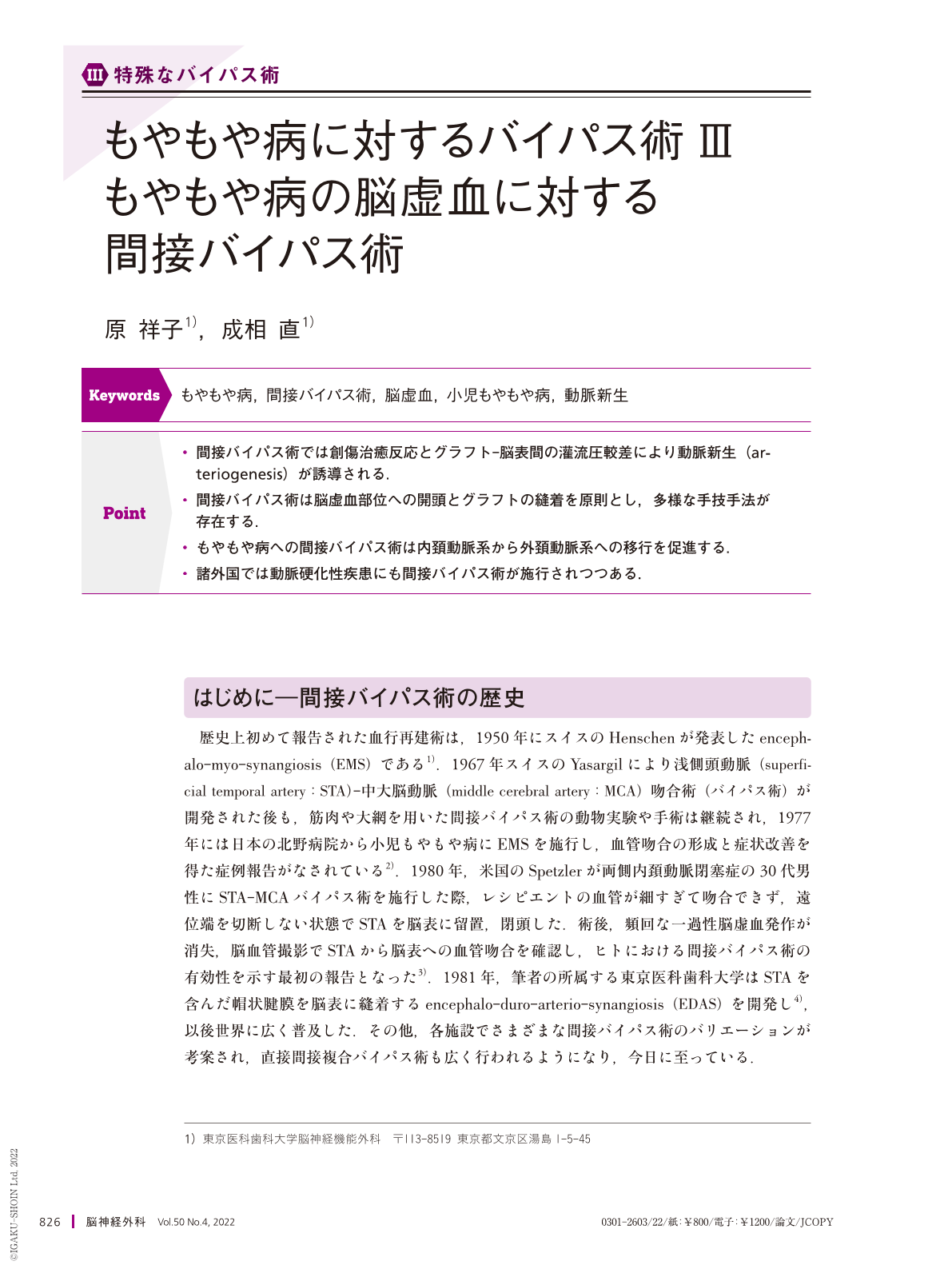
Point
・間接バイパス術では創傷治癒反応とグラフト-脳表間の灌流圧較差により動脈新生(arteriogenesis)が誘導される.
・間接バイパス術は脳虚血部位への開頭とグラフトの縫着を原則とし,多様な手技手法が存在する.
・もやもや病への間接バイパス術は内頚動脈系から外頚動脈系への移行を促進する.
・諸外国では動脈硬化性疾患にも間接バイパス術が施行されつつある.
*本論文中、[Video]マークのある図につきましては、関連する動画を見ることができます(公開期間:2025年8月まで)。
Indirect revascularization is a surgical procedure to reduce cerebral ischemia, using subcutaneous tissues or dura mater supplied by extracranial arteries as grafts. The perfusion pressure gradient between the cortex and the graft, if present, induces arteriogenesis and develops extracranial-intracranial anastomoses to supply blood flow to the cerebral cortex underneath the graft. Therefore, it is essential to perform the craniotomy over the site of the cerebral ischemia to induce functional anastomoses. The details of the indirect revascularization procedure vary among institutes in terms of the grafts used(skin arteries, such as the superficial temporal artery; temporal muscle, galea, or pericranium), dura mater incisions(removal and replacement with the grafts, linear incision, or multiple small incisions), and the location and size of the craniotomy. Indirect revascularization is especially effective in patients with moyamoya disease because the pathophysiology of the disease itself is related to intracranial to extracranial carotid system conversion. Generally, indirect revascularization was considered ineffective in patients with atherosclerotic steno-occlusive cerebrovascular disease; however, recent clinical trials suggested that it may also be effective in these patients. If a future clinical trial demonstrates a positive outcome, indirect revascularization may become a possible treatment for atherosclerotic patients.
Copyright © 2022, Igaku-Shoin Ltd. All rights reserved.