Japanese
English
- 有料閲覧
PPV購入案内
1,320円 (1,200円+税10%) こちらは、432ページから437ページの文献です。購入には医書.jp本会員登録が必要です。
会員登録完了後に改めて上記「購入サイトへ」を選択してください。
または「購入サイトへ」選択後に「購入ログイン」、「新規会員登録」の順に進んでください。
会員登録について詳しくはをご確認ください。
- Abstract 文献概要
- 1ページ目 Look Inside
- 参考文献 Reference
Point
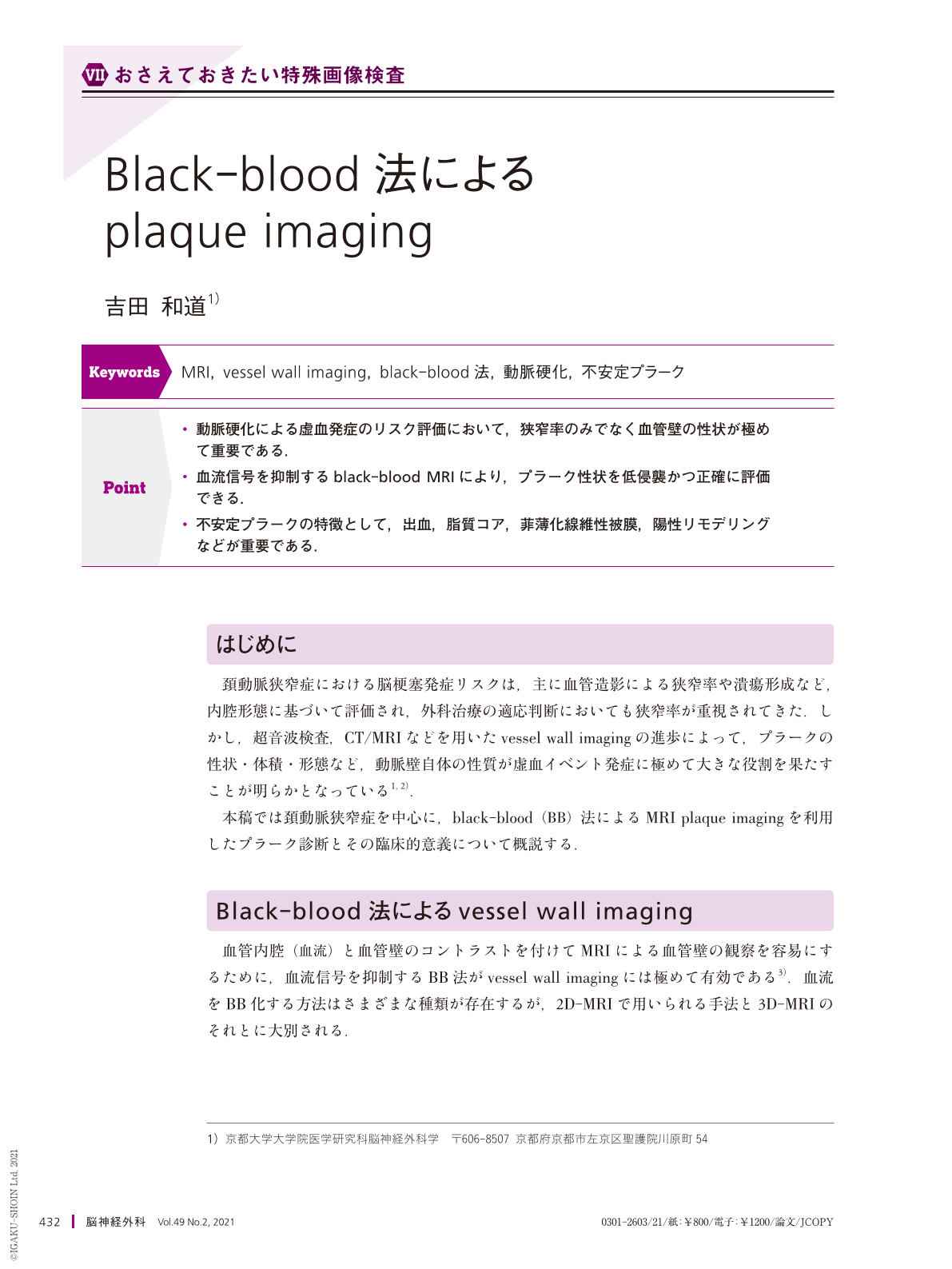
・動脈硬化による虚血発症のリスク評価において,狭窄率のみでなく血管壁の性状が極めて重要である.
・血流信号を抑制するblack-blood MRIにより,プラーク性状を低侵襲かつ正確に評価できる.
・不安定プラークの特徴として,出血,脂質コア,菲薄化線維性被膜,陽性リモデリングなどが重要である.
The risk of future ischemic events, such as angiographically determined stenosis and ulceration, in patients with atherosclerosis has long been mainly assessed using luminal morphology. However, recent remarkable advances in vessel wall imaging combined with a deeper understanding of vascular biology have shown that vessel wall characteristics also have a considerable influence on the onset of ischemic events. Among the modalities for vessel wall imaging, such as ultrasound, CT, and MRI, MRI is useful for plaque characterization because of its high accuracy and less invasiveness. Several features of vulnerable plaques, such as intraplaque hemorrhage, large lipid-rich necrotic cores, and ruptured fibrous caps, can be observed using contemporary high-resolution MRI. The assessment of plaque characteristics is essential for the management of atherosclerosis.
In this article, the current status of carotid plaque characterization using black-blood MRI will be briefly highlighted, and potential clinical implications of MRI plaque imaging will be demonstrated.
Copyright © 2021, Igaku-Shoin Ltd. All rights reserved.