Japanese
English
- 有料閲覧
PPV購入案内
1,320円 (1,200円+税10%) こちらは、249ページから253ページの文献です。購入には医書.jp本会員登録が必要です。
会員登録完了後に改めて上記「購入サイトへ」を選択してください。
または「購入サイトへ」選択後に「購入ログイン」、「新規会員登録」の順に進んでください。
会員登録について詳しくはをご確認ください。
- Abstract 文献概要
- 1ページ目 Look Inside
- 参考文献 Reference
Ⅰ.はじめに
頚動脈病変はその脆弱性(vulnerability)により脳梗塞発症の危険性が大きく異なり,狭窄率や形態の評価に加え,その性状評価が重要である9,16).性状評価に関してhigh-resolution black-blood (BB)MRIの有用性が報告されており6,15),当院では2D spin-echo BB法T1,T2強調画像で評価を行ってきた12-14).特にT1強調画像はvulnerable plaqueの特徴の1つであるプラーク内出血の検出に有用である.しかし,2D spin-echo BB-MRIは撮像時間が長く,急性期症例などには不適当と思われる.そこで短時間で撮像できる3D gradient-echo BB法T1強調画像によるscreening BB-MRIの有用性を検討した.
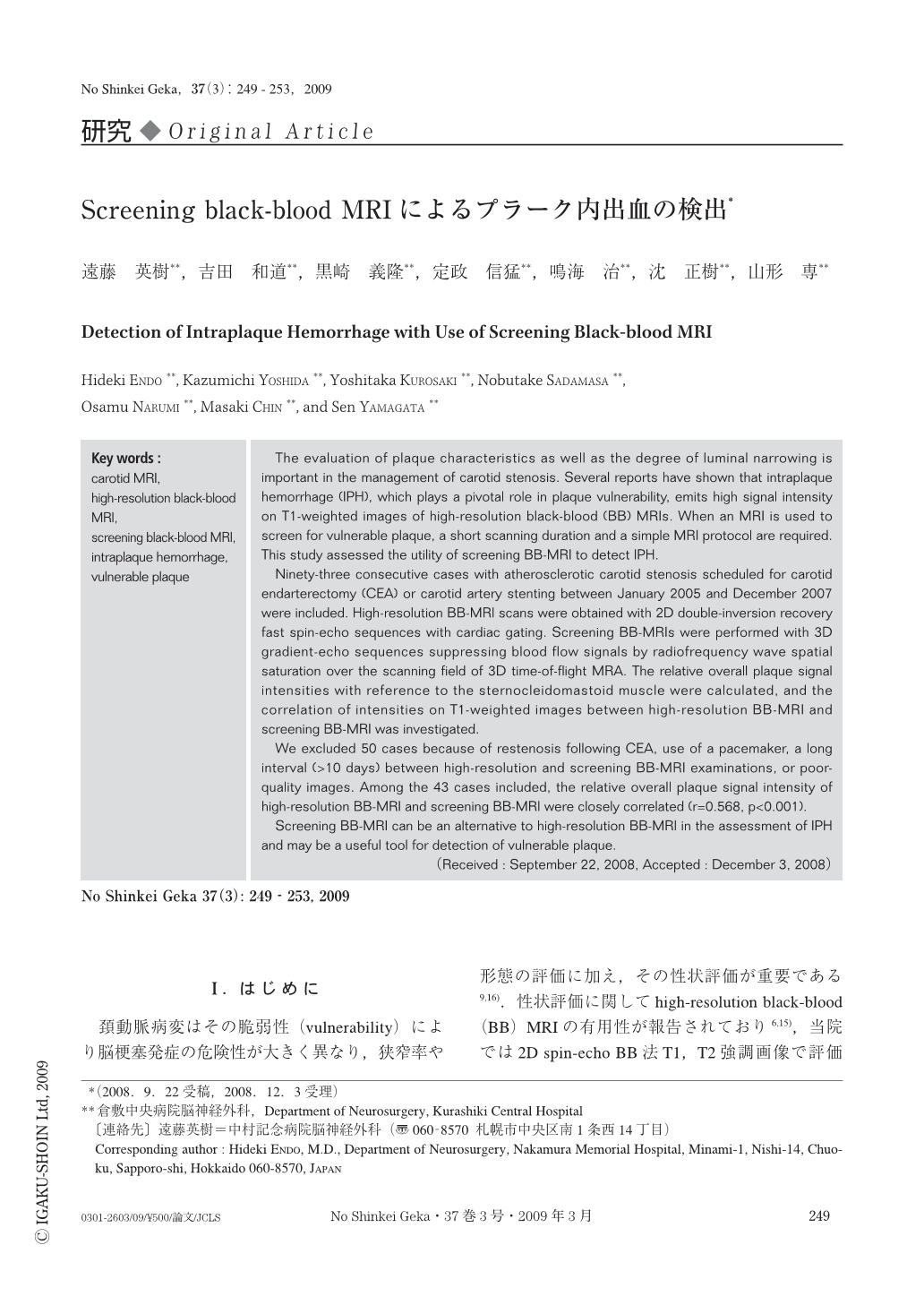
The evaluation of plaque characteristics as well as the degree of luminal narrowing is important in the management of carotid stenosis. Several reports have shown that intraplaque hemorrhage (IPH), which plays a pivotal role in plaque vulnerability, emits high signal intensity on T1-weighted images of high-resolution black-blood (BB) MRIs. When an MRI is used to screen for vulnerable plaque, a short scanning duration and a simple MRI protocol are required. This study assessed the utility of screening BB-MRI to detect IPH.
Ninety-three consecutive cases with atherosclerotic carotid stenosis scheduled for carotid endarterectomy (CEA) or carotid artery stenting between January 2005 and December 2007 were included. High-resolution BB-MRI scans were obtained with 2D double-inversion recovery fast spin-echo sequences with cardiac gating. Screening BB-MRIs were performed with 3D gradient-echo sequences suppressing blood flow signals by radiofrequency wave spatial saturation over the scanning field of 3D time-of-flight MRA. The relative overall plaque signal intensities with reference to the sternocleidomastoid muscle were calculated, and the correlation of intensities on T1-weighted images between high-resolution BB-MRI and screening BB-MRI was investigated.
We excluded 50 cases because of restenosis following CEA, use of a pacemaker, a long interval (>10 days) between high-resolution and screening BB-MRI examinations, or poor-quality images. Among the 43 cases included, the relative overall plaque signal intensity of high-resolution BB-MRI and screening BB-MRI were closely correlated (r=0.568, p<0.001).
Screening BB-MRI can be an alternative to high-resolution BB-MRI in the assessment of IPH and may be a useful tool for detection of vulnerable plaque.
Copyright © 2009, Igaku-Shoin Ltd. All rights reserved.