Japanese
English
- 有料閲覧
PPV購入案内
1,320円 (1,200円+税10%) こちらは、325ページから332ページの文献です。購入には医書.jp本会員登録が必要です。
会員登録完了後に改めて上記「購入サイトへ」を選択してください。
または「購入サイトへ」選択後に「購入ログイン」、「新規会員登録」の順に進んでください。
会員登録について詳しくはをご確認ください。
- Abstract 文献概要
- 1ページ目 Look Inside
- 参考文献 Reference
Ⅰ.はじめに
硬膜動静脈瘻(dural arteriovenous fistula:dAVF)に静脈洞の狭窄や閉塞が合併することはよく知られており,その因果関係に関してはさまざまな仮説が報告されてきた1,4,10).静脈洞の狭窄や閉塞は静脈灌流障害を引き起こし,頭蓋内圧亢進をもたらす原因となり,dAVFの病態に大きく影響する要素であるといえる.
今回,われわれは頭蓋内圧亢進症状で発症した横-S状静脈洞部dAVFに合併したS状静脈洞狭窄に対して静脈洞ステント留置術を施行し,劇的に静脈灌流障害の改善がみられた症例を経験したので報告する.
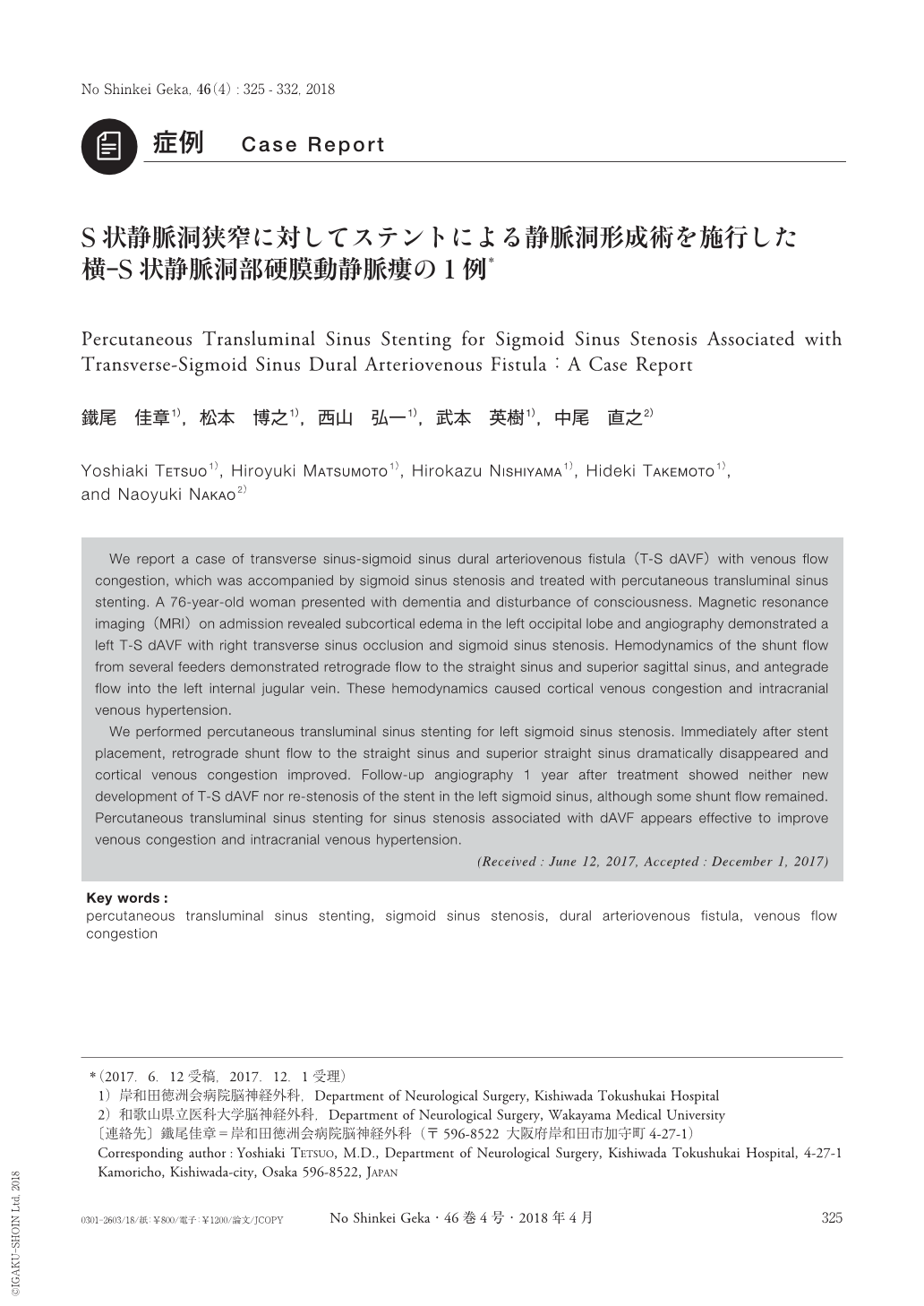
We report a case of transverse sinus-sigmoid sinus dural arteriovenous fistula(T-S dAVF)with venous flow congestion, which was accompanied by sigmoid sinus stenosis and treated with percutaneous transluminal sinus stenting. A 76-year-old woman presented with dementia and disturbance of consciousness. Magnetic resonance imaging(MRI)on admission revealed subcortical edema in the left occipital lobe and angiography demonstrated a left T-S dAVF with right transverse sinus occlusion and sigmoid sinus stenosis. Hemodynamics of the shunt flow from several feeders demonstrated retrograde flow to the straight sinus and superior sagittal sinus, and antegrade flow into the left internal jugular vein. These hemodynamics caused cortical venous congestion and intracranial venous hypertension.
We performed percutaneous transluminal sinus stenting for left sigmoid sinus stenosis. Immediately after stent placement, retrograde shunt flow to the straight sinus and superior straight sinus dramatically disappeared and cortical venous congestion improved. Follow-up angiography 1 year after treatment showed neither new development of T-S dAVF nor re-stenosis of the stent in the left sigmoid sinus, although some shunt flow remained. Percutaneous transluminal sinus stenting for sinus stenosis associated with dAVF appears effective to improve venous congestion and intracranial venous hypertension.
Copyright © 2018, Igaku-Shoin Ltd. All rights reserved.