Japanese
English
- 有料閲覧
PPV購入案内
1,320円 (1,200円+税10%) こちらは、123ページから129ページの文献です。購入には医書.jp本会員登録が必要です。
会員登録完了後に改めて上記「購入サイトへ」を選択してください。
または「購入サイトへ」選択後に「購入ログイン」、「新規会員登録」の順に進んでください。
会員登録について詳しくはをご確認ください。
- Abstract 文献概要
- 1ページ目 Look Inside
- 参考文献 Reference
Ⅰ.はじめに
Watershed shift(WS)は,もやもや病に対する浅側頭動脈-中大脳動脈(superficial temporal artery-middle cerebral artery:STA-MCA)バイパス術後の,局所脳循環変化による脳虚血の原因の1つとして提唱された概念である7).WSに伴う脳梗塞は,もやもや病に対するバイパス術全体の1.2〜5.7%に起こる7,16).これまでWSを画像で直接確認した報告はない.今回われわれは,成人もやもや病術後に過灌流症候群(cerebral hyperperfusion syndrome:CHPS)を来し,その後WSが原因と考えられる脳梗塞を来した1例を報告する.
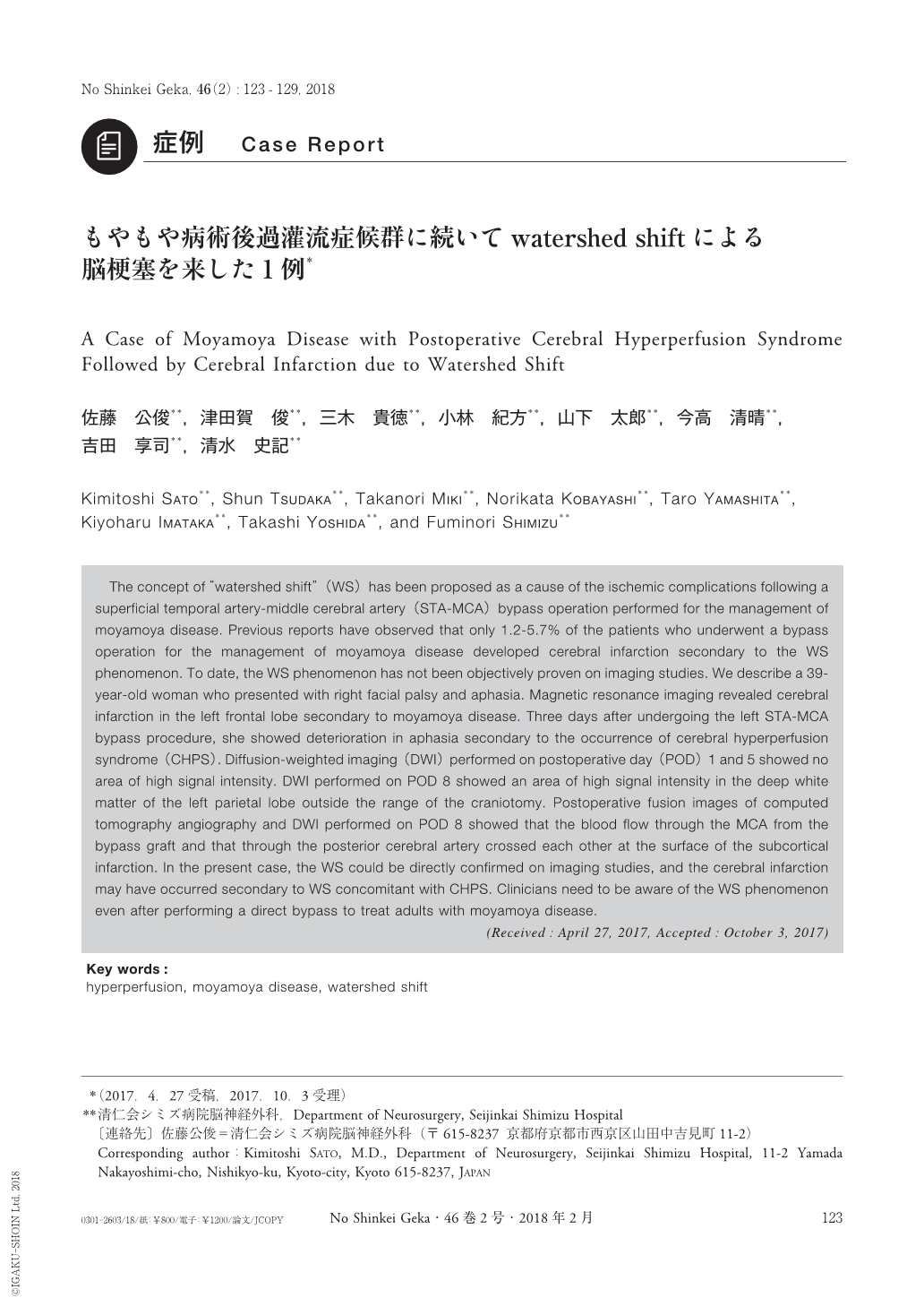
The concept of “watershed shift”(WS)has been proposed as a cause of the ischemic complications following a superficial temporal artery-middle cerebral artery(STA-MCA)bypass operation performed for the management of moyamoya disease. Previous reports have observed that only 1.2-5.7% of the patients who underwent a bypass operation for the management of moyamoya disease developed cerebral infarction secondary to the WS phenomenon. To date, the WS phenomenon has not been objectively proven on imaging studies. We describe a 39-year-old woman who presented with right facial palsy and aphasia. Magnetic resonance imaging revealed cerebral infarction in the left frontal lobe secondary to moyamoya disease. Three days after undergoing the left STA-MCA bypass procedure, she showed deterioration in aphasia secondary to the occurrence of cerebral hyperperfusion syndrome(CHPS). Diffusion-weighted imaging(DWI)performed on postoperative day(POD)1 and 5 showed no area of high signal intensity. DWI performed on POD 8 showed an area of high signal intensity in the deep white matter of the left parietal lobe outside the range of the craniotomy. Postoperative fusion images of computed tomography angiography and DWI performed on POD 8 showed that the blood flow through the MCA from the bypass graft and that through the posterior cerebral artery crossed each other at the surface of the subcortical infarction. In the present case, the WS could be directly confirmed on imaging studies, and the cerebral infarction may have occurred secondary to WS concomitant with CHPS. Clinicians need to be aware of the WS phenomenon even after performing a direct bypass to treat adults with moyamoya disease.
Copyright © 2018, Igaku-Shoin Ltd. All rights reserved.