Japanese
English
- 有料閲覧
PPV購入案内
1,320円 (1,200円+税10%) こちらは、153ページから157ページの文献です。購入には医書.jp本会員登録が必要です。
会員登録完了後に改めて上記「購入サイトへ」を選択してください。
または「購入サイトへ」選択後に「購入ログイン」、「新規会員登録」の順に進んでください。
会員登録について詳しくはをご確認ください。
- Abstract 文献概要
- 1ページ目 Look Inside
- 参考文献 Reference
Ⅰ.はじめに
慢性硬膜下血腫は脳神経外科臨床で遭遇する機会の多い疾患であるが,慢性硬膜下血腫の被膜に感染を来す感染性硬膜下血腫は稀である1,4,11,12).感染性硬膜下血腫は,遠隔の病巣からの血行性感染が特徴であり,硬膜下膿瘍における副鼻腔などからの直達感染や,慢性硬膜下血腫の術後感染とは明らかに異なる1,4,8,10,11).
今回われわれは,慢性硬膜下血腫に対して穿頭ドレナージ術を施行し,その約1年後に尿路感染から感染性硬膜下血腫を発症した稀な1例を経験したので文献的考察を加えて報告する.
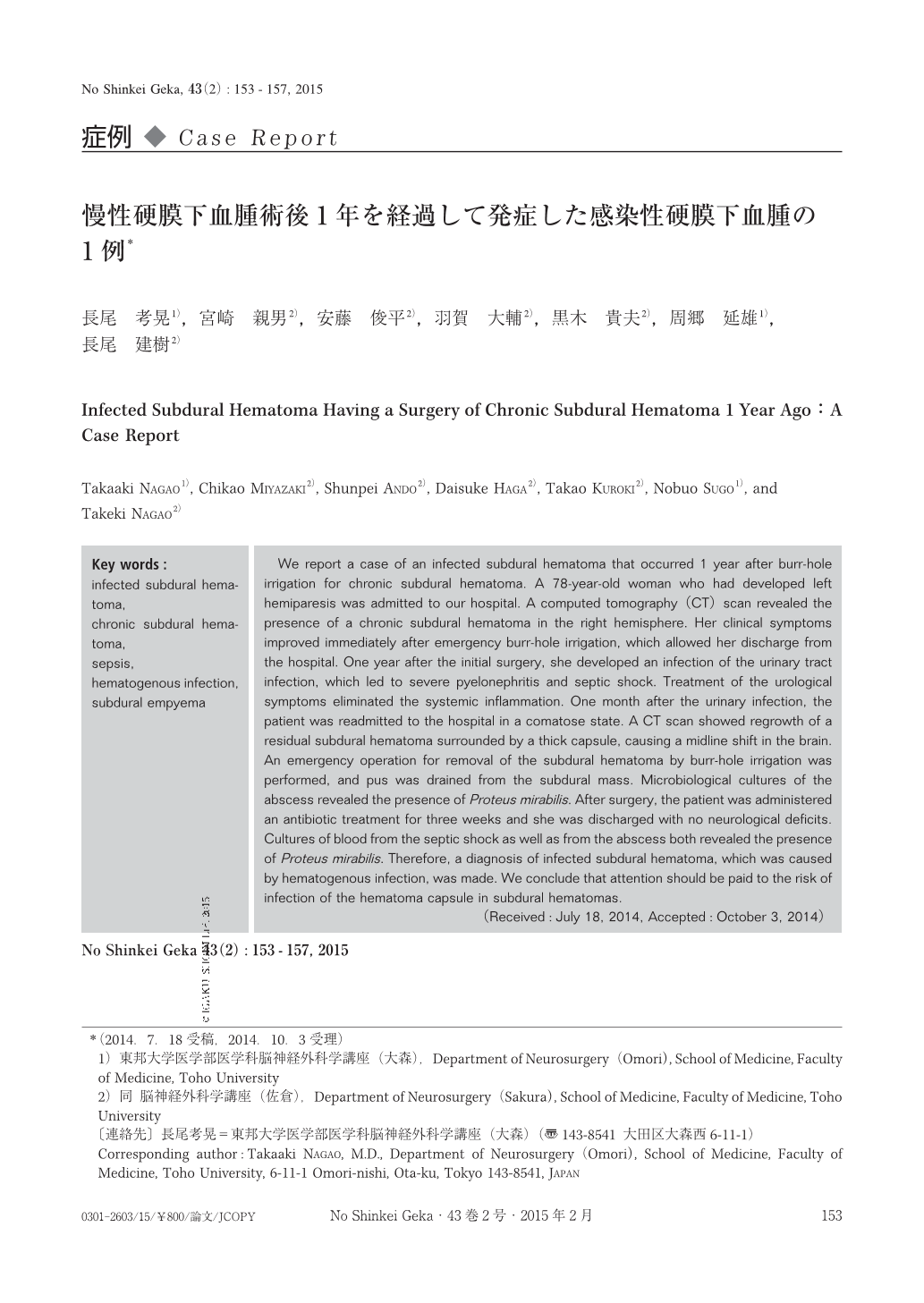
We report a case of an infected subdural hematoma that occurred 1 year after burr-hole irrigation for chronic subdural hematoma. A 78-year-old woman who had developed left hemiparesis was admitted to our hospital. A computed tomography(CT)scan revealed the presence of a chronic subdural hematoma in the right hemisphere. Her clinical symptoms improved immediately after emergency burr-hole irrigation, which allowed her discharge from the hospital. One year after the initial surgery, she developed an infection of the urinary tract infection, which led to severe pyelonephritis and septic shock. Treatment of the urological symptoms eliminated the systemic inflammation. One month after the urinary infection, the patient was readmitted to the hospital in a comatose state. A CT scan showed regrowth of a residual subdural hematoma surrounded by a thick capsule, causing a midline shift in the brain. An emergency operation for removal of the subdural hematoma by burr-hole irrigation was performed, and pus was drained from the subdural mass. Microbiological cultures of the abscess revealed the presence of Proteus mirabilis. After surgery, the patient was administered an antibiotic treatment for three weeks and she was discharged with no neurological deficits. Cultures of blood from the septic shock as well as from the abscess both revealed the presence of Proteus mirabilis. Therefore, a diagnosis of infected subdural hematoma, which was caused by hematogenous infection, was made. We conclude that attention should be paid to the risk of infection of the hematoma capsule in subdural hematomas.
Copyright © 2015, Igaku-Shoin Ltd. All rights reserved.