Japanese
English
- 有料閲覧
PPV購入案内
1,320円 (1,200円+税10%) こちらは、511ページから517ページの文献です。購入には医書.jp本会員登録が必要です。
会員登録完了後に改めて上記「購入サイトへ」を選択してください。
または「購入サイトへ」選択後に「購入ログイン」、「新規会員登録」の順に進んでください。
会員登録について詳しくはをご確認ください。
- Abstract 文献概要
- 1ページ目 Look Inside
- 参考文献 Reference
Ⅰ.はじめに
近年,さまざまな領域で内視鏡支援による検査・手術法が導入され,より低侵襲で安全な外科的治療法が報告されている.脳神経外科においても,下垂体手術や頭蓋底手術14),クリッピング術12,19),脳内血腫除去術18)など,多くの分野で用いられるようになった.水頭症に対するシャント手術においても,腹側カテーテルの腹腔内挿入を腹腔鏡支援下で行う手技が報告されている1-3,5-8,10,15-17).直視下で操作ができ,腹腔内で遠位カテーテルの開存を確認できること2,3,5),手術創が小さく低侵襲で,術後腹腔内癒着が最小限で済み,創部イレウスが少ないこと2,11),創部痛が軽減されること2,11),小児や肥満など比較的体型を選ばずに行えること3,5),遠位カテーテル閉塞が少ないこと8)などの有用性が報告されている.しかしながら本邦においては必ずしも普及していない7,16).これには,腹腔鏡使用において消化器外科の協力が必要であることに加えて,専用の腹腔穿刺針が存在しないなど,いまだ手技が確立されていないことが1つの要因であると思われる.
われわれは2010年6月より,すべてのシャント手術を腹腔鏡支援下に行ってきた.またその過程で,経臍的腹腔鏡手術およびそれに新しいデバイスを導入することで,より低侵襲な手技を確立することができた.
本報告では,われわれの行っている腹腔鏡支援下での挿入方法を紹介するとともに,これまでの自験例の手術成績について報告し,有用性と問題点を検討する.あわせて,われわれが用いているカテーテル挿入の際の腹腔穿刺針について紹介する.
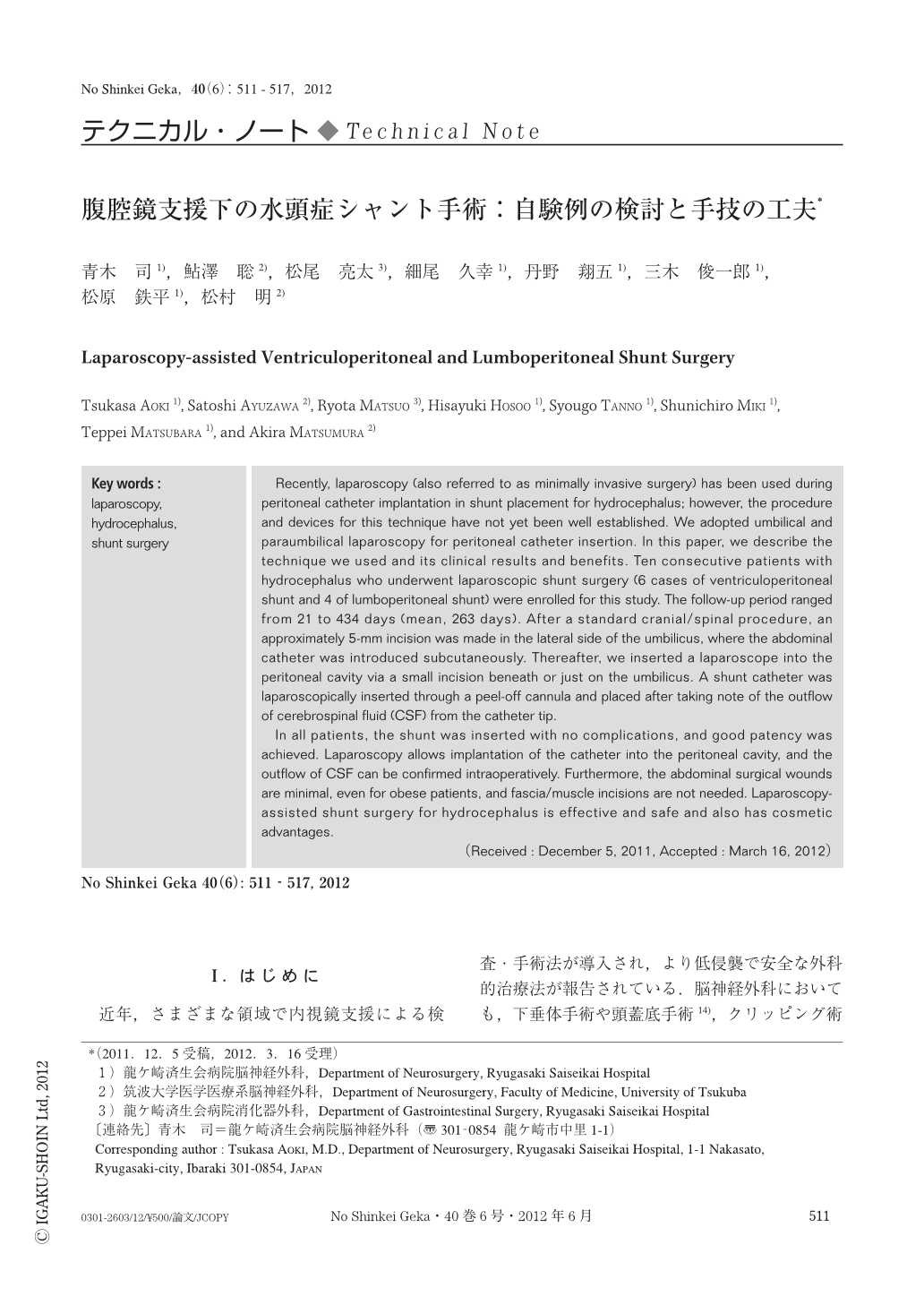
Recently,laparoscopy (also referred to as minimally invasive surgery) has been used during peritoneal catheter implantation in shunt placement for hydrocephalus; however,the procedure and devices for this technique have not yet been well established. We adopted umbilical and paraumbilical laparoscopy for peritoneal catheter insertion. In this paper,we describe the technique we used and its clinical results and benefits. Ten consecutive patients with hydrocephalus who underwent laparoscopic shunt surgery (6 cases of ventriculoperitoneal shunt and 4 of lumboperitoneal shunt) were enrolled for this study. The follow-up period ranged from 21 to 434 days (mean,263 days). After a standard cranial/spinal procedure,an approximately 5-mm incision was made in the lateral side of the umbilicus,where the abdominal catheter was introduced subcutaneously. Thereafter,we inserted a laparoscope into the peritoneal cavity via a small incision beneath or just on the umbilicus. A shunt catheter was laparoscopically inserted through a peel-off cannula and placed after taking note of the outflow of cerebrospinal fluid (CSF) from the catheter tip.
In all patients,the shunt was inserted with no complications,and good patency was achieved. Laparoscopy allows implantation of the catheter into the peritoneal cavity,and the outflow of CSF can be confirmed intraoperatively. Furthermore,the abdominal surgical wounds are minimal,even for obese patients,and fascia/muscle incisions are not needed. Laparoscopy-assisted shunt surgery for hydrocephalus is effective and safe and also has cosmetic advantages.
Copyright © 2012, Igaku-Shoin Ltd. All rights reserved.