Japanese
English
- 有料閲覧
PPV購入案内
1,320円 (1,200円+税10%) こちらは、771ページから778ページの文献です。購入には医書.jp本会員登録が必要です。
会員登録完了後に改めて上記「購入サイトへ」を選択してください。
または「購入サイトへ」選択後に「購入ログイン」、「新規会員登録」の順に進んでください。
会員登録について詳しくはをご確認ください。
- Abstract 文献概要
- 1ページ目 Look Inside
- 参考文献 Reference
Ⅰ.はじめに
初回のdigital subtraction angiography(DSA)で出血源が不明の非外傷性のくも膜下出血(subarachnoid hemorrhage:SAH)は,約5~20%の頻度でみられるとされ,これまでも数多くの報告がある2,6,7,10,13).通常,入院時のcomputed tomography(CT)上の血腫の分布所見から,perimesencephalic nonaneurysmal SAH(PMSAH)と,それ以外のnon-PMSAHに分類され,前者は再出血もなく予後良好とされる.PMSAHはオランダのグループのvan Gijnらによって初めて報告され14),その後同グループのRinkelらによってそのCT所見の血腫の特徴的な分布様式が定義された9).
しかし,PMSAHのCT所見の定義に関して表現上のあいまいさの問題があり,また,必ずしもその定義を満たさないvariantの報告もある12).これらのことを念頭に置き,今回われわれは,当科で経験した初回DSAで出血源が不明のSAH症例を検討した.
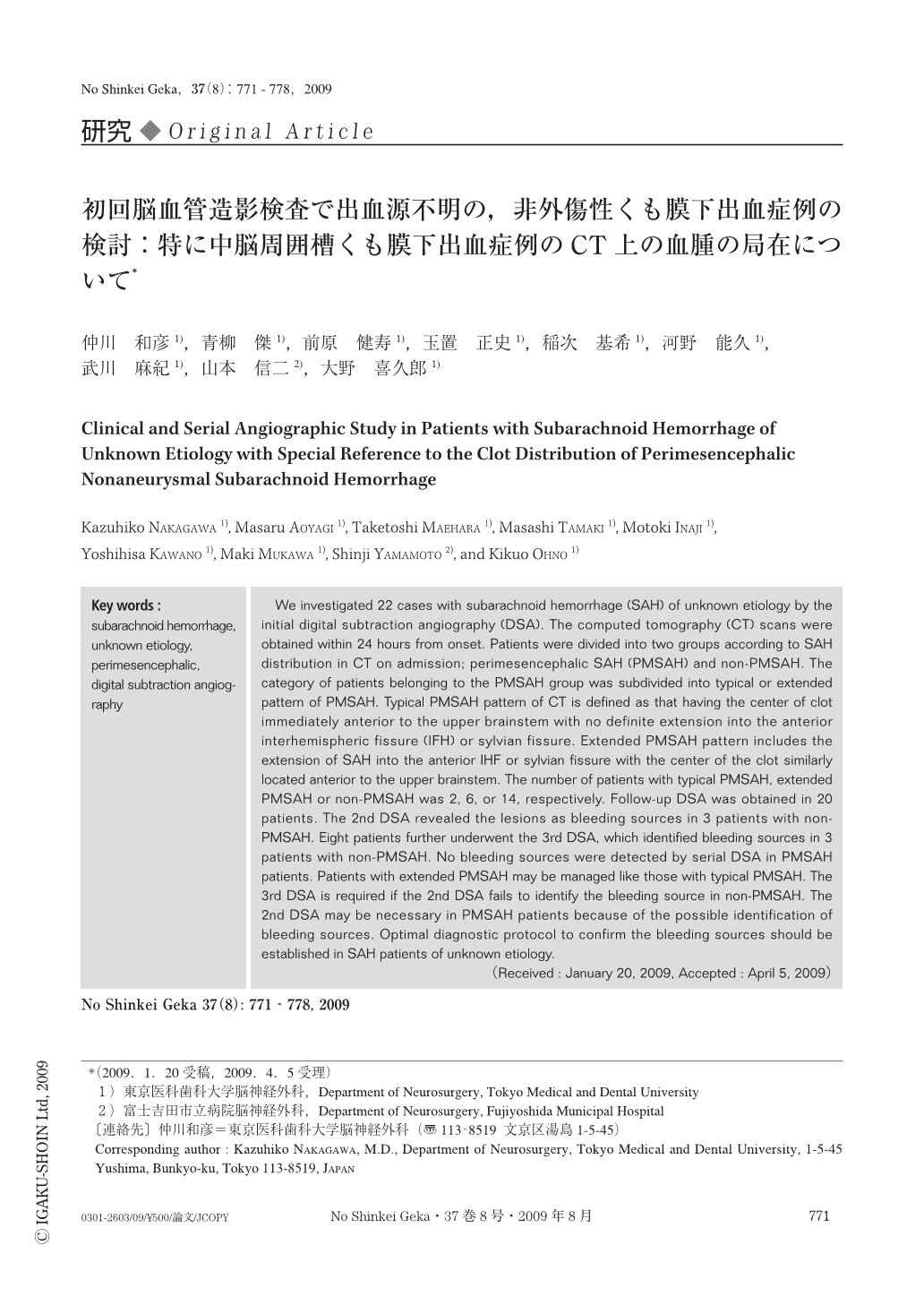
We investigated 22 cases with subarachnoid hemorrhage (SAH) of unknown etiology by the initial digital subtraction angiography (DSA). The computed tomography (CT) scans were obtained within 24 hours from onset. Patients were divided into two groups according to SAH distribution in CT on admission; perimesencephalic SAH (PMSAH) and non-PMSAH. The category of patients belonging to the PMSAH group was subdivided into typical or extended pattern of PMSAH. Typical PMSAH pattern of CT is defined as that having the center of clot immediately anterior to the upper brainstem with no definite extension into the anterior interhemispheric fissure (IFH) or sylvian fissure. Extended PMSAH pattern includes the extension of SAH into the anterior IHF or sylvian fissure with the center of the clot similarly located anterior to the upper brainstem. The number of patients with typical PMSAH, extended PMSAH or non-PMSAH was 2, 6, or 14, respectively. Follow-up DSA was obtained in 20 patients. The 2nd DSA revealed the lesions as bleeding sources in 3 patients with non-PMSAH. Eight patients further underwent the 3rd DSA, which identified bleeding sources in 3 patients with non-PMSAH. No bleeding sources were detected by serial DSA in PMSAH patients. Patients with extended PMSAH may be managed like those with typical PMSAH. The 3rd DSA is required if the 2nd DSA fails to identify the bleeding source in non-PMSAH. The 2nd DSA may be necessary in PMSAH patients because of the possible identification of bleeding sources. Optimal diagnostic protocol to confirm the bleeding sources should be established in SAH patients of unknown etiology.
Copyright © 2009, Igaku-Shoin Ltd. All rights reserved.