Japanese
English
- 有料閲覧
PPV購入案内
1,320円 (1,200円+税10%) こちらは、1013ページから1018ページの文献です。購入には医書.jp本会員登録が必要です。
会員登録完了後に改めて上記「購入サイトへ」を選択してください。
または「購入サイトへ」選択後に「購入ログイン」、「新規会員登録」の順に進んでください。
会員登録について詳しくはをご確認ください。
- Abstract 文献概要
- 1ページ目 Look Inside
- 参考文献 Reference
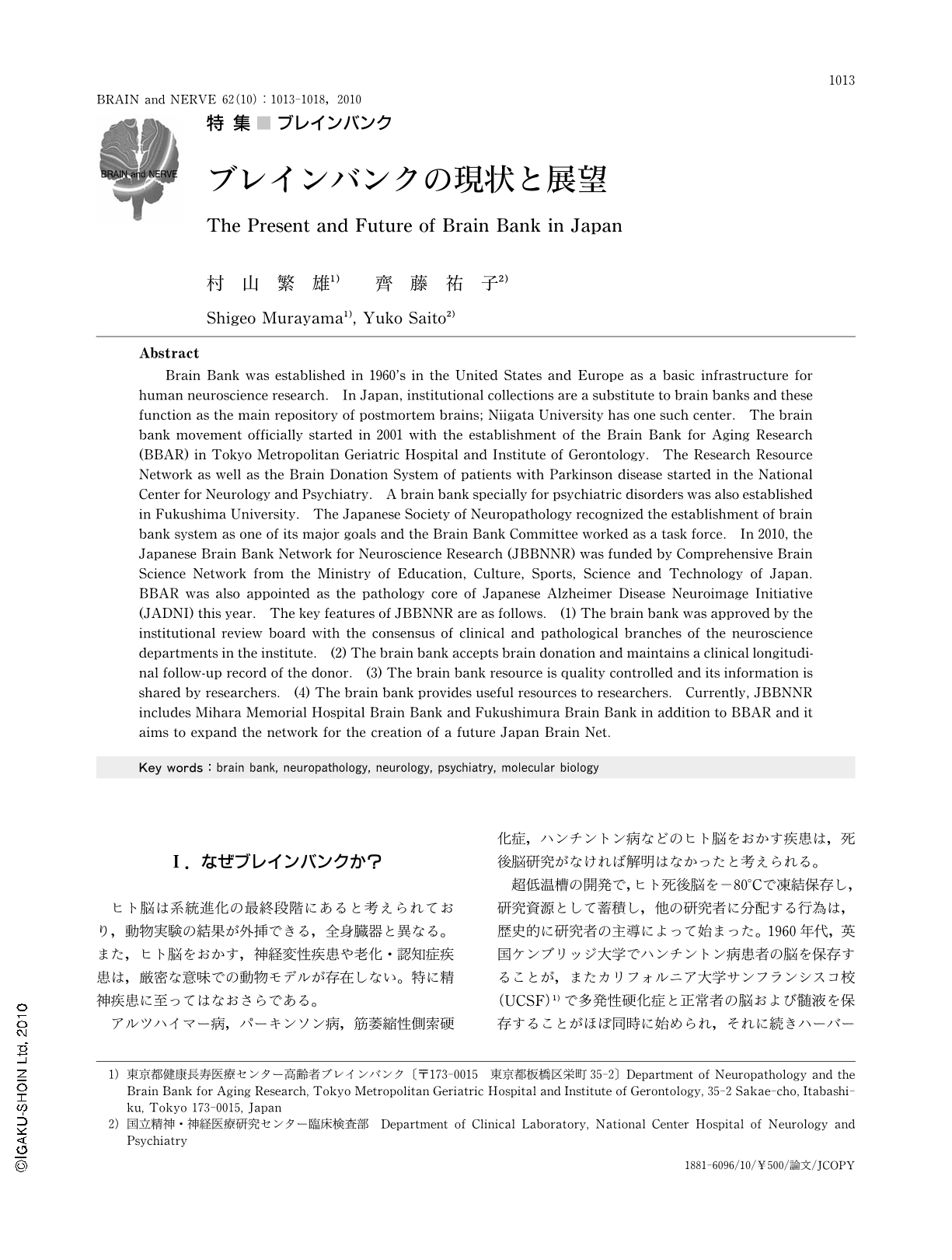
Ⅰ.なぜブレインバンクか?
ヒト脳は系統進化の最終段階にあると考えられており,動物実験の結果が外挿できる,全身臓器と異なる。また,ヒト脳をおかす,神経変性疾患や老化・認知症疾患は,厳密な意味での動物モデルが存在しない。特に精神疾患に至ってはなおさらである。
アルツハイマー病,パーキンソン病,筋萎縮性側索硬化症,ハンチントン病などのヒト脳をおかす疾患は,死後脳研究がなければ解明はなかったと考えられる。
Abstract
Brain Bank was established in 1960's in the United States and Europe as a basic infrastructure for human neuroscience research. In Japan,institutional collections are a substitute to brain banks and these function as the main repository of postmortem brains; Niigata University has one such center. The brain bank movement officially started in 2001 with the establishment of the Brain Bank for Aging Research (BBAR) in Tokyo Metropolitan Geriatric Hospital and Institute of Gerontology. The Research Resource Network as well as the Brain Donation System of patients with Parkinson disease started in the National Center for Neurology and Psychiatry. A brain bank specially for psychiatric disorders was also established in Fukushima University. The Japanese Society of Neuropathology recognized the establishment of brain bank system as one of its major goals and the Brain Bank Committee worked as a task force. In 2010,the Japanese Brain Bank Network for Neuroscience Research (JBBNNR) was funded by Comprehensive Brain Science Network from the Ministry of Education,Culture,Sports,Science and Technology of Japan. BBAR was also appointed as the pathology core of Japanese Alzheimer Disease Neuroimage Initiative (JADNI) this year. The key features of JBBNNR are as follows. (1) The brain bank was approved by the institutional review board with the consensus of clinical and pathological branches of the neuroscience departments in the institute. (2) The brain bank accepts brain donation and maintains a clinical longitudinal follow-up record of the donor. (3) The brain bank resource is quality controlled and its information is shared by researchers. (4) The brain bank provides useful resources to researchers. Currently,JBBNNR includes Mihara Memorial Hospital Brain Bank and Fukushimura Brain Bank in addition to BBAR and it aims to expand the network for the creation of a future Japan Brain Net.
Copyright © 2010, Igaku-Shoin Ltd. All rights reserved.