Japanese
English
- 有料閲覧
PPV購入案内
1,320円 (1,200円+税10%) こちらは、363ページから367ページの文献です。購入には医書.jp本会員登録が必要です。
会員登録完了後に改めて上記「購入サイトへ」を選択してください。
または「購入サイトへ」選択後に「購入ログイン」、「新規会員登録」の順に進んでください。
会員登録について詳しくはをご確認ください。
- Abstract 文献概要
- 1ページ目 Look Inside
- 参考文献 Reference
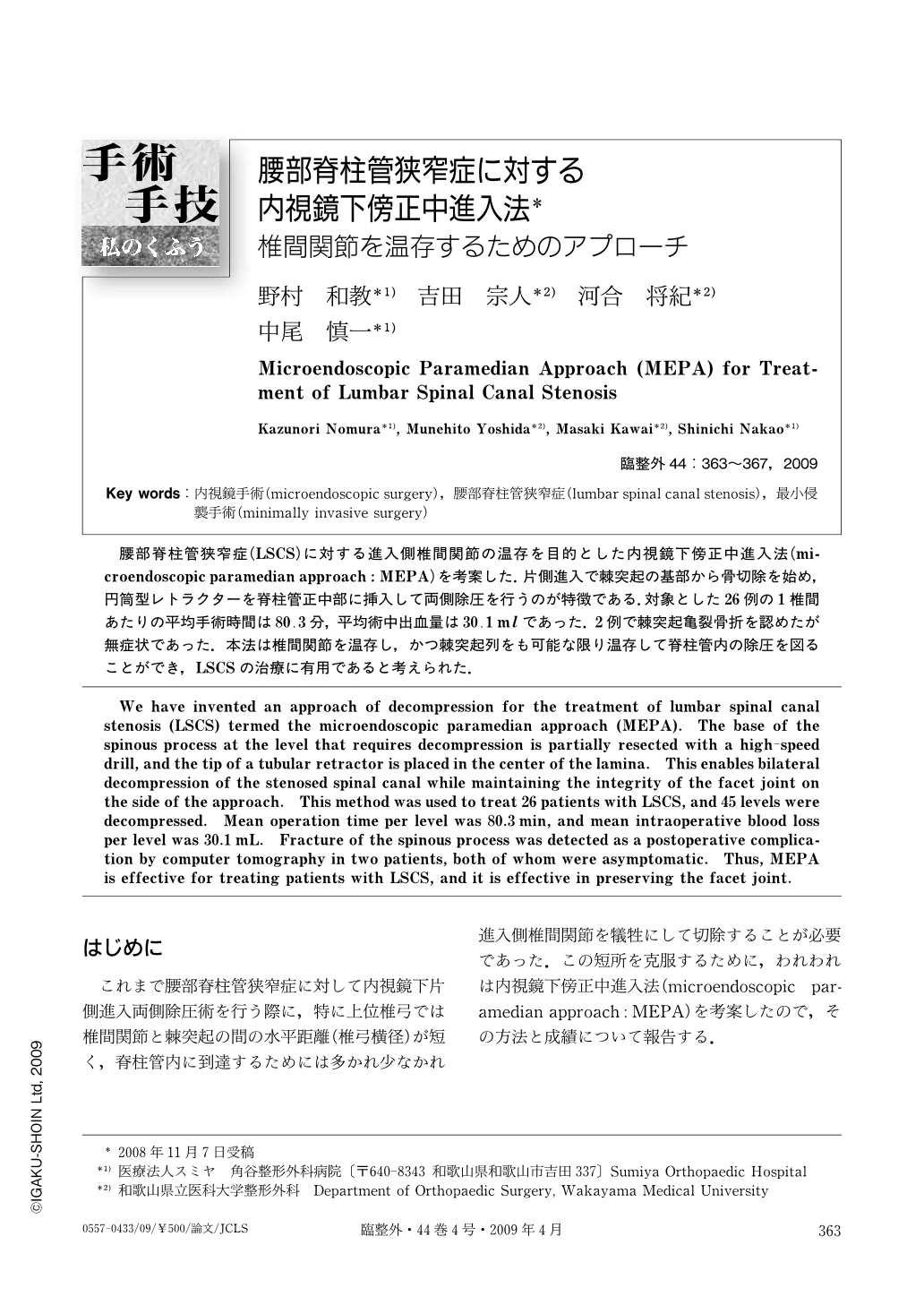
腰部脊柱管狭窄症(LSCS)に対する進入側椎間関節の温存を目的とした内視鏡下傍正中進入法(microendoscopic paramedian approach:MEPA)を考案した.片側進入で棘突起の基部から骨切除を始め,円筒型レトラクターを脊柱管正中部に挿入して両側除圧を行うのが特徴である.対象とした26例の1椎間あたりの平均手術時間は80.3分,平均術中出血量は30.1mlであった.2例で棘突起亀裂骨折を認めたが無症状であった.本法は椎間関節を温存し,かつ棘突起列をも可能な限り温存して脊柱管内の除圧を図ることができ,LSCSの治療に有用であると考えられた.
We have invented an approach of decompression for the treatment of lumbar spinal canal stenosis (LSCS) termed the microendoscopic paramedian approach (MEPA). The base of the spinous process at the level that requires decompression is partially resected with a high-speed drill, and the tip of a tubular retractor is placed in the center of the lamina. This enables bilateral decompression of the stenosed spinal canal while maintaining the integrity of the facet joint on the side of the approach. This method was used to treat 26 patients with LSCS, and 45 levels were decompressed. Mean operation time per level was 80.3min, and mean intraoperative blood loss per level was 30.1mL. Fracture of the spinous process was detected as a postoperative complication by computer tomography in two patients, both of whom were asymptomatic. Thus, MEPA is effective for treating patients with LSCS, and it is effective in preserving the facet joint.
Copyright © 2009, Igaku-Shoin Ltd. All rights reserved.