Japanese
English
- 有料閲覧
PPV購入案内
1,320円 (1,200円+税10%) こちらは、167ページから172ページの文献です。購入には医書.jp本会員登録が必要です。
会員登録完了後に改めて上記「購入サイトへ」を選択してください。
または「購入サイトへ」選択後に「購入ログイン」、「新規会員登録」の順に進んでください。
会員登録について詳しくはをご確認ください。
- Abstract 文献概要
- 1ページ目 Look Inside
- 参考文献 Reference
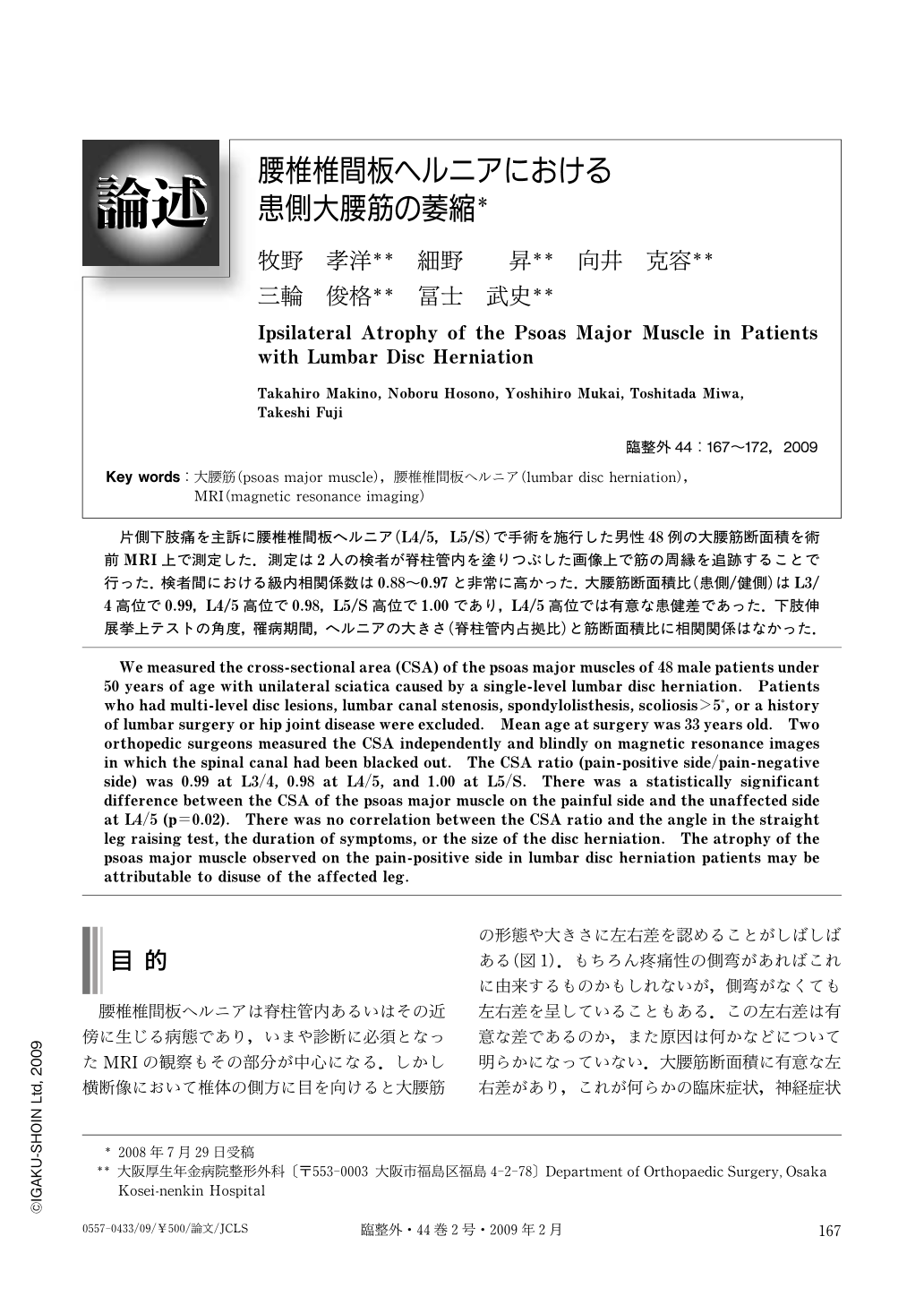
片側下肢痛を主訴に腰椎椎間板ヘルニア(L4/5,L5/S)で手術を施行した男性48例の大腰筋断面積を術前MRI上で測定した.測定は2人の検者が脊柱管内を塗りつぶした画像上で筋の周縁を追跡することで行った.検者間における級内相関係数は0.88~0.97と非常に高かった.大腰筋断面積比(患側/健側)はL3/4高位で0.99,L4/5高位で0.98,L5/S高位で1.00であり,L4/5高位では有意な患健差であった.下肢伸展挙上テストの角度,罹病期間,ヘルニアの大きさ(脊柱管内占拠比)と筋断面積比に相関関係はなかった.
We measured the cross-sectional area (CSA) of the psoas major muscles of 48 male patients under 50 years of age with unilateral sciatica caused by a single-level lumbar disc herniation. Patients who had multi-level disc lesions, lumbar canal stenosis, spondylolisthesis, scoliosis>5°, or a history of lumbar surgery or hip joint disease were excluded. Mean age at surgery was 33 years old. Two orthopedic surgeons measured the CSA independently and blindly on magnetic resonance images in which the spinal canal had been blacked out. The CSA ratio (pain-positive side/pain-negative side) was 0.99 at L3/4,0.98 at L4/5, and 1.00 at L5/S. There was a statistically significant difference between the CSA of the psoas major muscle on the painful side and the unaffected side at L4/5 (p=0.02). There was no correlation between the CSA ratio and the angle in the straight leg raising test, the duration of symptoms, or the size of the disc herniation. The atrophy of the psoas major muscle observed on the pain-positive side in lumbar disc herniation patients may be attributable to disuse of the affected leg.
Copyright © 2009, Igaku-Shoin Ltd. All rights reserved.