Japanese
English
- 有料閲覧
PPV購入案内
1,320円 (1,200円+税10%) こちらは、79ページから83ページの文献です。購入には医書.jp本会員登録が必要です。
会員登録完了後に改めて上記「購入サイトへ」を選択してください。
または「購入サイトへ」選択後に「購入ログイン」、「新規会員登録」の順に進んでください。
会員登録について詳しくはをご確認ください。
- Abstract 文献概要
- 1ページ目 Look Inside
- 参考文献 Reference
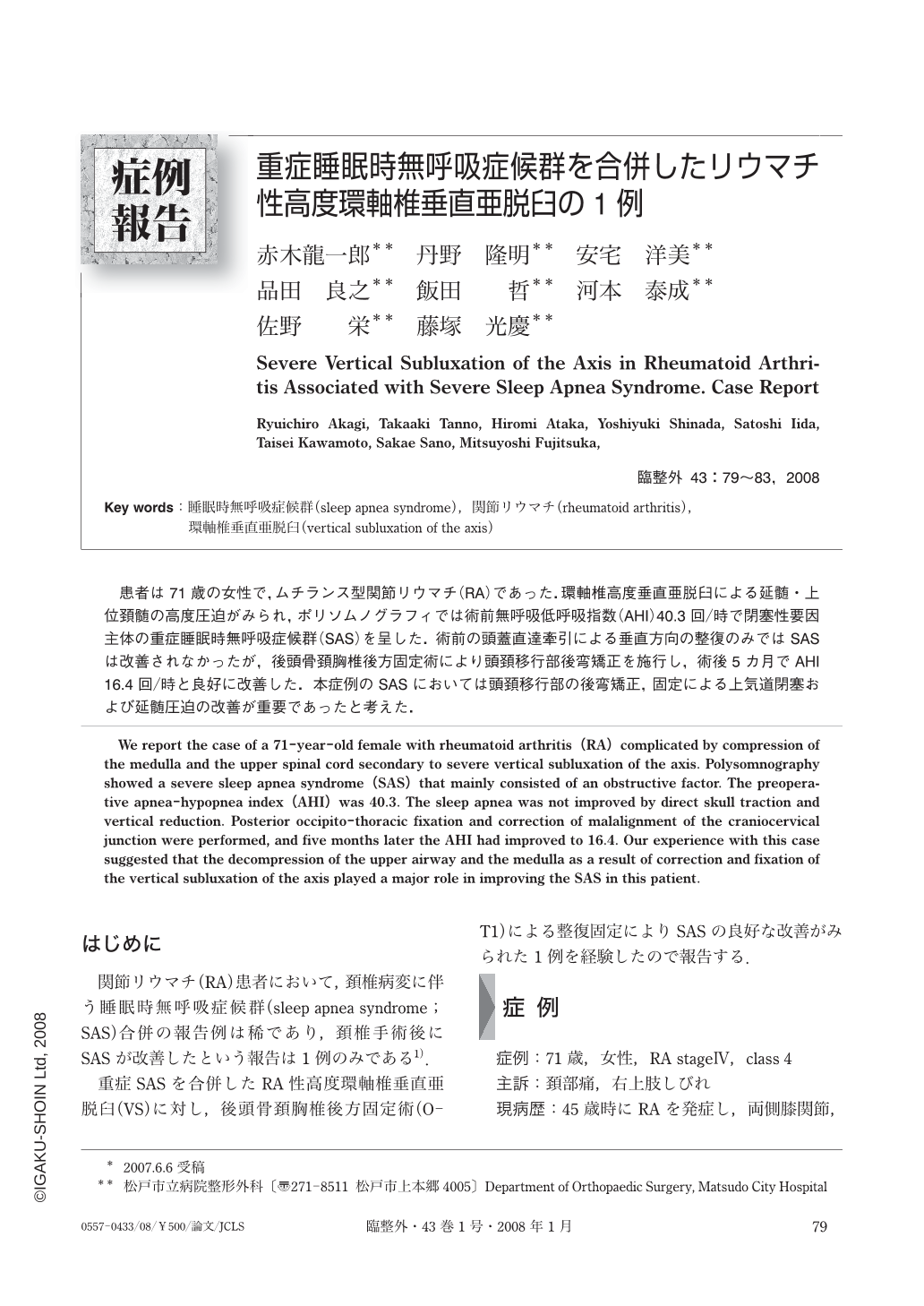
患者は71歳の女性で,ムチランス型関節リウマチ(RA)であった.環軸椎高度垂直亜脱臼による延髄・上位頚髄の高度圧迫がみられ,ポリソムノグラフィでは術前無呼吸低呼吸指数(AHI)40.3回/時で閉塞性要因主体の重症睡眠時無呼吸症候群(SAS)を呈した.術前の頭蓋直達牽引による垂直方向の整復のみではSASは改善されなかったが,後頭骨頚胸椎後方固定術により頭頚移行部後弯矯正を施行し,術後5カ月でAHI 16.4回/時と良好に改善した.本症例のSASにおいては頭頚移行部の後弯矯正,固定による上気道閉塞および延髄圧迫の改善が重要であったと考えた.
We report the case of a 71-year-old female with rheumatoid arthritis (RA) complicated by compression of the medulla and the upper spinal cord secondary to severe vertical subluxation of the axis. Polysomnography showed a severe sleep apnea syndrome (SAS) that mainly consisted of an obstructive factor. The preoperative apnea-hypopnea index (AHI) was 40.3. The sleep apnea was not improved by direct skull traction and vertical reduction. Posterior occipito-thoracic fixation and correction of malalignment of the craniocervical junction were performed, and five months later the AHI had improved to 16.4. Our experience with this case suggested that the decompression of the upper airway and the medulla as a result of correction and fixation of the vertical subluxation of the axis played a major role in improving the SAS in this patient.
Copyright © 2008, Igaku-Shoin Ltd. All rights reserved.