Japanese
English
- 有料閲覧
PPV購入案内
1,320円 (1,200円+税10%) こちらは、39ページから47ページの文献です。購入には医書.jp本会員登録が必要です。
会員登録完了後に改めて上記「購入サイトへ」を選択してください。
または「購入サイトへ」選択後に「購入ログイン」、「新規会員登録」の順に進んでください。
会員登録について詳しくはをご確認ください。
- Abstract 文献概要
- 1ページ目 Look Inside
はじめに
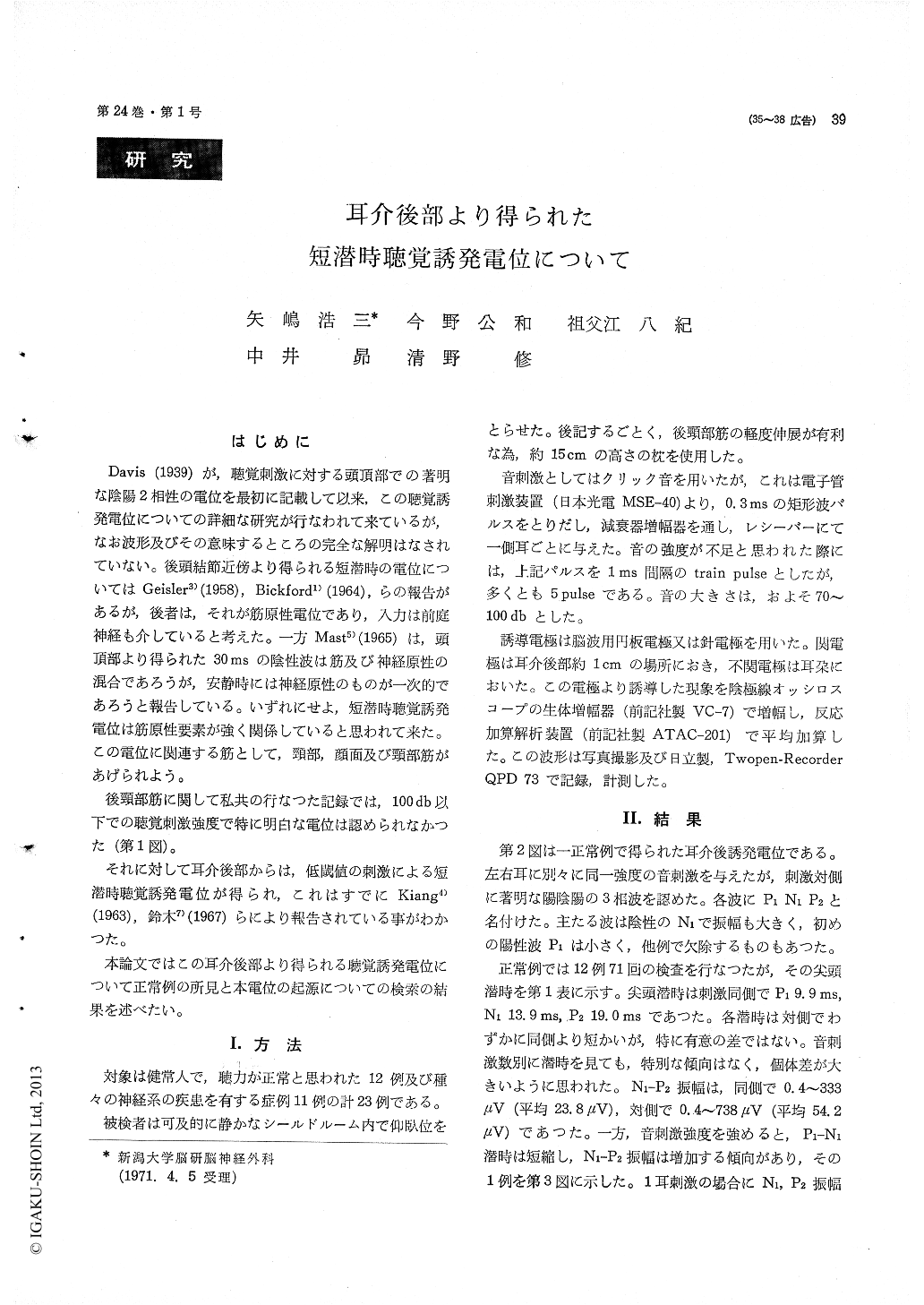
Davis (1939)が,聴覚刺激に対する頭頂部での著明な陰陽2相性の電位を最初に記載して以来,この聴覚誘発電位についての詳細な研究が行なわれて来ているが,なお波形及びその意味するところの完全な解明はなされていない。後頭結節近傍より得られる短潜時の電位についてはGeisler3)(1958),Bickford1)(1964),らの報告があるが,後者は,それが筋原性電位であり,入力は前庭神経も介していると考えた。一方Mast5)(1965)は,頭頂部より得られた30msの陰性波は筋及び神経原性の混合であろうが,安静時には神経原性のものが一次的であろうと報告している。いずれにせよ,短潜時聴覚誘発電位は筋原性要素が強く関係していると思われて来た。この電位に関連する筋として,頸部,顔面及び頸部筋があげられよう。
後頸部筋に関して私共の行なつた記録では,100db以下での聴覚刺激強度で特に明白な電位は認められなかつた(第1図)。
The human average evoked responses to auditorystimuli within 50 msec were recorded from theregion just behind the auricle and the ear lobe.The stimuli were 0. 3 msec pulses from a generator,which were amplified and devered to monoauralheadphone with intensity of about 70-100 dB.Twelve subjects with clinically normal hearing andeleven subjee4 with some lesions in nervous systemwere studied. We obtained the following results.
1) The responses consisted of three waves, posi-tive-negative-positive waves, and each of them wasnamed P1, N1 and P2, respectively. Ni was themost prominent but P1 was small and sometimesfailed.
2) Peak latencies of the response were measuredin 71 experimental sessions in the normal subjects.The values were as follows : P1 9.9±1.0 msec, N114.1±1.4 msec, P2 19.0±2.2 msec on stimulatedside and P1 9.6±1.0 msec, N1 13.7+1.3 msec on the non-stimulated side. N1-P2 amplitudes were0.4-333 μⅤ (mean value : 23.8 μⅤ) ipsilaterally and0.4-738 μⅤ (mean value : 54.2 μⅤ) contralaterally.As the intensity more increased, the peak latenciesof P1 and N1 became shorter and N1-P2 amplitude larger.
3) Twenty-four eares in the twelve normal sub-jects were stimulated. N1-P1 amplitudes on bothsides were compared with each other. The ampli-tudes on both sides were compared with each other. The amplitude was greater in 9 ears ipsilaterallyand in 10 ears contralaterally. There were no dif-ference in 4 ears and no response in one ear.
4) N1-P2 amplitude became larger when theexaminee flexed his neck, clenched his jaw, raisedhis brow, closed his eyes and mouth tightly, graspedhis hands, and calculated mentally, while it becamesmaller when he opened his eyes.
5) During light sleep this amplitude decreasedin one subject.
6) These responses could be detected only onsmall area just behind the auricle.
7) When the electrode was inserted into thetemporal muscle in one case, this response couldnot be detected.
8) In three ceses with facial palsy, these responsesalso existed on the paralytic side. Ni peak latencywas prolonged in two cases of tumor, one wassupratentorial tumor and the other was infratent-orial. In spite of high intensity stimulation to bothsides, no responses were obtained in three caseswith other disordere.
9) From these findings we considered that theorigin of these responses was neither from theinnervated by facial nerve, for example to auriclarmuscle, the stapedial muscle and the tensor tympamimuscle, nor from the temporal muscle and theback neck muscle.
Copyright © 1972, Igaku-Shoin Ltd. All rights reserved.