Japanese
English
- 有料閲覧
PPV購入案内
1,320円 (1,200円+税10%) こちらは、1179ページから1189ページの文献です。購入には医書.jp本会員登録が必要です。
会員登録完了後に改めて上記「購入サイトへ」を選択してください。
または「購入サイトへ」選択後に「購入ログイン」、「新規会員登録」の順に進んでください。
会員登録について詳しくはをご確認ください。
- Abstract 文献概要
- 1ページ目 Look Inside
- 参考文献 Reference
抄録
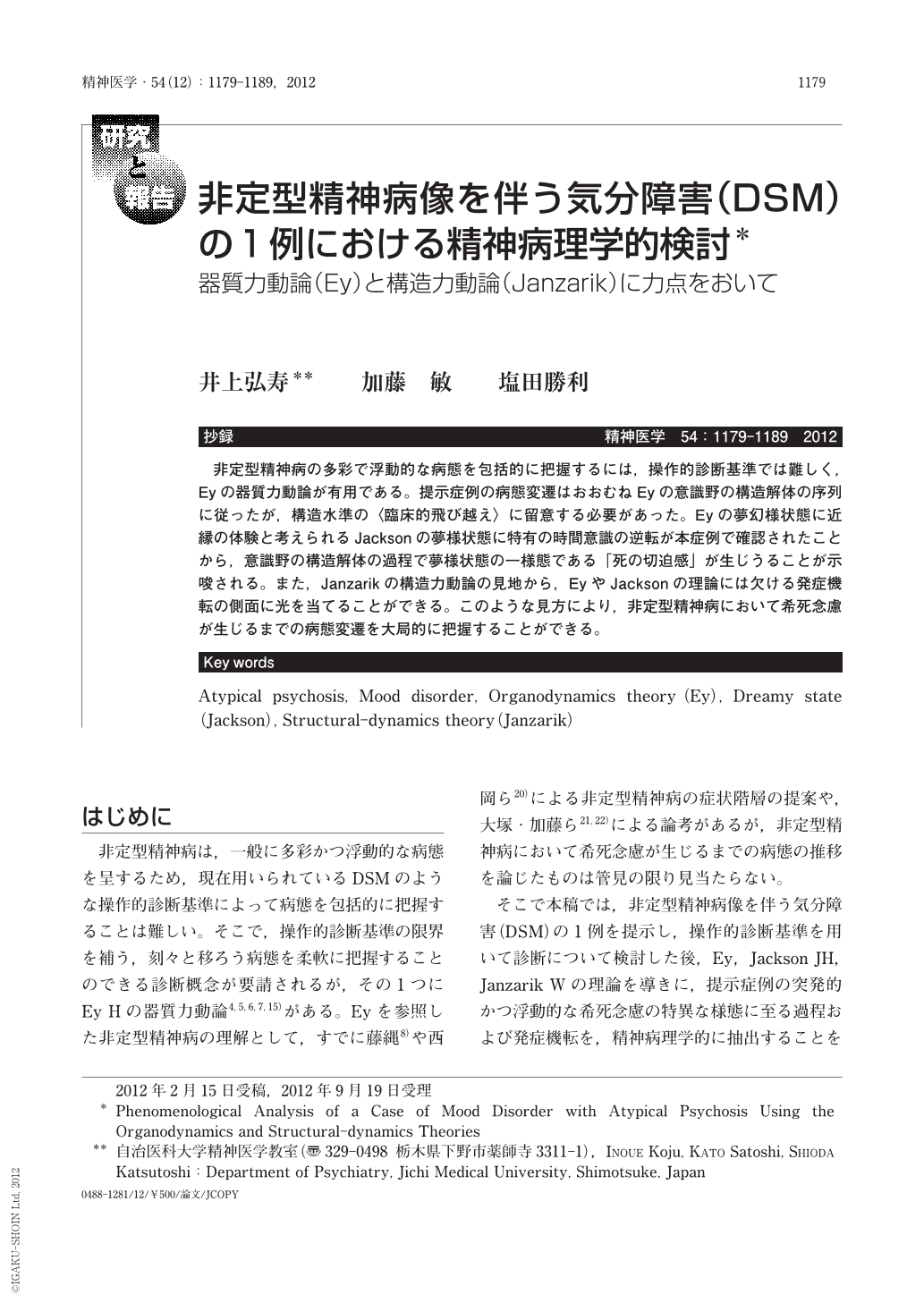
非定型精神病の多彩で浮動的な病態を包括的に把握するには,操作的診断基準では難しく,Eyの器質力動論が有用である。提示症例の病態変遷はおおむねEyの意識野の構造解体の序列に従ったが,構造水準の〈臨床的飛び越え〉に留意する必要があった。Eyの夢幻様状態に近縁の体験と考えられるJacksonの夢様状態に特有の時間意識の逆転が本症例で確認されたことから,意識野の構造解体の過程で夢様状態の一様態である「死の切迫感」が生じうることが示唆される。また,Janzarikの構造力動論の見地から,EyやJacksonの理論には欠ける発症機転の側面に光を当てることができる。このような見方により,非定型精神病において希死念慮が生じるまでの病態変遷を大局的に把握することができる。
Here, we report the case of a patient who presented with diverse and significantly variable psychiatric symptoms. It was difficult to understand the psychopathology of the patient using manipulative diagnostic systems, such as the Diagnostic and Statistical Manual of Mental Disorders (DSM), which are more applicable to dormant symptoms. Thus, a flexible diagnostic system that considers diverse, variable psychiatric symptoms was required. The organodynamics theory described by Ey H is one such system.
For our patient, the transition of psychiatric symptoms coincided with sequences for the “disintegration of field of consciousness” (“déstructuration du champ de la conscience” in French) described by Ey. However, the following 2 aspects are noteworthy. First, “disintegration of field of consciousness” is more likely to be exacerbated in the hypnagogic and hypnopompic transition periods and when the patient wakes up at night, as indicated by the fact that this has been rarely monitored by medical staff. Second, a “clinical leap” out of “disintegration of field of consciousness,” is possible, for example, a confusional state can suddenly emerge from a depressive state.
Furthermore, the patient exhibited “inverted time consciousness,” which is characteristic of the “dreamy state” described by Jackson JH. We think that the “dreamy state” can emerge in the course of “disintegration of field of consciousness” because the “dreamy state” and “oneiroid state” (described by Ey) are believed to be very close experiences. Hence, we must pay considerable attention to “impending death,” which occurs in the “dreamy state.”
According to the structural-dynamics theory described by Janzarik W, our patient with premorbid personality showing high innate values of “vital dynamics” and “situation cohesiveness” (described by Otsuka and Kato) had possibly developed “confusional dynamic derailment” (“dynamische Entgleisung” in German), i.e., atypical psychosis through a stage of manic-depression mixed state mainly due to strong psychological burden and antidepressants which can exacerbate “dynamic derailment.”
Copyright © 2012, Igaku-Shoin Ltd. All rights reserved.