Japanese
English
- 有料閲覧
PPV購入案内
1,320円 (1,200円+税10%) こちらは、721ページから726ページの文献です。購入には医書.jp本会員登録が必要です。
会員登録完了後に改めて上記「購入サイトへ」を選択してください。
または「購入サイトへ」選択後に「購入ログイン」、「新規会員登録」の順に進んでください。
会員登録について詳しくはをご確認ください。
- Abstract 文献概要
- 1ページ目 Look Inside
- 参考文献 Reference
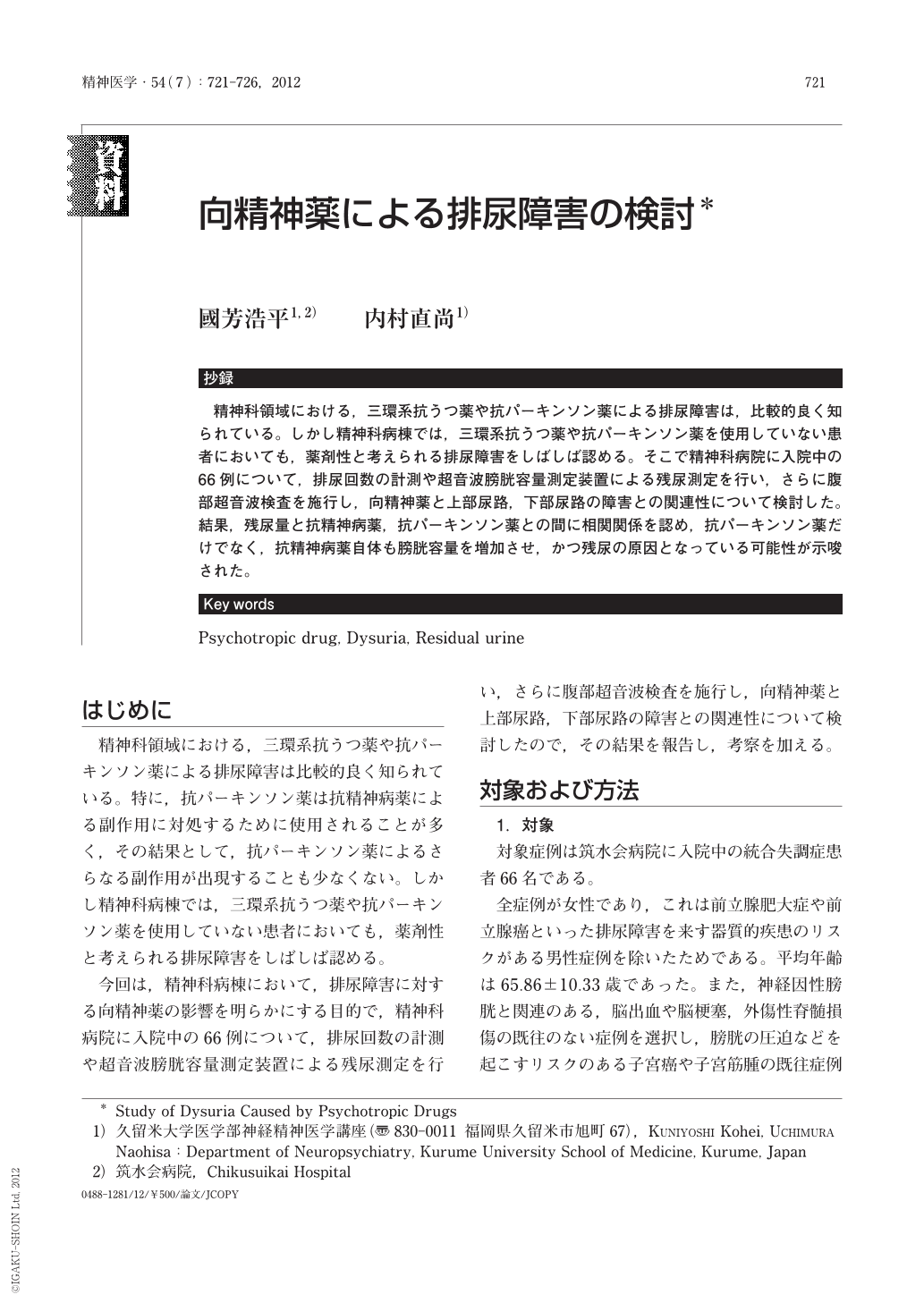
抄録
精神科領域における,三環系抗うつ薬や抗パーキンソン薬による排尿障害は,比較的良く知られている。しかし精神科病棟では,三環系抗うつ薬や抗パーキンソン薬を使用していない患者においても,薬剤性と考えられる排尿障害をしばしば認める。そこで精神科病院に入院中の66例について,排尿回数の計測や超音波膀胱容量測定装置による残尿測定を行い,さらに腹部超音波検査を施行し,向精神薬と上部尿路,下部尿路の障害との関連性について検討した。結果,残尿量と抗精神病薬,抗パーキンソン薬との間に相関関係を認め,抗パーキンソン薬だけでなく,抗精神病薬自体も膀胱容量を増加させ,かつ残尿の原因となっている可能性が示唆された。
In the field of psychiatry, it is well known that tricyclic antidepressants and antiparkinson drugs may canse dysuria. However, dysuria, which is considered to be caused mainly by the use of these drugs, is often observed in psychiatric wards even in patients who are not being treated with tricyclic antidepressants and antiparkinson drugs. Thus, we examined the relation between psychotropic drugs and upper/lower urinary tract damage by measuring urinary frequency, and determining residual urine levels by ultrasonographic measurement of bladder capacity as well as abdominal ultrasonography in 66 inpatients in a mental hospital. Consequently, a correlation was confirmed between the residual urine level and treatment with psychotropic/antiparkinson drugs. The results also suggest that in addition to antiparkinson drugs, all psychotropic drugs might cause residual urine by increasing bladder capacity.
Copyright © 2012, Igaku-Shoin Ltd. All rights reserved.