Japanese
English
- 有料閲覧
PPV購入案内
1,320円 (1,200円+税10%) こちらは、851ページから855ページの文献です。購入には医書.jp本会員登録が必要です。
会員登録完了後に改めて上記「購入サイトへ」を選択してください。
または「購入サイトへ」選択後に「購入ログイン」、「新規会員登録」の順に進んでください。
会員登録について詳しくはをご確認ください。
- Abstract 文献概要
- 1ページ目 Look Inside
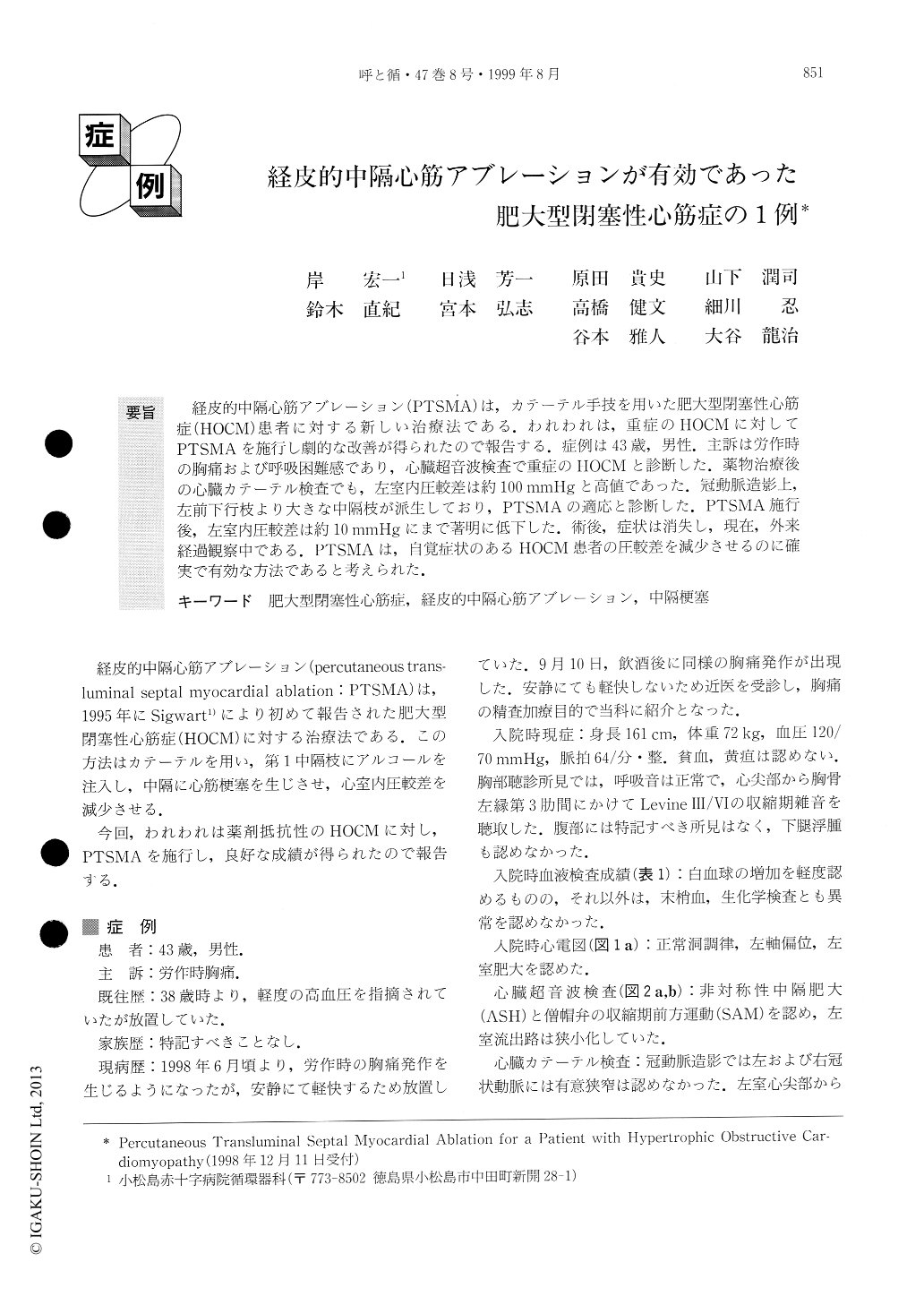
経皮的中隔心筋アブレーション(PTSMA)は,カテーテル手技を用いた肥大型閉塞性心筋症(HOCM)患者に対する新しい治療法である.われわれは,重症のHOCMに対してPTSMAを施行し劇的な改善が得られたので報告する.症例は43歳,男性.主訴は労作時の胸痛および呼吸困難感であり,心臓超音波検査で重症のHOCMと診断した.薬物治療後の心臓カテーテル検査でも,左室内圧較差は約100mmHgと高値であった.冠動脈造影上,左前下行枝より大きな中隔枝が派生しており,PTSMAの適応と診断した.PTSMA施行後,左室内圧較差は約10mmHgにまで著明に低下した.術後,症状は消失し,現在,外来経過観察中である.PTSMAは,自覚症状のあるHOCM患者の圧較差を減少させるのに確実で有効な方法であると考えられた.
We report a case of severe hypertrophic obstructive cardiomyopathy (HOCM) that was dramatically improved by percutaneous transluminal infarction (PTSMA). A 43-year-old man with a history of chest pain and dyspnea on effort (NYHA class II-III) was admitted to our hospital. His clinical findings were typical of HOCM. Cardiac catheterization showed a resting pressure gradient across the left ventricular outflow tract of 100 mmHg despite medical treatment. Coronary angiography revealed a large septal branch of the left anterior descending artery. A 2.5 mm percutaneous transluminal angioplasty balloon was inserted into the septal artery via a 0.014 inch guidewire. The balloon was inflated to a pressure of 4 atms, occluding the artery. Absolute alcohol was injected slowly through the inflated balloon into the artery. Five minutes after the alcohol injection was completed, the balloon was deflated and removed. The septal branch was completely blocked and the pressure gradient decreased to 10 mmHg after the procedure. The patient remains asymptomatic (NYHA I) and has returned to work. Further long-term follow-up is needed, but PTSMA would seem to he a promising technique for reducing the pressure gradient in symptomatic patients with HOCM.
Copyright © 1999, Igaku-Shoin Ltd. All rights reserved.