Japanese
English
- 有料閲覧
PPV購入案内
1,320円 (1,200円+税10%) こちらは、360ページから372ページの文献です。購入には医書.jp本会員登録が必要です。
会員登録完了後に改めて上記「購入サイトへ」を選択してください。
または「購入サイトへ」選択後に「購入ログイン」、「新規会員登録」の順に進んでください。
会員登録について詳しくはをご確認ください。
- Abstract 文献概要
- 1ページ目 Look Inside
- 参考文献 Reference
- サイト内被引用 Cited by
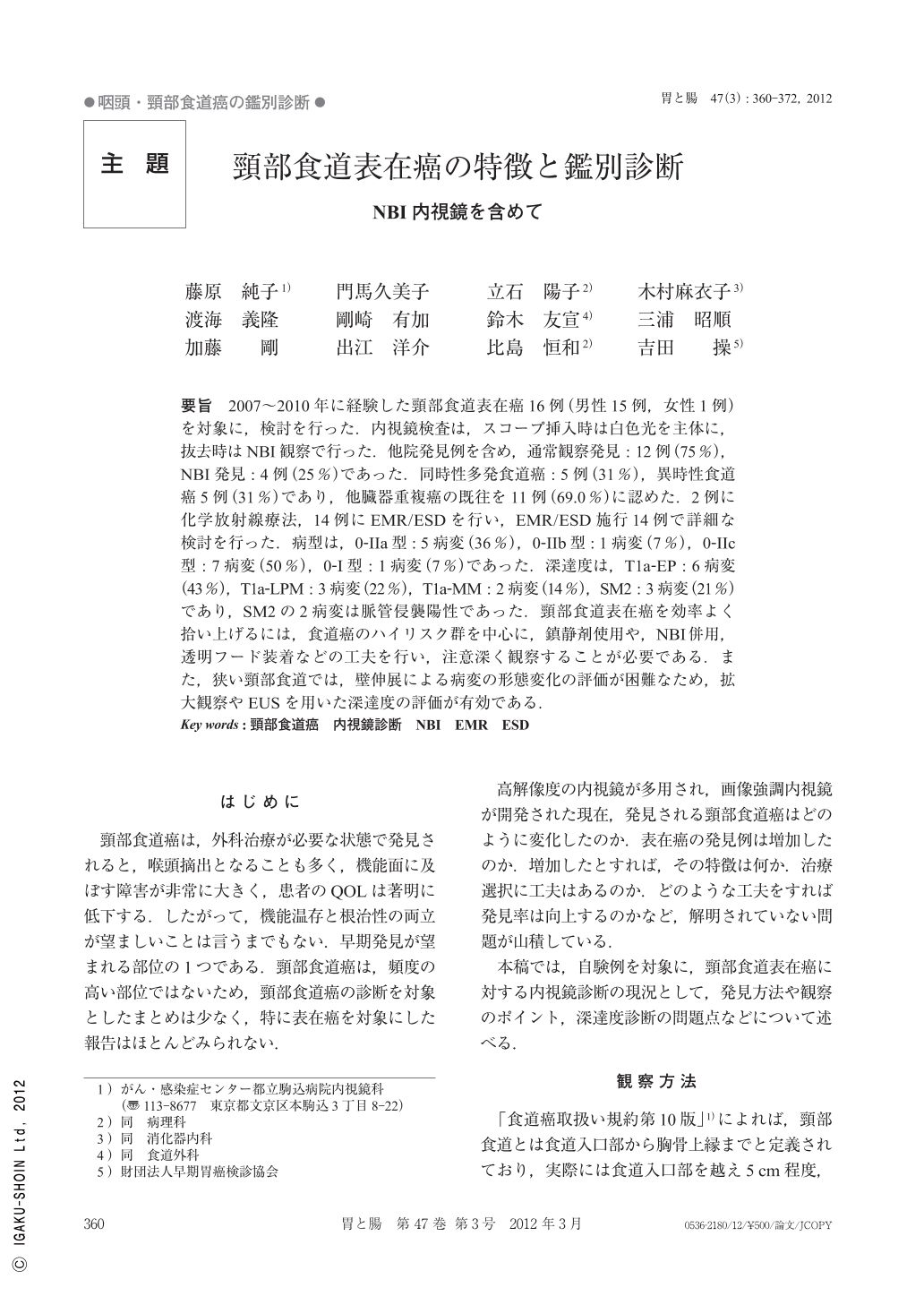
要旨 2007~2010年に経験した頸部食道表在癌16例(男性15例,女性1例)を対象に,検討を行った.内視鏡検査は,スコープ挿入時は白色光を主体に,抜去時はNBI観察で行った.他院発見例を含め,通常観察発見:12例(75%),NBI発見:4例(25%)であった.同時性多発食道癌:5例(31%),異時性食道癌5例(31%)であり,他臓器重複癌の既往を11例(69.0%)に認めた.2例に化学放射線療法,14例にEMR/ESDを行い,EMR/ESD施行14例で詳細な検討を行った.病型は,0-IIa型:5病変(36%),0-IIb型:1病変(7%),0-IIc型:7病変(50%),0-I型:1病変(7%)であった.深達度は,T1a-EP:6病変(43%),T1a-LPM:3病変(22%),T1a-MM:2病変(14%),SM2:3病変(21%)であり,SM2の2病変は脈管侵襲陽性であった.頸部食道表在癌を効率よく拾い上げるには,食道癌のハイリスク群を中心に,鎮静剤使用や,NBI併用,透明フード装着などの工夫を行い,注意深く観察することが必要である.また,狭い頸部食道では,壁伸展による病変の形態変化の評価が困難なため,拡大観察やEUSを用いた深達度の評価が有効である.
Anatomical and functional features restrict endoscopic studies on the cervical esophagus. Aim of this study is to find points of endoscopic observation and availability of NBI(narrow band imaging)in detection of superficial cancer of the cervical esophagus and endoscopic estimation of depth of invasion.
Conventional white light endoscopic observation was employed on the way going and NBI observation on the way back in this study. Sixteen patients(15 male and one female)with superficial cancer of the cervical esophagus were involved. They had been treated at our hospital from 2007 to 2010. Endoscopic treatments such as EMR(endoscopic mucosal resection)or ESD(endoscopic submucosal dissection)were employed for 14 patients and chemoradiotherapy for two patients. Pathological studies on endoscopically resected specimens revealed depth of cancer invasion : T1a-EP 6 cases(43), T1a-LPM 3(22), T1a-MM 2(14)and SM2 3(21). Type 0-IIa lesions occupied 36 of all cases, 0-IIb 7, 0-IIc 50 and 0-I 7. Endoscopic characteristics of 14 patients with endoscopic treatment were analyzed.
Iodine staining for screening endoscopy of cervical esophagus is not recommended for strong irritations. NBI observation allowed us to find cancer lesions as well defined brownish areas that made cancer detection easy even in sites where endoscopic approaches were restricted tangentially. Endoscopy with sedation made patients relax and gave us better observation. A transparent hood on the tip of the scope allowed us to keep a distance from the mucosa required for the better observation.
Sometimes adjacent organ compressed the cervical esophagus resulting in its deformities, restricting endoscopic observations and disturbing endoscopic estimation of depth of invasion. Closer observations with NBI allowed us to detect partial and deeper invasion in the cancer lesion. EUS(endoscopic ultrasonography) studies using miniature probe were recommended when NBI observation was not available while deeper invasion was suspected. Clinical investigations should be carried out considering facts that synchronous and metachronous multiple cancers were frequent among patients with cervical esophageal cancer.
Copyright © 2012, Igaku-Shoin Ltd. All rights reserved.